
A coin (the native currency of a network) is the asset that belongs to the blockchain itself, the shared transaction record of a network. It is what pays transaction fees, as ether does on Ethereum, which the network's whitepaper describes as the system's main "crypto-fuel" [1]. A token has no blockchain of its own. It lives inside a smart contract (a program executed by the network itself) or in some other mechanism of an existing network [2].
The problem this distinction solves is practical: how do you create a new digital asset without building an entire network from scratch, with its own nodes, its own consensus mechanism and its own security? Before tokens existed, anyone who wanted a new currency essentially had to build a new blockchain [1].
This article explains from zero how a token works, follows one real USDT transfer on Ethereum, compares the ways different networks implement tokens, and records what has gone wrong. It is informational and is not investment advice.
The problem: new digital money without a new network
Bitcoin was designed to do one thing: move bitcoin. When others wanted to use the same idea for something else, the obvious route was to build their own network. That is how Namecoin, a Bitcoin-like blockchain for registering names, came about in 2010 [1].
In Ethereum's whitepaper, Vitalik Buterin summed up the dilemma as three routes [1]. The first was a new blockchain, which gives near-total freedom but costs development time, the effort of attracting users and nodes, and security. The second was scripting on top of Bitcoin, easy but very limited. The third was a metaprotocol on Bitcoin, a set of rules that uses Bitcoin transactions to record its own activity. Buterin noted that "light" versions of such metaprotocols ended up relying on a trusted server, which in his view defeated part of the point [1].
Buterin also argued that the vast majority of applications would be too small to justify a blockchain of their own [1]. That is an estimate by the project's founder, not a measured fact. His answer was a network where every new "currency" is simply a program. As he put it, a token system is fundamentally "a database with one operation": subtract X units from A and give them to B, provided A has them and has approved the transfer [1].
Where the idea came from
The idea of tokens predates Ethereum, and it started, ironically, with the word "coins".
On 27 March 2012 Yoni Assia proposed colored coins, bitcoin carrying an extra marking [3][4]. The idea was that a specific amount of bitcoin could be "colored" to represent something else, such as a share or a coupon. Technically, the color is assigned to an output of a Bitcoin transaction and carries over to the outputs created when it is spent [1]. On 4 December 2012 Meni Rosenfeld published the first detailed paper, titled "Overview of Colored Coins" [3][4]. According to Journal du Coin, the first implementation was written in late 2012 by Alex Mizrahi [4]. A joint paper by Assia, Buterin, Hakim, Rosenfeld and Lev followed in 2013 [5].
In parallel, J.R. Willett published "The Second Bitcoin Whitepaper" in 2012, the proposal for Mastercoin [6]. According to Journal du Coin, the date was 6 January 2012 [4]. Mastercoin was a metaprotocol on Bitcoin that promised its own assets. Its sale opened on 31 July 2013 [7], at a price of 100 MSC per 1 BTC, and the new coins were sent from an address named the "Exodus Address" [6]. How much it raised is not clear. Willett's own profile, as quoted by Raconteur, gives about $500,000 in bitcoin [8], while CriptoNoticias reports about $600,000 [7]. Mastercoin was later renamed Omni [6].
Ethereum's whitepaper explicitly cites Mastercoin as a precedent, both for its funding model and in its reading list [1]. Even the whitepaper's own date is not consistent: the ethereum.org page says 2013 in one place and 2014 in another [1].
The step that turned tokens into an industry was a standard. On 19 November 2015 Fabian Vogelsteller and Vitalik Buterin submitted ERC-20, the standard for interchangeable tokens on Ethereum [2]. It defines a common set of functions so that any wallet and any exchange can handle any token without special adaptation, and its status today is "Final" [2]. Among its history links is a Reddit discussion titled "let's talk about the coin standard" [2]. Tokens, in other words, started out being called "coins".
A story few people know: USDT was born on Bitcoin
Today USDT, Tether's stablecoin (a token that aims for a stable value against a currency), is associated mainly with Ethereum and Tron. Its beginning lies elsewhere.
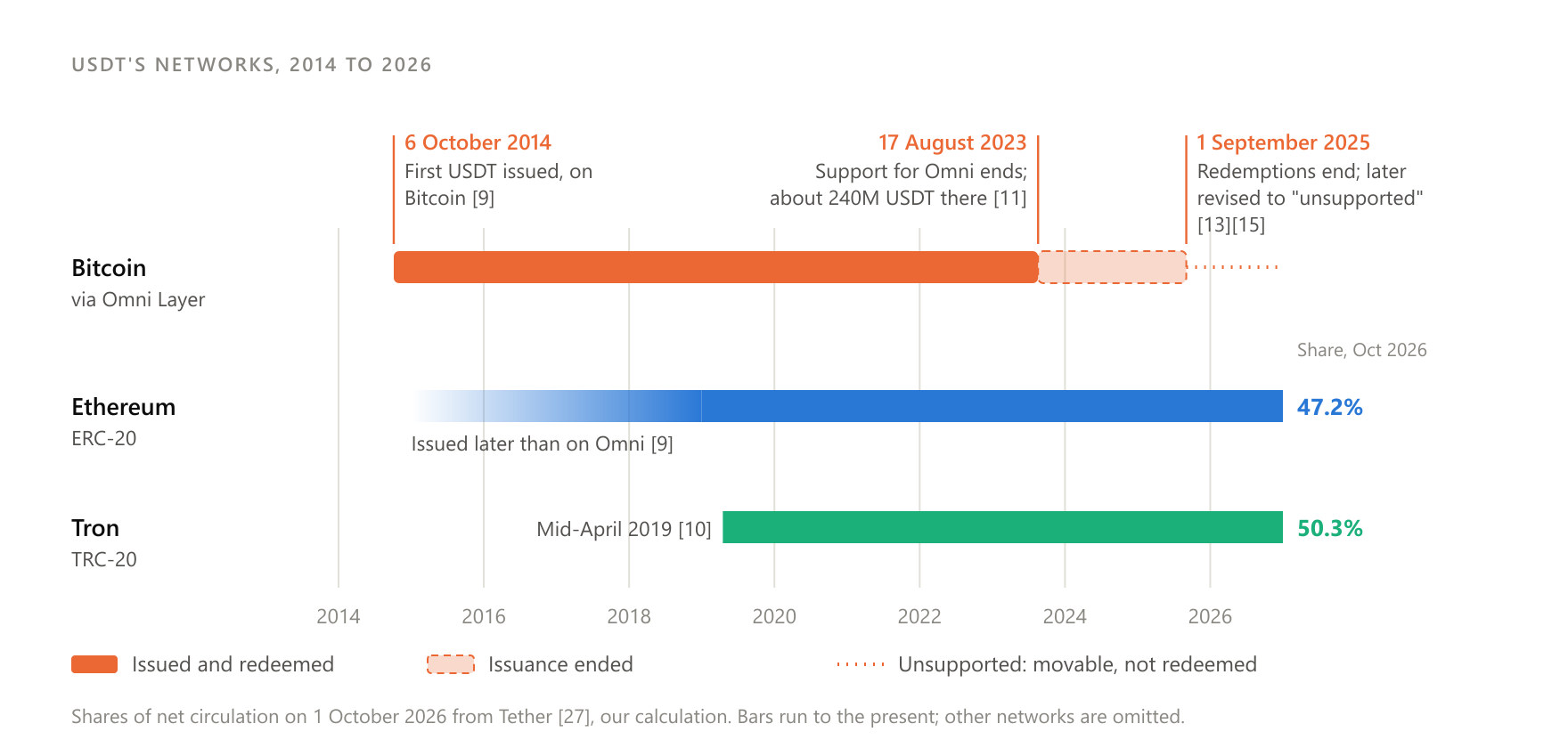
In July 2014 Brock Pierce, Reeve Collins and Craig Sellars announced Realcoin [9]. The first tokens were issued on 6 October 2014 on Bitcoin, through the Omni Layer, the successor to Mastercoin [9]. The renaming to Tether is reported as 20 November 2014, though Wikipedia notes that this date lacks a source [9]. USDT was later issued on Ethereum as an ERC-20 token [9], and in mid-April 2019 on Tron as a TRC-20 token [10].
On 17 August 2023 Tether announced it was ending support for USDT on Omni, along with Kusama and Bitcoin Cash SLP. It said Omni lacked popular tokens and that exchanges preferred other networks [11]. About 240 million USDT were circulating on Omni at the time [11]. Chief executive Paolo Ardoino wrote that the decision was painful for the team, especially regarding Omni, USDT's first network in 2014 [12].
In July 2025 Tether announced that from 1 September 2025 it would stop redemptions on five "legacy" networks, Omni among them, and freeze any tokens left there [13]. About 888 million USDT had been issued on Omni in total, of which about 82.9 million were still circulating [13][14]. In late August 2025 the company revised the plan: the tokens would not be frozen but would become "unsupported", meaning they can still be moved but are no longer issued or redeemed [15].
Not everyone knows this history. A KuCoin guide says USDT launched in 2014 as an ERC-20 token on Ethereum [16], which contradicts the sources above.
That is what the documents show. What follows is our reading. A coin cannot "move house": ETH is Ethereum and BTC is Bitcoin. A token issued by a company is different, because its "home" is a business decision of the issuer, and that decision can change. USDT on Omni did not technically stop existing; what stopped existing was anyone to redeem it. For the holder, the value of such a token depends not only on the blockchain but also on the issuer's choices.
How it works, from zero
Imagine a country with its own national currency.
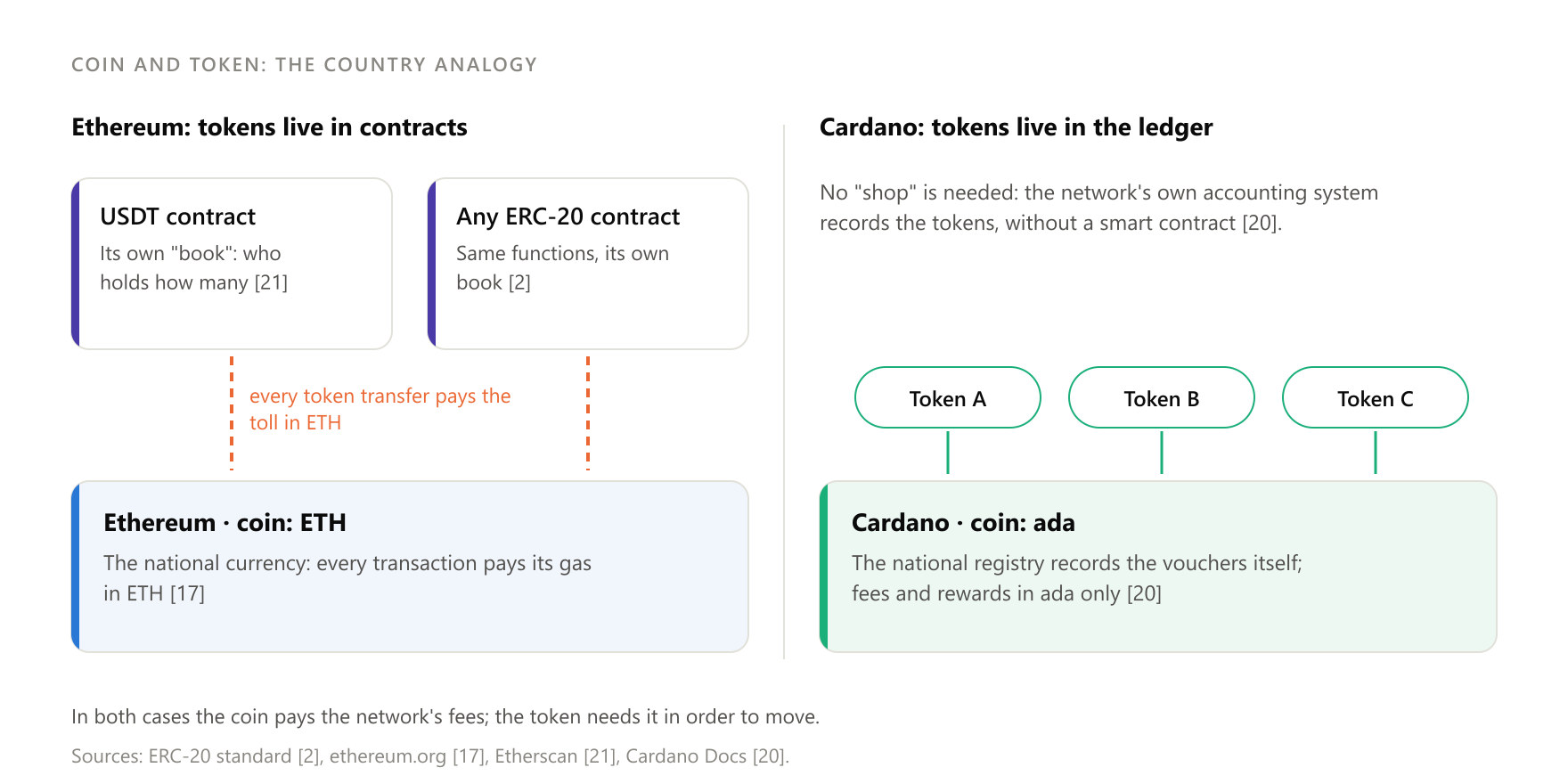
The coin is the national currency. Every time you use the country's roads you pay tolls, and tolls are paid only in the national currency. On Ethereum the tolls are called gas, and ethereum.org's documentation states that gas fees must be paid in ETH, the network's native currency [17]. The whitepaper itself calls ether the main "crypto-fuel" of Ethereum, used to pay fees [1].
The token is a gift voucher. A shop inside the country issues its own vouchers and keeps a book recording who holds how many. On Ethereum, that "book" is the storage of a smart contract, and the ERC-20 standard defines what it must do [2]. The function totalSupply reports how many units exist in total, the total supply, and balanceOf reports how many each address holds. The function transfer moves units from the sender to another address. The trio approve, transferFrom and allowance lets another program, such as a decentralised exchange, move units on the holder's behalf up to a limit the holder has approved. The fields name, symbol and decimals are optional; the standard explains that with 8 decimals, the amount is divided by 100,000,000 to display it to the user. When new tokens are created, the standard recommends recording a transfer from the address 0x0.
The key point is that moving a voucher still uses the country's roads, so it still pays tolls in the national currency. Ethereum's whitepaper noted that a token could "theoretically" let users pay fees in the token itself, through an ETH refund system inside the contract [1], but that is not the default way things work.
What a token can represent
From the start, Ethereum's whitepaper listed a wide range of uses [1]: currencies representing dollars or gold, company shares, rights to physical objects, coupons, and even reward points with no tie to conventional value at all. Ledger, a wallet manufacturer, adds in-game currencies and voting tools in decentralised organisations [18].
Where the analogy breaks down
The picture of a country and a shop helps, but it fails in three places.
First, anyone can open a "shop" in minutes. On Solana, for example, a single command creates a new token with zero initial supply [19].
Second, the shop's book is public code, and it does not always have an owner. ERC-20 provides no administrator function at all [2], although some tokens do have one, as we will see with USDT [21].
Third, on some networks no shop is needed. On Cardano, the "national registry" itself records the vouchers: tokens are moved by the network's own accounting system without any smart contract, and only ada is used for fees and rewards [20].
One real example: 15.21 USDT, step by step
Let us follow one real transaction on Ethereum: transaction 0x09906f4f…258257, in block 26,163,687, on 10 October 2026 at 18:00:23 UTC [22].
First, who sends and to where. The sender is address 0x46340b20…9758, which Etherscan labels "Crypto.com 12" [22]; the label is Etherscan's own attribution. The transaction is sent not to the recipient but to the USDT contract at 0xdAC17F95…1ec7, while the recipient, address 0xB1276185…1580, appears only inside the instruction data [22].
Next, how much ETH moves. The "Value" field shows 0 ETH [22]. No coin changes hands.
Third, what the contract is asked to do. The instruction data call the function transfer(address,uint256) with the value 0xe81610 [22]. In decimal that is 15,210,000 (our calculation). The USDT contract uses 6 decimals [21], so 15,210,000 / 1,000,000 = 15.21 USDT (our calculation).
Fourth, who pays the toll, and in what. The transaction fee was 0.000005319537389527 ETH, about $0.01 [22]. The transaction used 63,197 units of gas at a price of 0.084173891 Gwei [22]. As a check, 63,197 × 0.084173891 = 5,319.54 Gwei, or 0.00000531954 ETH, which matches the explorer (our calculation). Of that amount, 4,598.85 Gwei were "burned" because of the base fee of 0.072770075 Gwei (63,197 × 0.072770075, our calculation), the same figure Etherscan shows [22]. The remaining 720.69 Gwei went to the validator as a tip (our calculation).
Fifth, how much more expensive this is than a plain ETH transfer. A plain ETH transfer requires 21,000 units of gas [17]. The token transfer needed 63,197, about three times as many (63,197 / 21,000 ≈ 3.0, our calculation).
Finally, what gets recorded. The contract emits a Transfer event with the sender, the recipient and an amount of 15,210,000 base units [22]. The USDT balances of sender and recipient change inside the contract's storage, not in the ETH balances of the addresses.
The numbers that matter
| Parameter | Value | What it controls | Who can change it |
|---|---|---|---|
| Gas for a plain ETH transfer | 21,000 units [17] | The minimum cost of moving the coin | The protocol, through Ethereum upgrades |
| Gas for the USDT transfer in the example | 63,197 units [22] | The cost of executing the contract | Depends on the contract's code |
| ERC-20 decimals | Optional [2]; USDT: 6 [21] | How amounts are displayed | Set when the contract is created |
| Subdivision of ETH | 1 ETH = 10¹⁸ wei [1] | The coin's smallest unit | The protocol |
| Initial USDT supply on Ethereum | 100,000,000,000 base units [21], i.e. 100,000 USDT (our calculation) | Issuance at creation | Tether, through the contract's issue and redeem functions [21] |
| Fee to create a TRC-10 token | 1,024 TRX [23] | The cost of issuing a protocol-level token on Tron [23] | A Tron network parameter |
| Fee currency on Cardano | Ada only [20] | Which asset pays fees and rewards | The protocol |
The general rule is simple: anything concerning the coin can be changed only by the protocol, while anything concerning a token is set by its contract's code and by whoever holds rights over that code.
Who you trust when you hold a token
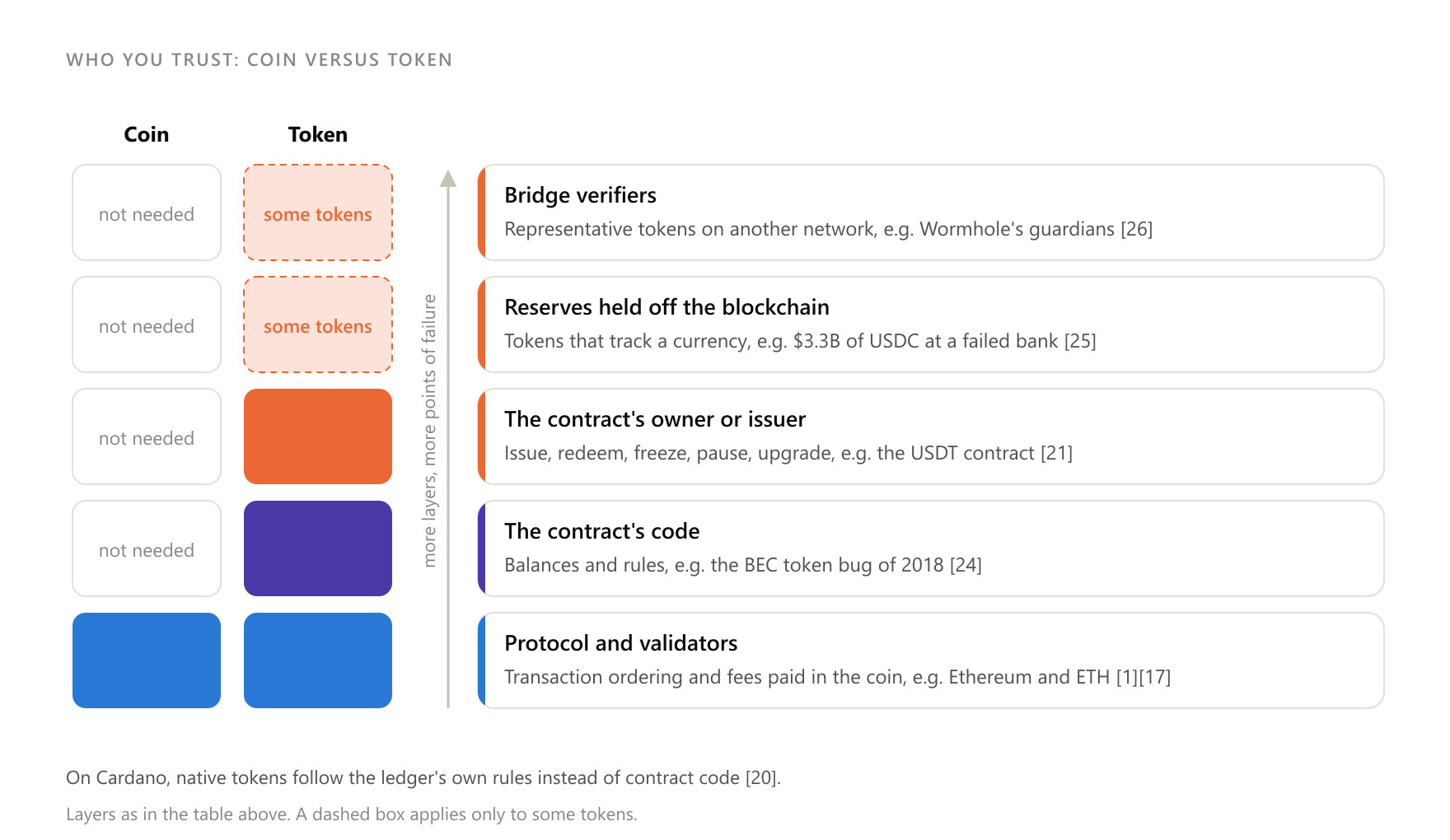
When you hold a coin, you trust the protocol and those who secure it, miners or validators (the nodes that confirm blocks). When you hold a token, you also trust every layer added on top.
| Layer | What it controls | Real example |
|---|---|---|
| Protocol and validators | Transaction ordering and fees paid in the coin | Ethereum and ETH [1][17] |
| The contract's code | The token's balances and rules | A bug in the BEC token in 2018 [24] |
| The contract's owner or issuer | Issuing, redeeming, freezing, pausing, upgrading | The functions of the USDT contract [21] |
| Reserves held off the blockchain | The value of a token that promises to track a currency | $3.3 billion of USDC reserves at a bank that collapsed [25] |
| The verifiers of a bridge (a link between networks) | Issuing representative tokens on another network | The check of "guardian" signatures on Wormhole [26] |
| The rules of the ledger itself | Transfers without a smart contract | Cardano native tokens [20] |
How much it is used: USDT in numbers
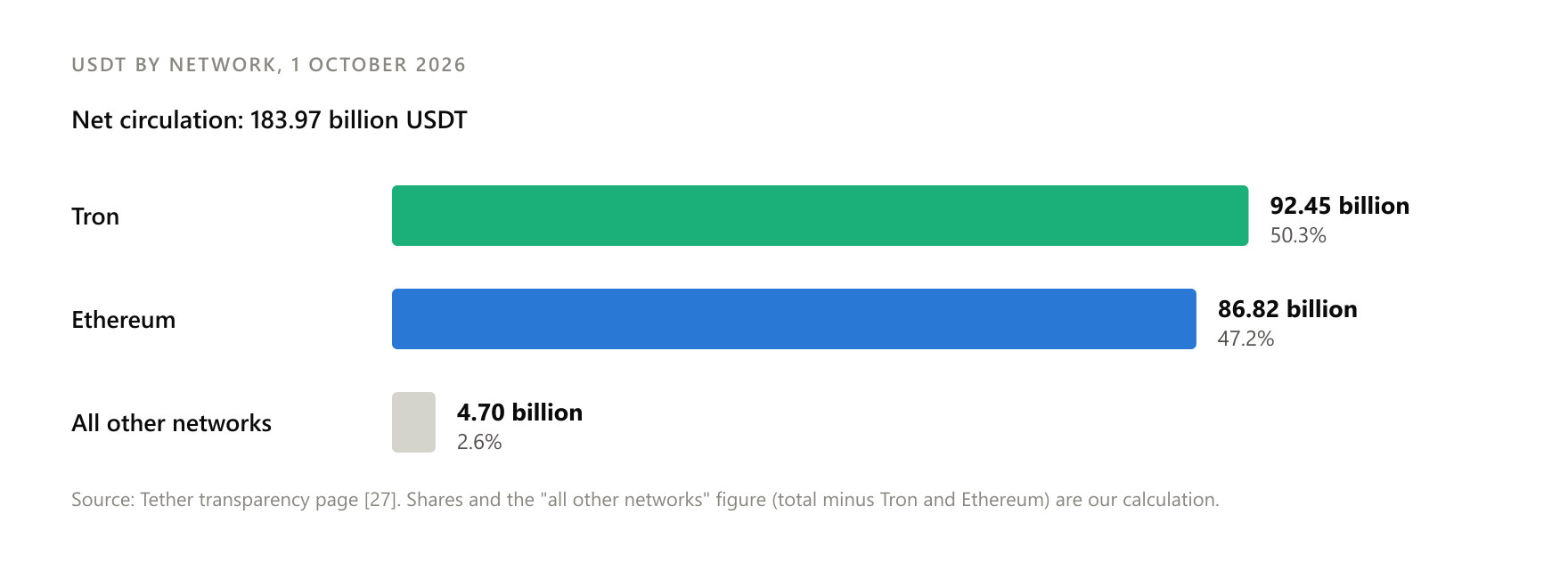
USDT is the clearest example of a token living on many networks at once. In its update of 1 October 2026, Tether reported total net circulation of 183,973,880,229.20 USDT [27].
| Measure | Value | Date | Source |
|---|---|---|---|
| USDT net circulation, all networks | 183,973,880,229.20 | 1 October 2026 | Tether [27] |
| Net circulation on Tron | 92,453,445,849.89 | 1 October 2026 | Tether [27] |
| Total authorized on Ethereum | 88,303,053,982.36 | 1 October 2026 | Tether [27] |
| Authorized but not issued on Ethereum | 1,480,557,900.92 | 1 October 2026 | Tether [27] |
| Net circulation on Ethereum | 86,822,496,081.45 | 1 October 2026 | Tether [27] |
| Contract "Max Total Supply" on Ethereum | 88,302,633,055.70 | 11 October 2026, 09:03 UTC | Etherscan [21] |
| Addresses holding USDT on Ethereum | 15,239,644 | 11 October 2026, 09:03 UTC | Etherscan [21] |
| USDT on Tron at the end of Q1 2026 | $84.5 billion | March 2026 | Messari [28] |
Using Tether's figures [27], Tron hosts 50.3% of net circulation (92.45 / 183.97, our calculation) and Ethereum 47.2% (86.82 / 183.97, our calculation). Together the two networks hold 97.4% (our calculation).
The two data providers appear to disagree about Ethereum, with Tether giving 86.8 billion and Etherscan 88.3 billion. In fact they measure different things. Etherscan's figure [21] is almost identical to Tether's "total authorized" [27], which includes tokens that have been created but not yet released. Subtracting those gives the net circulation (88,303,053,982.36 minus 1,480,557,900.92 = 86,822,496,081.44, our calculation). In our reading, the small gap that remains between the two figures is because they were measured ten days apart.
Central switches and upgrades
A coin has no "administrator" in the way a token can have an issuer. The verified code of the USDT contract on Ethereum includes the following functions [21]. addBlackList adds an address to a blacklist, and destroyBlackFunds destroys the funds of such an address. pause and unpause freeze and unfreeze the entire contract. issue and redeem create new tokens and withdraw tokens from circulation. deprecate redirects the contract to a new, upgraded address, and transferOwnership hands over ownership of it.
These switches are not theoretical. On 8 August 2022 Circle blacklisted addresses linked to the transaction-mixing service Tornado Cash following sanctions, and the USDC held in them was frozen [29]. The same source reported at the time that Tether had frozen 653 addresses on Ethereum over the preceding years [29].
The ERC-20 standard does not require any of these functions [2]. They are the issuer's choice, and readers can see them in the published code of any contract.
Which networks have tokens and how they differ
Tokens are not implemented the same way everywhere. The most important difference is where balances are kept: inside a contract, inside a shared program, or inside the network's own accounting system.
| Standard or method | Network | Where balances are recorded | What fees are paid in |
|---|---|---|---|
| ERC-20 | Ethereum | In a separate smart contract for each token [2] | ETH [17] |
| TRC-20 | Tron | In a smart contract, compatible with ERC-20 at the level of its functions [23][30] | TRX [23] |
| TRC-10 | Tron | At protocol level, without the virtual machine; no longer recommended for new tokens [23] | TRX, with a creation fee of 1,024 TRX [23] |
| BEP-20 | BNB Smart Chain | In a smart contract, as an extension of ERC-20 [31] | BNB [32] |
| SPL | Solana | In accounts controlled by a shared Token Program [19][33] | SOL, for fees and for account deposits [19] |
| Native tokens | Cardano | In the accounting system itself, without a smart contract [20][34] | Ada only [20] |
| Omni (formerly Mastercoin) | Bitcoin | In Bitcoin transaction data, under the metaprotocol's rules [1][9] | BTC |
| BRC-20 | Bitcoin | In data "inscriptions" read by indexers outside the blockchain [36][37] | BTC [36] |
| Runes | Bitcoin | In transaction outputs, with OP_RETURN messages; activated at block 840,000 on 20 April 2024 (UTC) [36][37] | BTC [36] |
Three details deserve attention. The terminology is not uniform: Tron's documentation describes TRX as the network's "native token" rather than as a token standard [23], while this article calls it a coin. Next, a coin can become a token on its own network. On Solana, SOL itself can be "wrapped" as an SPL token so that programs can handle it like any other token, and the process reverses when the account is closed [33]. Finally, the "same" token on two networks is two different tokens. USDT on Ethereum and USDT on Tron share an issuer but are two different contracts, and they cannot be sent directly from one network to the other. That is why Coinbase warns that it supports USDT only on Ethereum and asks users not to send USDT from another network [35].
Compared with the alternatives
Anyone who wants to create a new digital asset today has five basic routes. None is the "right" one; each trades something for something else.
| Approach | What it gains | What it trades away | Example |
|---|---|---|---|
| Its own blockchain (a coin) | Full design freedom | Development time, and having to find its own users, nodes and security [1] | Namecoin, Crypto.org Chain [1][39] |
| A token on a smart-contract network | Immediate access to the network's security and wallets | Dependence on the network's fees and congestion, and risk from code bugs [17][24] | ERC-20 tokens [2] |
| A native token on a multi-asset network | Transfers without contract execution [20][34] | Every transfer must carry a minimum amount of ada, and some issuance rules, such as one-time minting, still need a smart contract [20] | Cardano [20] |
| A metaprotocol on Bitcoin | Use of the Bitcoin network without a new blockchain | Light clients depend on trusted servers [1] | Omni, BRC-20 [1][36] |
| A representative token via a bridge | Use of an asset on another network | Dependence on the bridge's security [26][38] | Wrapped ETH on Solana via Wormhole [26] |
What each choice trades away
A token borrows the network's security, but it also borrows the network's limits. In our example, the USDT transfer used about three times the gas of a plain ETH transfer (our calculation, [17][22]), and without ETH in the wallet it could not have happened at all. The holder also takes on the code risk, since a bug in the contract can affect all of its tokens even while the network runs flawlessly [24], as well as the issuer's decisions [21].
A coin has its own security, but it has to build that security alone. Ethereum's whitepaper describes this as a cost in time, in bootstrapping effort and in security [1].
Moving from token to coin is not a conversion; it is a move to a new home, as the case of CRO shows. CRO started as an ERC-20 token. On 25 March 2021 the mainnet (the main, live network) of Crypto.org Chain launched with CRO as its native coin [39]. Holders had to move their CRO from Ethereum to the new network with dedicated migration tools, and staking (locking coins to take part in securing the network) requires native CRO, not the ERC-20 version [40].
What has gone wrong
On 22 April 2018, at 03:28:52 according to PeckShield, the firm's system flagged two transfers of the Beauty Ecosystem Coin token, each for an enormous amount: 0x8 followed by 63 zeros [41]. The bug was an integer overflow in the batchTransfer function, which sends the same amount to several recipients [24]. The number 0x8 followed by 63 zeros is 2²⁵⁵ (our calculation). For two recipients, the contract computed the total as 2 × 2²⁵⁵ = 2²⁵⁶, which in 256-bit arithmetic wraps around to zero (our calculation). The balance check therefore passed while tokens were created out of nothing [24][41]. Later that day the OKEx exchange suspended BEC withdrawals and trading, and PeckShield found more than a dozen ERC-20 contracts with the same flaw [41]. The vulnerability record describes the bug as exploited in the wild in April 2018 [24]. No fix of that particular contract has been reported.
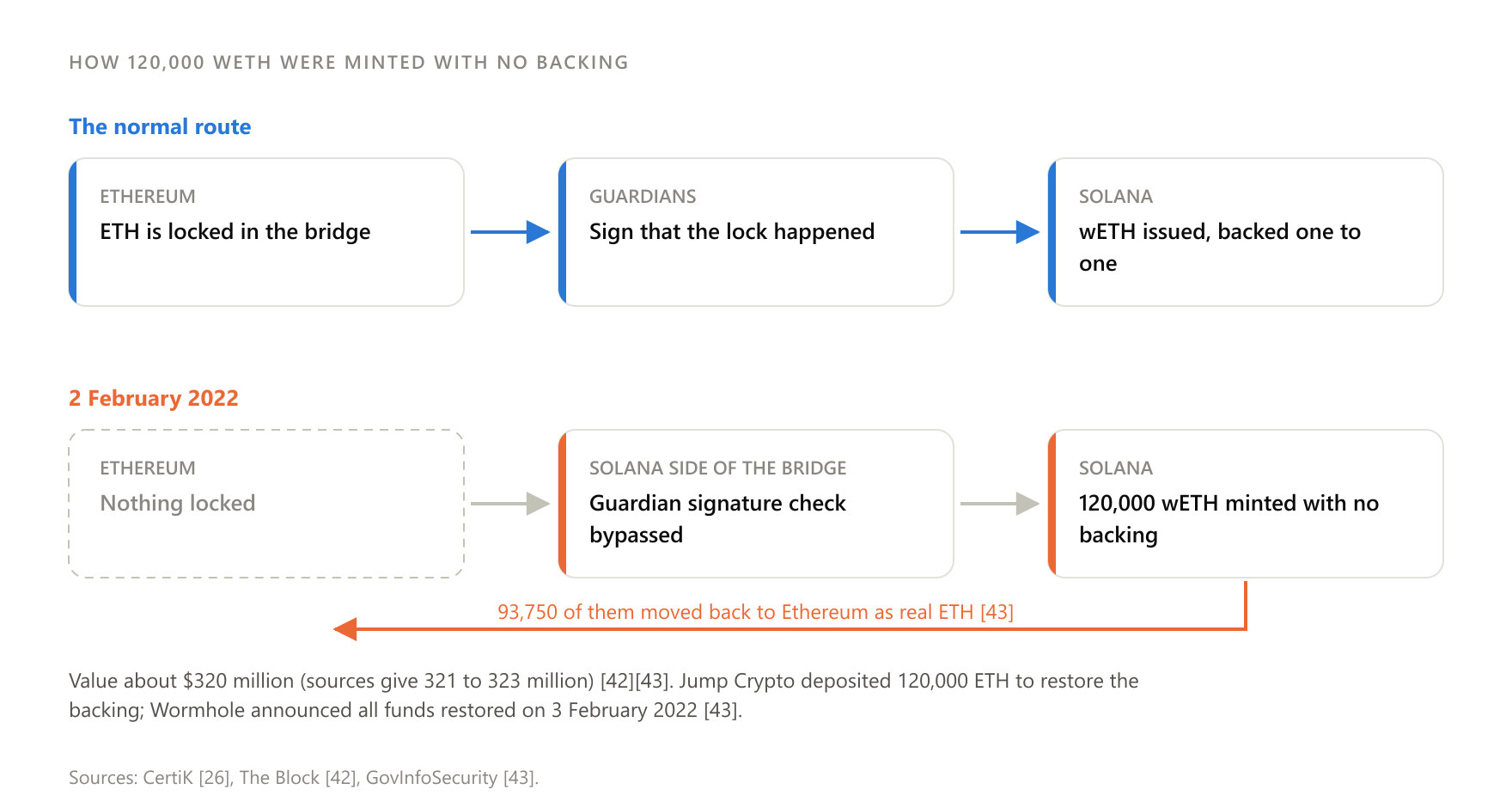
On 2 February 2022 an attacker bypassed the check of the "guardians'" signatures on the Solana side of the Wormhole bridge and minted 120,000 wETH, representative tokens of ETH, with no matching ETH locked as backing [26][43]. The attacker then moved 93,750 of them back to Ethereum as real ETH [43]. The value was about $320 million at that day's prices, with sources giving figures from 321 to 323 million [42][43]. Jump Crypto deposited 120,000 ETH to restore the one-to-one backing, and on 3 February 2022 Wormhole announced that all funds had been restored [43]. A representative token is worth only as much as the bridge that guarantees it.
On 11 March 2023 Circle disclosed that $3.3 billion of the roughly $40 billion in reserves backing USDC sat at Silicon Valley Bank, which had just collapsed [25]. That was about 8.25% of the reserves (our calculation). Sources disagree on the low: $0.88 according to CoinGecko [25] and $0.8774 according to CoinMarketCap [44]. On the evening of 12 March the authorities announced that the bank's depositors would have access to all their money, and USDC returned to about $0.99 [45].
Between 2023 and 2025, USDT's first home was wound down. Tether stopped issuing USDT on Omni in 2023 [11], announced the end of redemptions in July 2025 [13], and revised that plan in late August 2025, leaving the tokens movable but without official support [15]. What became of the roughly 82.9 million USDT circulating on Omni in July 2025 [14] has not been reported.
Common misconceptions
"The name tells you what it is." It does not. Beauty Ecosystem Coin was an ERC-20 token [24]. Colored coins and Mastercoin were tokens on Bitcoin [1][6]. Tron's documentation calls its own coin a "native token" [23], and even Ledger, while defining coins as an asset native to a blockchain, lists USDT in its section on coins [18]. What matters is one simple question: does the asset pay its own network's fees, or does it need another asset in order to move?
"A stablecoin is always worth one dollar." USDC fell to $0.88 or $0.8774, depending on the source, within a single weekend [25][44]. The value of a token that promises to track a currency depends on the issuer's reserves, not on the blockchain.
"I don't need a coin to send a token." In our example the transfer moved 0 ETH but paid its fee in ETH [22]. The same applies elsewhere: Solana requires SOL [19] and BNB Smart Chain requires BNB [32].
"A token converts directly into a coin." It does not. It needs a new network and a move of its holders onto it, as with CRO [39][40].
"Tokens are small and marginal." USDT's net circulation was 183.97 billion in October 2026 [27].
"USDT started on Ethereum." It started on Bitcoin, via Omni, in 2014 [9][11]. The KuCoin guide that says otherwise [16] is wrong on this point.
The open questions
Does the value of a token used only for payments hold up? In October 2017 Vitalik Buterin argued that the total value of a token used only as a medium of exchange within an application depends critically on how long users hold it: the shorter the holding time, the lower that value can be [46]. He concluded that this argument for value is "ultimately quite brittle", and proposed as an alternative mechanisms in which fees are used to buy back and destroy tokens, removing them from circulation [46]. The question remains open for any token whose only use is paying for one project's services.
Are bridges ever safe? In early January 2022 Buterin wrote that the future will be multi-chain but not cross-chain, because there are "fundamental limits to the security of bridges that hop across multiple 'zones of sovereignty'", and he used wrapped ETH held by a bridge on Solana as his example [38]. He acknowledged that his worst-case scenarios were unlikely to materialise soon, but noted that the risk grows as bridges are used more [38]. The Wormhole attack followed less than a month later, although it came from a code bug rather than the 51% attack scenario Buterin described.
Should an issuer be able to freeze tokens? Here the criticism comes from two opposite directions. On the day Circle froze addresses in 2022, analyst Dylan LeClair wrote: "Stablecoins are (obviously) not censorship resistant" [47]. In April 2026 investigator ZachXBT accused Circle of the opposite: failing to freeze about $420 million in USDC in time, across 15 theft and fraud cases since 2022 [48]. The same tool is judged excessive by some and underused by others, and there is no agreement on how it should be used.
Does a token need a smart contract? IOG, the company behind Cardano's development, and the network's documentation argue that tokens built on smart contracts add complexity, and with it room for error and cost, whereas on Cardano the transfer is handled by the accounting system itself [20][34]. The smart-contract side has in its favour the number of applications built on ERC-20 and its derivatives. Which approach will prevail in the long run is not known.
The risks for the reader
The most common practical risk is the wrong network. The same token on two networks is two different things, and some platforms accept only one of them, as Coinbase does with USDT [35]. Before any transfer, check that the sender and the recipient are using the same network.
The second risk is holding tokens without the coin needed for fees. A wallet (the app or device that holds the private keys) with USDT on Ethereum but no ETH cannot make a transfer [17]. The same applies to SOL on Solana [19] and BNB on BNB Smart Chain [32].
The third risk is the code and the issuer. A bug in the contract can create tokens out of nothing [24], an issuer with the right functions can freeze an address [21][29], and a token that promises a stable value can lose it if its reserves are at risk [25].
The fourth risk is representative tokens, whose value depends on the bridge that guarantees them [26][38]. If the issuer withdraws from a network, the tokens left there can lose their official redemption [13][15].
Finally, the rules governing crypto assets can change, and with them the obligations of those who issue tokens.
Where to go next
To see how a network works that has only a coin and no general-purpose smart contracts, start with our guide to Bitcoin. There you will find how blocks are produced and how those who secure them are paid: the mechanism every coin uses and every token borrows.
Sources
- P: Vitalik Buterin / ethereum.org, Ethereum Whitepaper, ethereum.org/whitepaper, 2014 (the page also states 2013) (project source)
- P: Fabian Vogelsteller, Vitalik Buterin, ERC-20: Token Standard, eips.ethereum.org/EIPS/eip-20, November 2015 (project source)
- S: Wikipedia, Colored Coins, en.wikipedia.org/wiki/Colored_Coins, accessed October 2026
- S: Journal du Coin, Des jetons sur Bitcoin : colored coins et autres procédés, journalducoin.com/analyses/jetons-bitcoin-colored-coins-autres-procedes, accessed October 2026
- P: Yoni Assia, Vitalik Buterin, Lior Hakim, Meni Rosenfeld, Rotem Lev, Colored Coins whitepaper, etoro.com/wp-content/uploads/2022/03/Colored-Coins-white-paper-Digital-Assets.pdf, 2013
- S: Cointelegraph Magazine, J.R. Willett launched the first ICO… but still has a day job, cointelegraph.com/magazine/jr-willett-launched-first-ico-but-still-has-day-job, accessed October 2026
- S: CriptoNoticias, A 6 años de la primera ICO: ¿qué ha pasado desde entonces?, criptonoticias.com/mercados/oferta-inicial-criptoactivos/6-anos-primera-ico-que-ha-pasado, 2019
- S: Raconteur, ICOs funding startups, raconteur.net/technology/icos-funding-startups, accessed October 2026
- S: Wikipedia, Tether (cryptocurrency), en.wikipedia.org/wiki/Tether_(cryptocurrency), accessed October 2026
- S: Cointelegraph, Stablecoin USDT Launched on Tron Blockchain, cointelegraph.com/news/stablecoin-usdt-launched-on-tron-blockchain, April 2019
- S: CoinDesk, Tether Stops Support for Bitcoin Layer Omni Citing Lack of Demand, coindesk.com/business/2023/08/17/tether-stops-support-for-bitcoin-layer-omni-citing-lack-of-demand, August 2023
- S: TechEconomy, Tether Ends Supports for Three Blockchains ($USDt), techeconomy.ng/tether-ends-supports-for-three-blockchains-usdt, August 2023
- S: The Block, Tether to sunset USDT on five legacy blockchains, including Algorand and Omni, theblock.co/post/362269, July 2025
- S: Cointelegraph, Tether to discontinue USDT on five blockchains to 'refocus resources', cointelegraph.com/news/tether-discontinue-usdt-redemptions-five-legacy-blockchains, July 2025
- S: Cointelegraph, Tether scraps plan to freeze USDT on five blockchains, cointelegraph.com/news/tether-drops-plan-to-end-usdt-on-five-chains, August 2025
- S: KuCoin Learn, Tether (USDT), kucoin.com/vi-au/learn/glossary/tether-usdt, October 2025
- P: ethereum.org, Gas and fees, ethereum.org/en/developers/docs/gas, accessed October 2026 (project source)
- S: Ledger Academy, Crypto Coins and Tokens: Their Use-Cases Explained, ledger.com/academy/crypto/what-is-the-difference-between-coins-and-tokens, April 2026 (manufacturer source)
- P: Solana, Quickstart: create a token with the CLI, solana.com/docs/tokens/quickstart, accessed October 2026 (project source)
- P: Cardano Docs, Native tokens, docs.cardano.org/developer-resources/native-tokens, accessed October 2026 (project source)
- P: Etherscan, Tether USD (USDT) token page, etherscan.io/token/0xdac17f958d2ee523a2206206994597c13d831ec7, October 2026
- P: Etherscan, Transaction 0x09906f4f…258257, etherscan.io/tx/0x09906f4f1996f3ef518af15fdb45dc3153e0df32d9b0eeb7ee50521271258257, October 2026
- P: TRON Developer Hub, Token standards overview, developers.tron.network/docs/token-standards-overview, September 2026 (project source)
- P: NIST National Vulnerability Database, CVE-2018-10299, nvd.nist.gov/vuln/detail/CVE-2018-10299, April 2018
- S: Reuters via Kitco, Circle assures market after stablecoin USDC breaks dollar peg, kitco.com/news/off-the-wire/2023-03-11, March 2023
- S: CertiK, Wormhole Bridge Exploit Incident Analysis, certik.com/blog/wormhole-bridge-exploit-incident-analysis, 2022
- P: Tether, Transparency, tether.to/en/transparency, October 2026 (project source)
- S: Messari, State of TRON Q1 2026, messari.io/report/state-of-tron-q1-2026, 2026
- S: The Block, Circle freezes USDC funds in Tornado Cash's US Treasury-sanctioned wallets, theblock.co/post/162172, August 2022
- P: TRON Developer Hub, TRC-20 Protocol Interface, developers.tron.network/docs/trc20, accessed October 2026 (project source)
- P: BNB Chain Docs, BEP20 Token, docs.bnbchain.org/docs/BEP20, accessed October 2026 (project source)
- S: Trust Wallet, BEP-20, trustwallet.com/glossary/bep-20, September 2026 (manufacturer source)
- P: Solana Program, Token, solana-program.com/docs/token, accessed October 2026 (project source)
- P: IOG, Native tokens on Cardano: core principles and points of difference, iog.io/news/native-tokens-on-cardano-core-principles-and-points-of-difference, accessed October 2026 (project source)
- S: Coinbase, Tether price page, coinbase.com/price/tether, accessed October 2026
- S: Decrypt, Bitcoin Runes Launch at the Halving: Here's Everything You Need to Know, decrypt.co/221962, April 2024
- S: Blockworks, Bitcoin Runes look to spice up the halving party, blockworks.com/news/bitcoin-halving-runes-launch, April 2024
- S: The Defiant, Vitalik Sounds Alarm on Security of Cross-chain Bridges, thedefiant.io/news/defi/vitalik-eth-cross-chain-bridges-security, January 2022
- S: Cointelegraph, Crypto.com launches CRO token mainnet, cointelegraph.com/news/crypto-com-launches-cro-token-mainnet, March 2021
- P: Crypto.com Help Center, Tudo sobre staking na CRO, help.crypto.com/pt/articles/5015391, accessed October 2026 (project source)
- S: PeckShield, New batchOverflow Bug in Multiple ERC20 Smart Contracts (CVE-2018-10299), peckshield.medium.com, April 2018
- S: The Block, $323 million in ETH stolen from cross-chain protocol Wormhole, theblock.co/post/132841, February 2022
- S: GovInfoSecurity, Wormhole Blockchain Bridge Exploited for Over $300 Million, govinfosecurity.com/wormhole-blockchain-bridge-exploited-for-over-300-million-a-18442, February 2022
- S: Forkast, Circle's USDC stablecoin regains parity as regulators act to stop bank run risk, forkast.news/circles-usdc-stablecoin-regains-parity-as-regulators-act-to-stop-bank-run-risk, March 2023
- S: The Block, USDC, crypto rallies on news that SVB, Signature Bank deposits are safe, theblock.co/post/219128, March 2023
- P: Vitalik Buterin, On Medium-of-Exchange Token Valuations, vitalik.ca/general/2017/10/17/moe.html, October 2017
- S: Bitcoin Magazine, Treasury Sanctions Open Source Software, bitcoinmagazine.com/legal/treasury-sanctions-open-source-software, August 2022
- S: Cointelegraph, ZachXBT accuses Circle of $420M compliance failures since 2022, cointelegraph.com/news/zachxbt-accuses-circle-420m-compliance-failures-since-2022, April 2026
This article is educational and for general information. The facts in crypto move quickly, so verify them before you act on anything here. This is not financial advice.