

Cardano is a blockchain (a public, shared ledger of transactions) that runs on proof of stake (a method in which holding coins, rather than burning energy, earns the right to add new blocks). Its mainnet (the main, live network) went live in September 2017 [1]. Charles Hoskinson, one of the co-founders of Ethereum, founded it together with Jeremy Wood [2]. Its currency, ada (ticker symbol ADA), pays transaction fees, lets holders take part in securing the network, and gives them a vote on changes to it.
The problem Cardano set out to solve was not the one Bitcoin solved. Bitcoin had already shown that a network with no central authority could keep an honest ledger, but it did so through proof of work, which protects the chain by burning electricity. In proof of stake, coins replace energy: the more of the currency you hold, the more say you have in who writes the next block.
The idea was not new. The hard part was proving that nobody could cheat the system. Cardano bet on treating that problem first as an academic question and only then as an engineering one. Its designers presented its consensus protocol, Ouroboros, as the first proof of stake protocol with mathematically proven security [5].
This article covers the history, the mechanics, the supply, who runs the network, and what has gone wrong. It is for information only and is not investment advice.
How it started
Hoskinson helped found Ethereum but left in 2014 after a disagreement over whether the project should operate as a company or as a nonprofit foundation [2][3]. In 2015, he and Jeremy Wood, a former Ethereum colleague, founded the engineering company IOHK to build a new platform [2][4].
Three organizations, one network
The design split the work across three separately owned organizations. IOHK would build the technology. The founders set up the Cardano Foundation in Switzerland to oversee development and represent users. EMURGO took on the commercial side [47]. A multiyear contract with EMURGO supplied much of the early funding for IOHK [8].
The names were deliberate. The blockchain takes its name from Gerolamo Cardano and the currency from Ada Lovelace [59]. Lovelace was the daughter of the poet Lord Byron, which is why the first phase of the network carries the name Byron [8][59].
Research before code
What set the project apart was its method. Instead of shipping code and fixing it later, IOHK commissioned academic papers and submitted them for peer review.
CRYPTO 2017, the leading conference in the field, accepted the first paper, Ouroboros: A Provably Secure Proof-of-Stake Blockchain Protocol, by Aggelos Kiayias, Alexander Russell, Bernardo David, and Roman Oliynykov [5][6]. IOHK noted that the conference accepted 72 of the 311 papers submitted that year. It also noted that it had funded all three blockchain papers at the conference [6]. Keep the second fact in mind when you read the first. EUROCRYPT 2018 accepted the next paper, Ouroboros Praos [7].
The launch
The sale
Cardano raised its money before it even existed. From October 2015 to January 2017, a Japanese company sold vouchers (coupons redeemable for ada) in four stages, mostly in Japan. Gross sales reached 108,844.5 BTC [9]. Data sources put the amount at about $62.24 million [11], at a presale price of $0.0024 per ada [12].
The genesis block
The first block, the genesis block (the block that starts the chain), carries a timestamp of 21:44:51 UTC on September 23, 2017 [13]. The network launched publicly on September 29, 2017 [1].
That time of day never went away. Cardano divides time into five-day epochs, and every epoch still starts at around 21:44 UTC. The Shelley upgrade took effect at exactly 21:44:51 UTC on July 29, 2020 [33]. Epoch 654 began at 21:44:54 UTC on September 6, 2026 [36].
A controlled start
In its first phase, Byron, Cardano was not decentralized at all. A group of nodes run by the founding organizations produced blocks in 20-second slots (fixed time windows) [13][14]. The genesis file lists seven authorized block signers [13]. In 2019, the analyst Ed Posnak went further: he described the first Byron implementation as fully centralized, with only IOHK-controlled nodes taking part in consensus [8].
Anyone could hold and send ada, but nobody outside that group could produce blocks. That changed only in 2020.
The 318 million ada nobody claimed
Vouchers, not coins
When Cardano launched, none of the people who had paid for ada actually held any ada. They held vouchers. The genesis file records every launch ada as a voucher entry. There are 14,505 such entries, adding up to about 31.1 billion ada [13]. Buyers had to redeem their vouchers in the Daedalus wallet (software that holds the keys to your coins) to receive their coins [16].
What happened to the unclaimed coins
Not everyone showed up. In 2020, the Shelley upgrade retired the old Byron-era address format. From that moment on, redeeming the remaining vouchers became technically impossible [16]. At that point, about 318 million ada remained unclaimed, roughly 1.2% of the public sale (our calculation).
Their path from there:
- December 16, 2020: the Allegra hard fork (a coordinated change to the network rules) moved the unclaimed vouchers to the reserve, the ada not yet issued [15].
- October 23, 2021: a special transaction, signed with the original keys of the founding organizations (genesis keys), moved about 318.2 million ada from the reserve to six escrow addresses [15].
- Until 2024: Input Output support staff paid verified claimants from these addresses, tracing buyers mostly in Japan [15][16].
Meanwhile, Attain, the company that originally sold the vouchers, had gone bankrupt [10].
The allegation and the audit
In May 2025, the NFT artist Masato Alexander accused Hoskinson of using the genesis keys to take control of the 318 million ada [10]. Hoskinson denied it. He said holders had redeemed 99.8% of the vouchers. According to him, the unclaimed remainder, about 18 to 24 million ada, had passed to Intersect, an organization within Cardano governance (the process through which the network makes decisions) [10].
Input Output commissioned an audit from the law firm McDermott Will & Emery and the accounting firm BDO, and the results came out on September 3, 2025. The audit recorded a 99.7% redemption rate and found no evidence to support the allegations [17].
Our reading
That is what the documents show. What follows is our interpretation.
The episode matters less for where the coins went than for how they moved. In 2020 and 2021, a small set of keys held by the founding organizations could move hundreds of millions of ada without any public vote. The 2025 Plomin upgrade handed that direct control to on-chain governance, meaning votes that take place on the blockchain itself [18]. The voucher story is the clearest proof of why that change mattered.
How the ledger works
Accounts or envelopes
Cardano keeps its records the way Bitcoin does, not the way Ethereum does. Its ledger uses a model called UTXO, short for unspent transaction output [19].
In an account model, like the one Ethereum uses, the ledger stores one balance per address and adjusts it up or down. The UTXO model has no balances, only individual pieces of value. Each piece is an output made of two things: an address, which acts as a lock, and an amount. The matching signature is the key that opens it [19]. Your "balance" is simply the sum of all the unspent outputs your keys can open.
The easiest way to picture it is a drawer full of sealed envelopes. Each envelope holds a fixed amount, and only you can open it. You never tear an envelope in half: you hand over whole envelopes and get new ones back. Every node keeps a copy of the full set of envelopes nobody has opened yet, the so-called UTXO set [19].
The extension
Cardano uses its own version, extended UTXO, or eUTXO [19]. It lets a script (a small program) lock an output in place of a signature. It also lets an output carry its own data, called the datum [20]. The script decides whether the envelope can open, and it can only answer yes or no; it cannot start any action on its own [20].
This is how Cardano runs smart contracts (programs that hold and move funds according to fixed rules) without switching to an account model.
How a transaction works
Inputs, outputs, and change
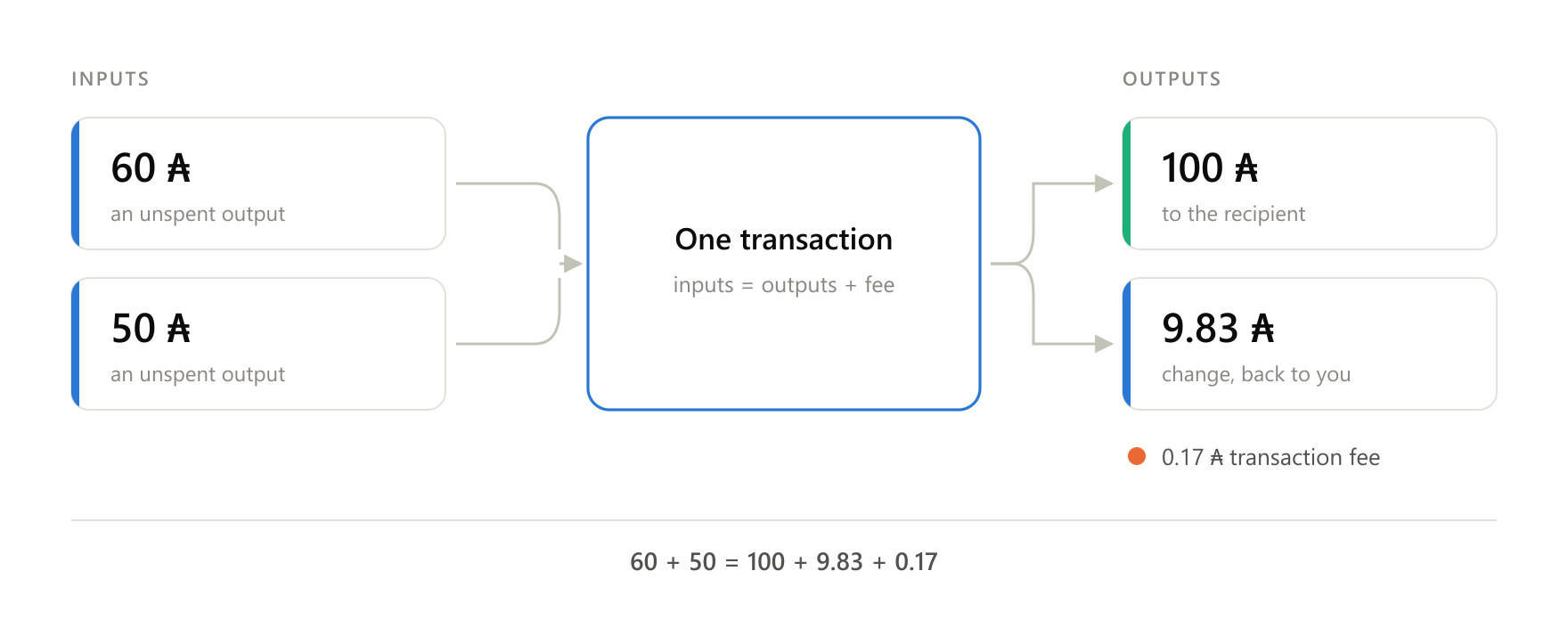
A Cardano transaction states exactly what it spends and exactly what it creates. Its inputs point to existing unspent outputs, and its outputs create new ones. The arithmetic has to balance down to the last unit: inputs equal outputs plus the transaction fee [21].
As with Bitcoin, you pay with whole outputs and get change back. If you hold outputs of 60 and 50 ada and want to send 100, the transaction consumes both. The recipient gets 100, and the rest, minus the transaction fee, comes back to you as a new output.
Transaction fees
A set formula, not an auction, determines transaction fees. The transaction fee is a fixed base of 155,381 lovelace plus 44 lovelace for every byte of the transaction [22]. A simple transfer costs about 0.17 to 0.20 ada. Because the formula never varies, the wallet knows the exact transaction fee before you press "send." There is no bidding war when the network is busy [22].
Transactions that use smart contracts add a computation cost to the transaction fee. They also have to put up collateral, which they lose if the script fails [23].
Double-spending
The ledger itself prevents double-spending. An input is valid only if the output it points to still exists and remains unspent [21]. If you try to spend the same output twice, the second attempt points to something the network has already deleted.
Keys: two instead of one, and why that matters
Two credentials in one address
In Bitcoin, one private key controls an address. A standard Cardano address, called a base address, combines two separate credentials [24]. The payment credential controls who can spend the coins. The staking credential handles staking (putting your coins to work in running and securing the network): it controls how you delegate the coins and where the rewards end up.
This separation is why staking on Cardano never touches your funds. You can hand someone else the staking rights while you keep the spending key.
The recovery phrase
Both keys come from a single recovery phrase. Most modern Cardano wallets use 24 words, and some lighter ones use 15 [25]. That one phrase regenerates every key in the wallet, so it is the only backup you need [25].
If you lose it, nobody can restore your coins. If you share it, anyone can take them.
How blocks get made: Ouroboros
Slots and epochs
Cardano divides time into one-second slots. Slots group into five-day epochs of 432,000 slots each [26].
The lottery
In every slot, a lottery decides whether any block producer gets to write a block, and which one. The lottery aims for one winner every 20 seconds on average, or about 21,600 blocks per epoch. The more ada delegated to a producer, the better its odds [26].
The lottery uses a verifiable random function (a way to draw a random result that others can check afterward). Each producer checks privately whether it has won. Only the winner knows it was chosen until its block appears, so attackers cannot target it in advance [27][28]. When two producers win the same slot, a fixed rule decides which block the chain keeps [28].
Stake pools, core nodes, and relays
The block producers are stake pools (pools that gather the ada of many holders). Stake pool operators (SPOs) run them. A pool usually runs two kinds of node on the same software [29]. The core node holds the keys and builds the blocks. The relay nodes hold no keys and cannot produce blocks; they pass blocks and transactions on to the rest of the network.
This is the Cardano version of something beginners often miss in Bitcoin: running a node and producing blocks are different jobs.
Rewards and penalties
Pools earn their rewards from transaction fees and newly issued ada [26]. From the rewards of each pool, the operator first takes a fixed cost and then a margin percentage. The rest goes to everyone who delegated ada, in proportion to their share [30].
Penalties hit only rewards. A pool that misses the blocks due to it earns less. Each pool declares an amount its owners commit to keep in it, the pledge. If they fall short of it, the pool earns nothing for that epoch [30]. No mechanism exists that takes away the delegated ada itself.
Staking without handing over your coins
How delegation works
Staking on Cardano means delegation: you point the staking credential of your wallet at a pool. Your ada stays in your wallet, and you can spend it at any time [32]. There is no lockup and no waiting period to leave [3]. The first rewards arrive after about four epochs, or roughly 20 days [33].
How much ada takes part
In September 2026, about 56% of all ada took part in staking, some 20.7 billion coins [34]. Coinbase advertised an estimated yield of 1.36% a year for customers staking through it [34]. That is an exchange yield, after the exchange takes its own commission. In an analysis written before September 2024, the block explorer (a tool for browsing the blockchain) Cexplorer put typical network rewards at 2.5% to 3% [31].
Where the rewards come from
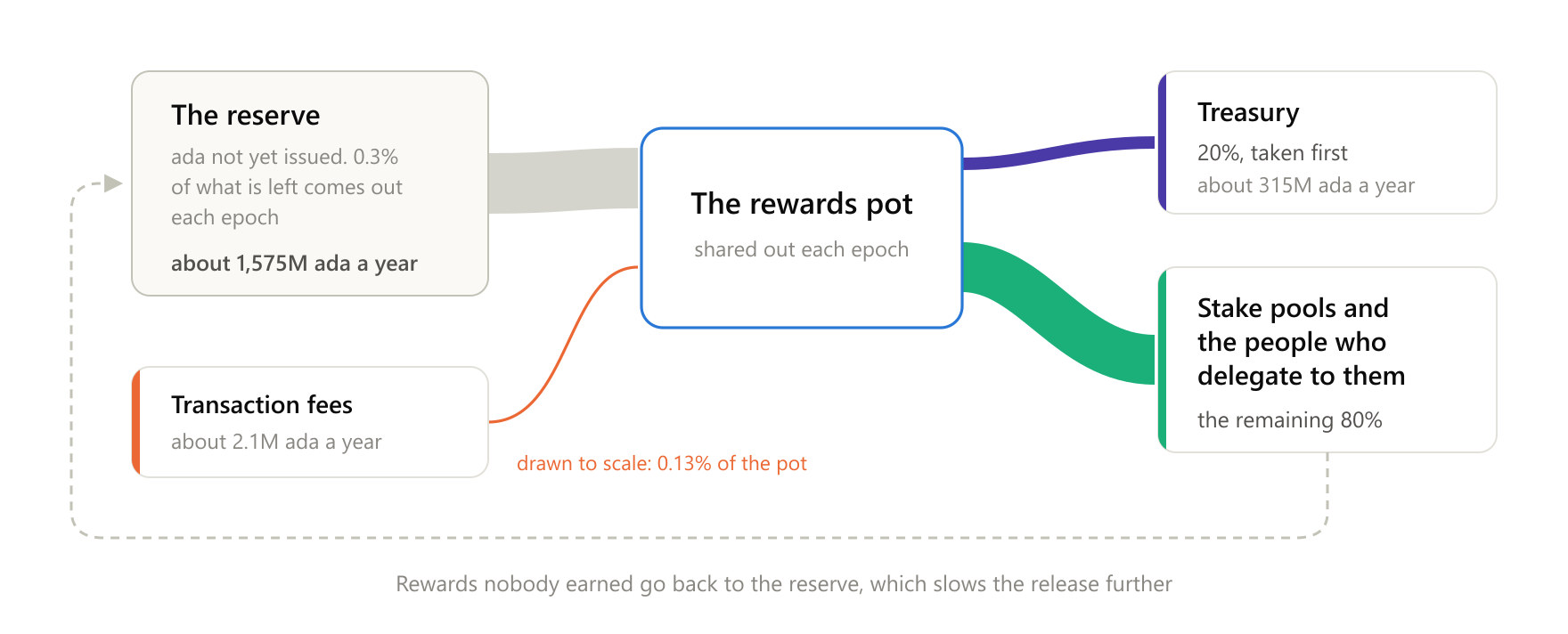
Each epoch, the protocol takes 0.3% of the remaining reserve, the ada not yet issued, and adds it to the transaction fees collected. The treasury (the shared community fund) takes 20% of that sum before anything else gets paid. The rest becomes staking rewards [35]. Rewards that nobody earns go back to the reserve, for example because some pools were too small, too large, or offline [35].
The designers expected transaction fees to take over the role of the reserve gradually as usage grew [35]. So far, that has not happened. In epoch 654, the entire network paid about 29,277 ada in transaction fees [36], or about 2.1 million ada a year (our calculation). The treasury alone receives about 315 million ada a year [37]. The Cexplorer analysis from before 2024 found that about 99% of rewards came from the reserve [31].
In plain terms, Cardano staking rewards are overwhelmingly new coins, not a share of network revenue. Staking mainly protects your share of the supply from the dilution that new issuance causes. The people who do not stake are the ones who get diluted.
Who runs it
Several organizations with different legal forms run Cardano. Since 2025, an on-chain voting system, meaning one that runs on the blockchain itself, has had the final say over money and upgrades.
The organizations
| Organization | What it does | Legal form and base | Leadership | Funding |
|---|---|---|---|---|
| Input Output (formerly IOHK, then IOG) | Core research and development | Company registered in Wyoming, USA [47] | CEO: Charles Hoskinson [48] | Genesis allocation [9]; contracts paid from the treasury |
| Cardano Foundation | Adoption, standards, participation in governance | Swiss nonprofit foundation, with subsidiaries in Zug, Berlin, and Cork [49] | CEO: Frederik Gregaard [67] | Its own funds: assets of 287.5 million Swiss francs at the end of 2025 [50] |
| EMURGO | Commercial arm; developed the Yoroi and SecondFi wallets | Company based in Singapore, with operations in Tokyo [51] | CEO: Phillip Phan [52] | Genesis allocation [9] |
| Intersect | Coordinates governance; manages treasury contracts | Member organization operating under Wyoming law [42] | Executive director: Jack Briggs [53] | The treasury |
| Midnight Foundation | Midnight, a privacy blockchain linked to Cardano | Base not stated in our sources | President: Fahmi Syed [54] | Not stated in our sources |
In January 2026, these five organizations formed a coordination group called the Pentad [55]. EMURGO left in July 2026 to focus on recovering funds lost in a wallet attack [55].
How decisions get made
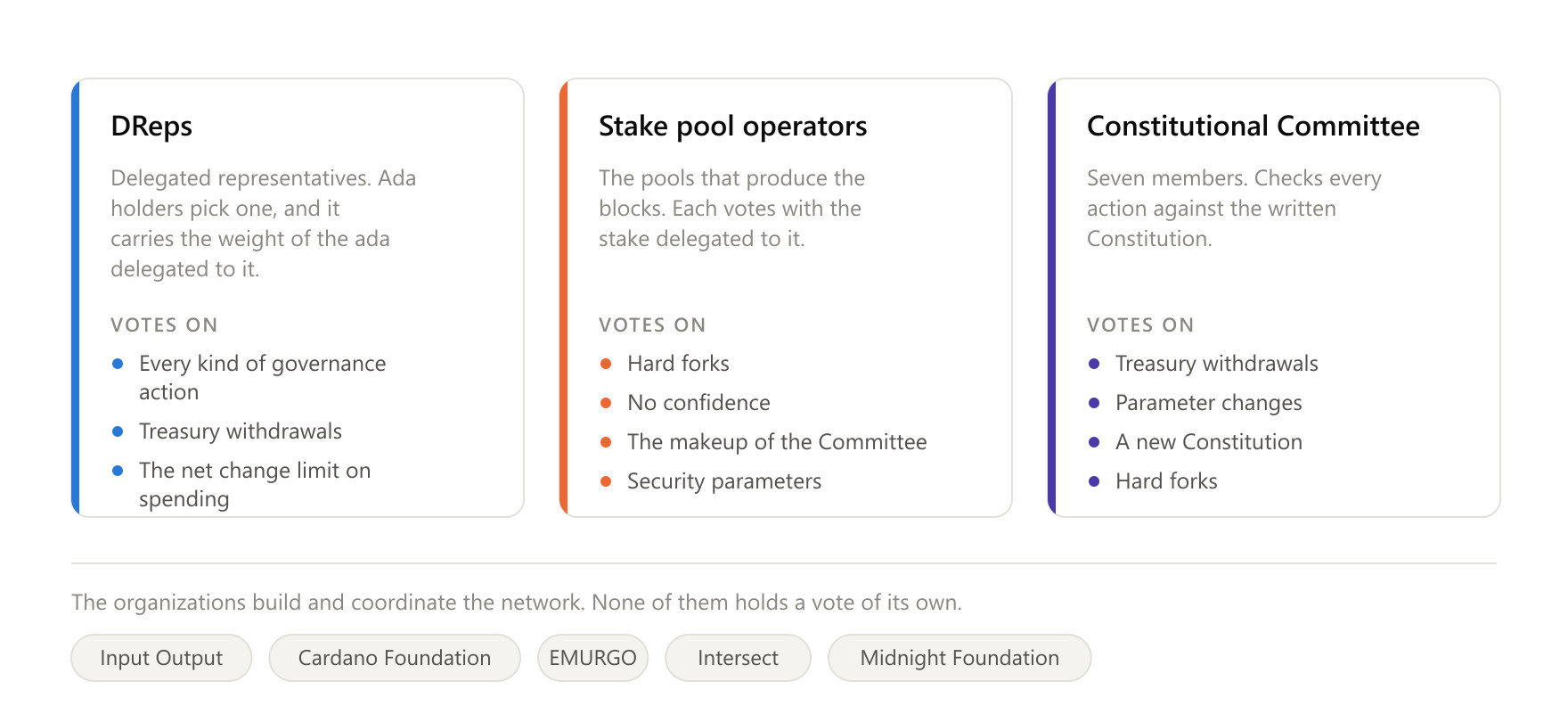
Changes start as Cardano Improvement Proposals (public technical documents). Binding decisions happen on-chain under a framework called CIP-1694, which gives a vote to three groups [39]: DReps (representatives that ada holders choose), stake pool operators, and a seven-member Constitutional Committee, which checks every action against the written Cardano Constitution [43].
How the treasury gets spent
DReps and the Constitutional Committee vote on withdrawals from the treasury. Stake pools do not vote on them. The Plomin upgrade of January 29, 2025, made this possible [40].
A net change limit caps total spending in each period, and DReps approve it by simple majority [41]. For the period from February 2026 to July 2027, the limit started at 350 million ada [57]. In July 2026, DReps backed raising it to 500 million, with 62.36% in favor [42].
By September, Intersect had paid contractors 74 million ada and 22 million USDCx under that year's budget [44]. USDCx is a stablecoin (a cryptocurrency designed to hold a steady value) pegged to the dollar.
Close to paralysis
The weak spot of the system showed in August 2026. Terms were ending for four of the seven seats on the Committee. The vote to seat their elected replacements needed 67% of DReps and 51% of stake pools. On August 14, it stood at 30.03% and 1.69% respectively [43]. Had it failed, the Committee would have dropped below its minimum size, and almost every kind of decision would have frozen [43]. In the end, it passed with 71.95% and 56.54% [44].
Why participation is hard
Part of the explanation is structural. Every holder who wants to take part in governance has to choose a DRep or one of the predefined options. One of these, Always Abstain, keeps the stake of the holder out of every count while still counting as a choice [38]. In September 2026, 10.30 billion ada, or 27.46% of the circulating supply, sat in this option [46].
The Constitution and how a decision gets made
A written Constitution, ratified on-chain
Cardano has a written Constitution. More than 65 workshops with about 1,800 participants drafted it, and elected delegates finalized it at a constitutional convention held in Buenos Aires and Nairobi in December 2024 [83][84].
Ratification was no formality. The text went on-chain as a governance action (a formal proposal put to a vote on the blockchain) and needed a supermajority of 75% of the active stake that DReps represent, plus approval from the interim Constitutional Committee. It cleared both hurdles in February 2025, with DRep approval reaching about 85.7% and all seven members of the interim committee voting in favor [85][83].
The Constitution describes itself as a living document, and it has already changed. A third revision won ratification on January 19, 2026, with 79% of active DRep stake in favor, and took effect at the epoch boundary on January 24, 2026 [86]. Since then, every new governance action faces review against the revised text.
What it contains
The text has eight articles and two appendices. The articles define what Cardano is, the rights and duties of community members, the three governance bodies, how budgets work, and the process for amending the Constitution itself. The first appendix, the Guardrails (the protective limits), is the part with teeth: it sets what can change, within what limits, and what nobody may touch.
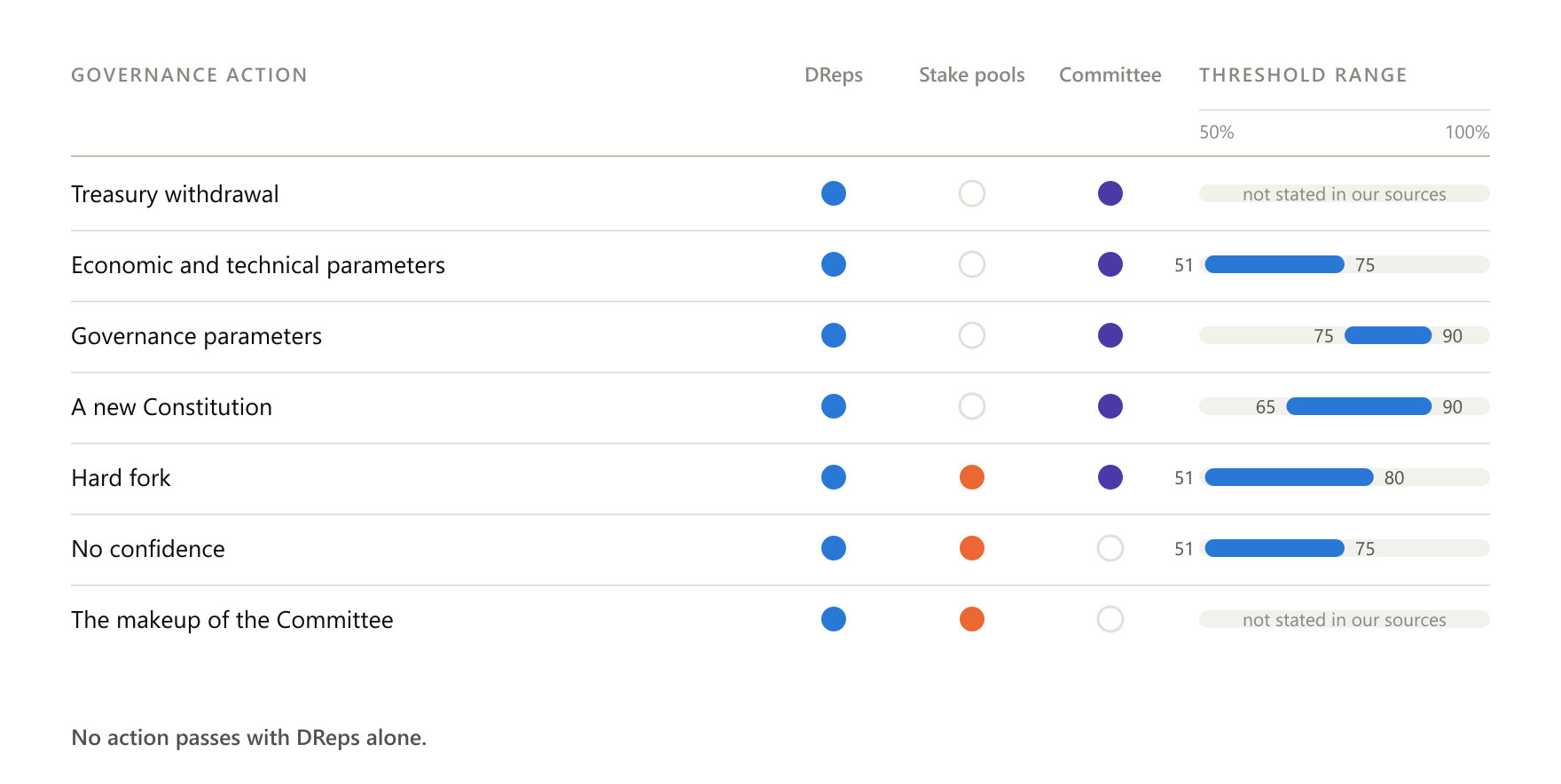
The Guardrails give ranges, not fixed numbers. Changes to economic and technical parameters must pass with between 51% and 75% of active stake, governance parameters themselves with 75% to 90%, hard forks with 51% to 80%, a new Constitution with 65% to 90%, and a no-confidence action with 51% to 75% [87]. The community can move the thresholds, but only within these bands.
No body decides alone
Every governance action needs the agreement of at least two of the three bodies [84]. Which two depends on the type of action. Treasury withdrawals, constitutional changes, and most parameter changes pair DReps with the Constitutional Committee. No-confidence votes and changes to the makeup of the Committee itself pair DReps with stake pool operators. A hard fork needs all three. No action passes with DReps alone [88].
Anyone can submit a governance action, but not for free. The deposit was 100,000 ada in March 2025, and it comes back once voters have decided the action [84]. That keeps the proposal queue serious.
Stake votes, not heads
Voting power follows ada, not the number of voters. CIP-1694, the framework behind the system, says it plainly: one lovelace, one vote [84].
The numbers make the effect easy to see. In a Committee vote in August 2026, 115 DReps in favor against 3 opposed amounted to just 51.68% of the stake that voted, because each DRep carries the weight of the ada delegated to it [89]. In the same period, about 9.75 billion ada of DRep voting power sat in Always Abstain, and another 10.51 billion ada across 563 stake pools sat passively in the same option [89].
Project Catalyst, the older route
Before treasury spending moved on-chain, and alongside it to this day, Cardano funded community projects through Project Catalyst. Anyone with an idea submits a proposal, ada holders vote according to how much ada they hold, and winners receive payment in installments tied to milestones agreed in advance. Since it began, it has distributed more than $150 million, with 1,722 completed proposals [90][91].
Catalyst is now in transition. Responsibility for it passed from Input Output to the Cardano Foundation, with DRep approval in early 2026 and guaranteed continuity for Funds 10 through 14 [92]. Funds 15 and 16 were canceled, and their ada returned to the treasury [93]. In August 2026, a smaller pilot fund launched with a total grant pool of 2 million ada [94]. Funding rounds may now pause between funds while the handover finishes [90].
Supply: 45 billion and a shrinking reserve
Cardano has a maximum supply of 45 billion ada, fixed in the original network settings (genesis) [13].
The launch allocation
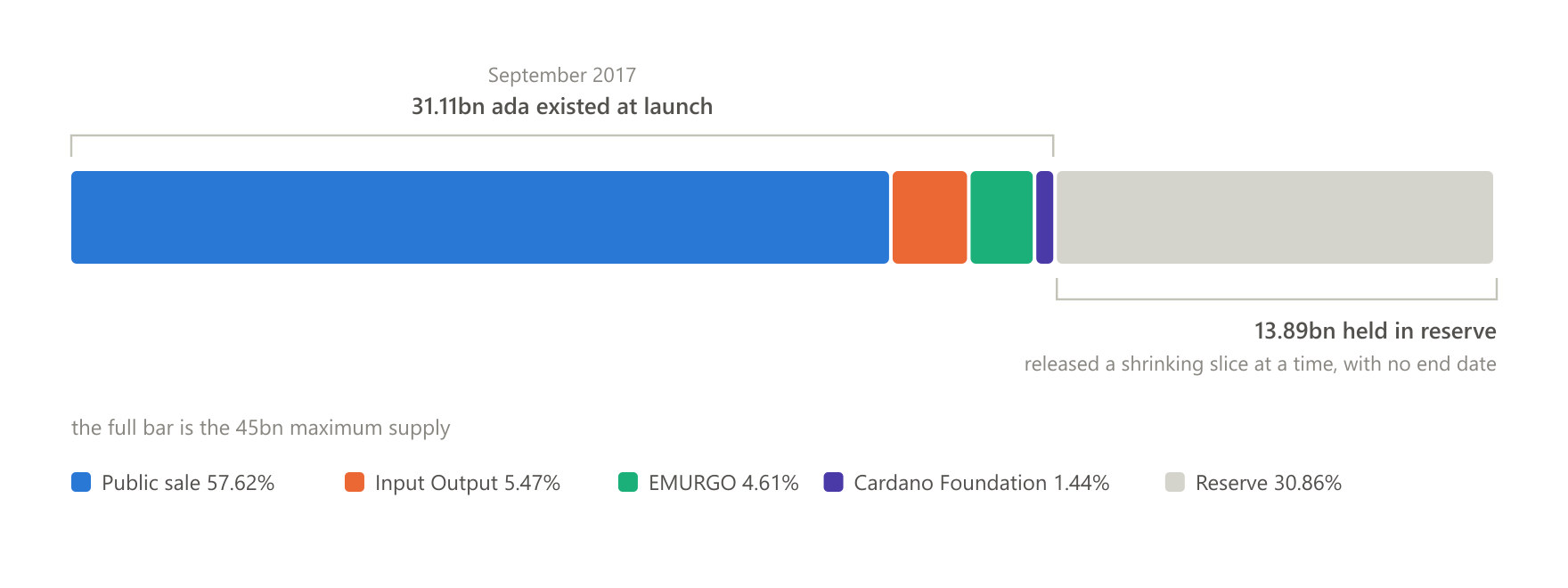
At launch, 31,112,484,646 ada existed [9].
| Recipient | ADA at launch | Share |
|---|---|---|
| Public sale (vouchers) | 25,927,070,538 | 83.3% |
| IOHK (now Input Output) | 2,463,071,701 | 7.9% |
| EMURGO | 2,074,165,644 | 6.7% |
| Cardano Foundation | 648,176,761 | 2.1% |
| Total | 31,112,484,646 | 100% |
The genesis design set the share of the founding organizations, 5,185,414,108 ada, at 20% of the vouchers sold [9]. That equals 16.7% of the launch supply and 11.5% of the final maximum supply (our calculations).
The rest, about 13.9 billion, stayed in the reserve for gradual release as rewards and treasury income [35]. There is no coin burning: transaction fees go into the pot that pays rewards, and nothing destroys them [35].
Where things stand today
Estimates of the circulating supply in September 2026 vary by data provider. CoinMarketCap counted 36.75 billion ada [12], while CoinDesk counted 37.52 billion [61]. The treasury held about 1.47 billion ada in early July 2026 [60].
Where the supply is heading
Most summaries treat the 45 billion maximum supply like the 21 million limit on Bitcoin and give a date for reaching it. No such date exists.
Each epoch, the protocol takes a fixed percentage of whatever remains in the reserve. That makes every release smaller than the one before it. The designers chose 0.3% per epoch, so that half of the remaining reserve runs out every four to five years [35]. A fixed percentage of a shrinking pile never quite reaches zero. Issuance slows toward nothing, but it has no end date. Unearned rewards returning to the reserve slow it down even further [35].
One more difference from Bitcoin: the economic settings of Cardano are not frozen. Protocol parameters, the adjustable network settings such as transaction fees and reward rates, change through on-chain governance [23]. Genesis fixed the maximum supply. How fast ada moves toward it, though, is ultimately up to the people who vote.
The economics of ada: who gets what, and who can change it
Three jobs for one coin
The ada coin does three things at once. It pays transaction fees, secures the chain through staking, and carries voting weight in governance [84]. The third job is the one that changed its economics. Once the parameters that set transaction fees, the split of rewards, and treasury funding went up for a vote, who holds ada stopped being a market question and became a question of control.
The allocation, measured against the maximum supply
The launch allocation covers only part of the eventual 45 billion. Measured against the maximum supply, it looks like this.
| Allocation | Share of maximum supply | ADA |
|---|---|---|
| Public sale (vouchers) | 57.62% | 25,927,070,538 |
| Reserve for staking and treasury funding | 30.86% | 13,887,515,354 |
| IOHK (now Input Output) | 5.47% | 2,463,071,701 |
| EMURGO | 4.61% | 2,074,165,644 |
| Cardano Foundation | 1.44% | 648,176,761 |
Source: FinDaS and Tokenomist, based on the Cardano genesis distribution page [84][95].
Two things stand out in the table. First, almost a third of all the ada that will ever exist never went to anyone: it sits in the reserve and comes out slowly. That means a pot that shrinks every epoch funds both staking rewards and treasury income. Second, the 5.19 billion ada of the founding organizations is enough to count in a stake-weighted vote, yet no public documentation describes a vesting or on-chain lockup schedule for these allocations [84]. That does not mean there were no restrictions. It means nobody outside can read them from the ledger.
The engine
Each epoch, the transaction fees from the blocks of that epoch go into a shared pot, along with a fixed percentage of the remaining reserve. That percentage, the rho parameter, is 0.3%. A fixed share of the pot, the tau parameter, goes to the treasury before anything else gets paid. The tau parameter is 20%, and it applies to both transaction fee income and new issuance [35][84].
One detail sets Cardano apart from chains where transaction fees go to whoever wins the block. The block producer does not collect the transaction fees. The protocol gathers them and shares them among all the pools that produced blocks during the epoch [84]. This smooths out block-level luck, and network activity benefits stake pools collectively rather than each one on its own.
The levers, and who pulls them
Every economically important setting has a name and falls under governance: txFeePerByte and txFeeFixed for transaction fees, monetaryExpansion (rho) for issuance, and treasuryCut (tau) for the treasury share [84].
Two more settings determine how rewards divide between pools and delegators, and both are under discussion right now.
The k parameter, the target number of stake pools, sets a soft cap on the size of each pool. The cap equals the maximum supply minus whatever remains in the reserve, divided by k, so it rises gradually as the reserve empties [96]. Stake above that cap earns nothing extra, which nudges delegators toward smaller pools. The k parameter has stood at 500 since the Shelley era. In early 2026, that put the per-pool cap at around 76 million ada, and the Cardano Parameter Committee has proposed doubling k to 1,000, which would cut it to about 37.5 million [97].
The minPoolCost parameter is the fixed cost a pool keeps from its rewards before anything reaches its delegators. It dropped from 340 to 170 ada in 2023. In April 2026, the Parameter Committee reached consensus on a further cut, to 75 ada, with implementation expected before the fourth quarter of 2026 [98]. The reason is arithmetic: for a small pool that produces one block in an epoch, the fixed cost currently swallows more than half of the reward, while 75 ada would bring that burden close to 22%, in line with the early Shelley years [97][98].
Neither change is cosmetic. Both decide how much network income reaches ordinary holders, and both now go to a vote instead of resting with the founding companies.
Units: from ada to lovelace
The ticker for ada is ADA, and the coin has its own symbol: ₳ [58]. It divides into six decimal places. The smallest unit is the lovelace, one millionth of an ada [58]. As the transaction fee formula above shows, the network itself counts in lovelace.
The naming carries over to the upgrades. Each phase and many hard forks bear the name of a scientist, a scholar, or a community member [59]. Vasil, for example, takes its name from Vasil Dabov, a member of the Cardano community [1].
How it has changed
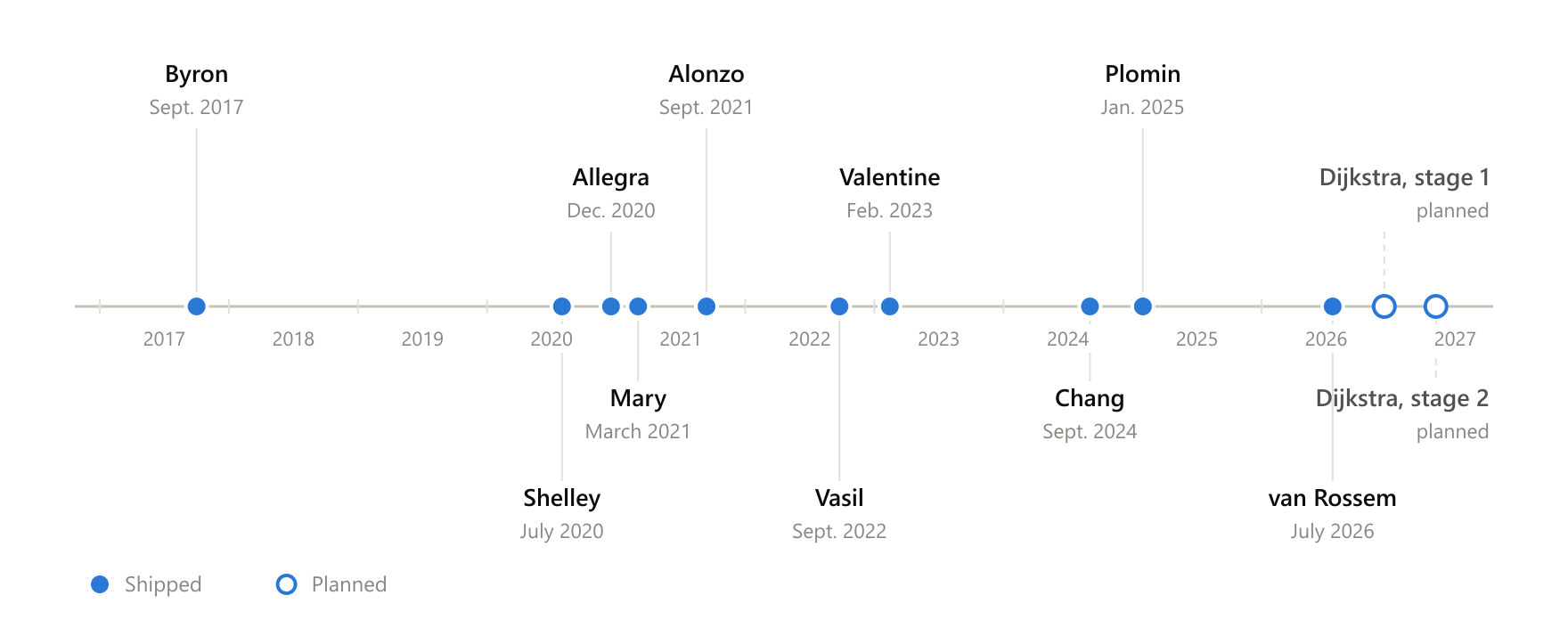
Cardano has upgraded through a series of hard forks. In each hard fork, all nodes start applying new rules at the same moment. On Cardano, every such change has gone through without the chain splitting or stopping [1].
| Date | Upgrade | What changed |
|---|---|---|
| September 29, 2017 | Byron | Launch of the mainnet and of ada; block production by a closed group of nodes [1] |
| July 29, 2020 | Shelley | Staking and decentralized block production by stake pools [1] |
| December 16, 2020 | Allegra | Token locking, a step toward smart contracts [1] |
| March 1, 2021 | Mary | Native tokens (digital assets created directly on the chain): anyone can create tokens without a smart contract [1] |
| September 12, 2021 | Alonzo | Smart contracts, through the Plutus language [1] |
| September 22, 2022 | Vasil | Smart contract performance and efficiency [1] |
| February 14, 2023 | Valentine | Further improvements to Plutus [1] |
| September 1, 2024 | Chang | The first on-chain governance features [1] |
| January 29, 2025 | Plomin | Full on-chain governance, with DReps and treasury withdrawals [1] |
| July 18, 2026 | van Rossem | Cleaner ledger rules, faster smart contracts, new cryptography [1] |
What comes next
Developers plan the next upgrade, named Dijkstra, in two stages [42]:
- First stage, targeted for the end of 2026: it will add "nested transactions" and an early version of Leios. Leios is a redesign of block production that aims for much greater capacity.
- Second stage, targeted for the second quarter of 2027: it will add Peras, a protocol for faster transaction finality.
A public testnet (a test network that runs alongside the live one) for Leios has been running since June 2026 [82]. All of this remains a plan until it ships.
Where people use it in practice
Staking and governance
Staking is the most widespread use: holders have delegated more than half of all ada to stake pools [34]. Holders can also delegate their voting power to DReps, who decide on upgrades and treasury spending [39][40].
Decentralized finance and tokens
Cardano hosts exchanges, lending platforms, and stablecoins, though on a small scale. On September 20, 2026, Cardano DeFi (decentralized finance) applications held a combined $59.72 million. The largest was the Minswap exchange, with $15.81 million. Stablecoins on the network came to $68.06 million [11]. Since 2021, anyone can also create tokens directly on Cardano without writing a smart contract [1].
Payments
Since March 2026, customers at 137 SPAR supermarkets in Switzerland and Liechtenstein can pay in ada through the Open Crypto Pay system. The store receives Swiss francs [66].
Access to Midnight
Midnight is a privacy-focused blockchain developed alongside Cardano. It distributed 4.5 billion of its tokens, called NIGHT, partly to ada holders [64]. Its mainnet launched on March 30, 2026, run at first by a set of trusted validators (nodes that check and approve new blocks) [64][65].
What it is not
Cardano is not anonymous. Every transaction is public, and every node keeps the full set of unspent outputs [19]. Once anyone links an address to you, they link its entire history to you as well.
Staking is not a lockup, since delegated ada never leaves your wallet [32]. The ada coin is not the same asset as NIGHT, because Midnight is a separate blockchain with its own token [64]. And the economics of ada are not frozen: a vote can change its parameters [23].
What has gone wrong
An honest article includes this part too.
The chain split, November 21, 2025
At around 08:00 UTC on November 21, 2025, a malformed transaction exploited a bug in a software library that the validation code failed to catch. Newer nodes accepted the transaction while older ones rejected it, and the network split into two chains [69]. The bug dated back to 2022 [70].
Emergency fixes shipped within three hours, and the chain came back together by the next day [70]. The Cardano Foundation said block production never stopped [71]. Intersect said no user funds were at risk [69]. Some transactions, however, ended up orphaned, and concerns arose about double-spending that affected some users [72].
A user calling themselves "Homer J" claimed to have sent the transaction [73]. Hoskinson called it a deliberate attack and said the FBI was involved [70]. DL News could not independently confirm that anyone had notified the authorities [74]. An Input Output employee resigned in protest over the handling of the case [70]. No investigation has reported any findings.
The SecondFi wallet attack, June 2026
From June 21 to June 23, 2026, attackers drained about 16.1 million ada from 374 wallets on SecondFi, the EMURGO wallet that succeeded Yoroi [75]. The signing process of the wallet could leak enough information through public blockchain data to rebuild private keys [75]. The Cardano protocol itself was not at fault, and hardware wallet users were unaffected [75].
The team secured 129 million ada before the attackers could reach it [76]. SecondFi is shutting down. In September 2026, the recovery process for affected users was still under development [75]. As of September 20, 2026, there were no reports of any distribution of recovered funds.
Where the ecosystem falls short
The technology has mostly done what it promised. The ecosystem around it is the weak point, and the problems are structural, not circumstantial.
Funding for builders has become unpredictable
Project Catalyst was the Cardano answer to funding public goods without letting a single investor decide what gets built. In practice, critics said it scattered money across many small projects with unclear results [93]. The 2026 restructuring responded by changing who manages it, canceling two funding rounds, and returning their ada to the treasury [93][92]. The side effect, however, is that the main grant pipeline of the ecosystem can now pause between rounds [90]. The pilot that replaced those rounds started with 2 million ada [94], a fraction of what earlier rounds handed out.
Small pools are getting squeezed
The Cardano decentralization story rests on hundreds of independent operators. The Parameter Committee itself describes the current situation as "operator frustration," with falling rewards for small pools [97]. The fixed cost arithmetic described above is one cause. The other is what the Committee calls sticky stake: a large volume of delegated ada has not moved in ten years, which cancels out the effect of any parameter change designed to spread stake around [97].
Underneath lies a complaint about process. In a 2023 poll, stake pool operators backed raising k to 1,000 and halving the minimum fixed cost. The Parameter Committee applied the cost cut and kept k at 500 [99], which operators argued was not what they had voted for [100]. Three years later, raising k remains a proposal.
Businesses that could not sustain themselves
JPG Store, for years the main Cardano NFT marketplace, closed on May 23, 2026, saying its operations were no longer sustainable [68]. The analytics service TapTools also closed, citing costs and staff departures [77]. In August 2026, the value locked in Cardano DeFi applications stood 87.56% below its August 2025 high [81]. Applications on a chain need users who pay transaction fees, and at current Cardano activity levels, the math rarely works.
The treasury is the prize
The risk a tokenomics analyst would rank first is neither a bug nor an attack. Writing in May 2025, Hristo Piyankov of FinDaS named governance capture through stake concentration as the dominant risk for Cardano: stake-weighted voting tends first to professionalize and then to concentrate, and the more valuable treasury decisions become, the harder some will try to control them [84]. His second risk is one this article has already described from the protocol side: the squeeze on the security budget as the reserve shrinks. The third is subtler: the genesis allocations are public down to the last ada, but holdings spread across many addresses and intermediaries make it hard to trace who holds influence today [84].
The defense Cardano has is procedural: a Constitution, a committee that checks constitutionality, and thresholds within set ranges. These stop just anything from passing. They do not stop the same coalition from winning every time.
The open questions
Who really decides?
On paper, on-chain governance gives every holder a voice. In practice, more than a quarter of the circulating supply abstains permanently [46]. Ten DReps hold more than half of all delegated voting power [45]. And the August 2026 Committee vote showed how close low turnout can bring the system to paralysis [43].
Criticism comes from both directions. Hoskinson himself has complained that voters are too reluctant to spend the treasury [56]. The investor Justin Bons, founder of Cyber Capital, argued the opposite risk: that moving governance discussion into moderated channels would hand influence back to groups close to Input Output [78]. Researchers at the Nara Institute of Science and Technology in Japan found that raising k improves decentralization at first but has a limited long-term effect [79].
Can it scale?
Bons put the maximum capacity of Cardano at about 23 transactions per second [78]. That is his own estimate based on block limits, not a measured figure. Actual usage is far lower: 25,584 transactions in the 24 hours to September 20, 2026 [11], or about 0.3 per second (our calculation).
Before you compare that number with the equivalent for other networks, though, look at what exactly counts as a "transaction" on Cardano. It is not the same unit.
One transaction can hide dozens of others
In the eUTXO model, a transaction can have any number of inputs and outputs [101]. That is not an accounting detail: it is why a single entry on the blockchain can represent the work of dozens of users.
The reason this happens in practice is a constraint. On a decentralized exchange, the liquidity pool lives inside one specific output, and only one party can "open" it per transaction. If every user sent a separate transaction, they would all collide over the same pool [102]. The fix that platforms such as Minswap and SundaeSwap adopted is batching: the user does not send the swap itself but an order that sits on the blockchain as an output of its own. A batcher, a program that runs off-chain, collects dozens of these orders, takes them all as inputs to a single transaction, and creates a matching output for each user with the coins they bought [102][103].
As a result, one transaction on the network counters can be thirty or forty swaps for thirty or forty different people. The whole batch pays one transaction fee, and the chain records once what an account model would need dozens of entries to record.
There is a ceiling, too. The maximum transaction size, a protocol parameter that always changed by network decision and now changes by vote, sets how many orders fit in a batch [23]. At the Shelley launch, the limit was 16,384 bytes per transaction [13].
How to see it for yourself
The quickest way to check this is not to take our word for it but to look. On eUTxO.org, a visual Cardano explorer built by Peter Oravec, every transaction appears as a shape: inputs on the left, outputs on the right, and lines between them. Simple transfers look like small, symmetrical shapes with one or two inputs. Batcher transactions stand out at once: they are the large fans with dozens of inputs flowing into dozens of outputs. The same tool also shows how many transactions an account model such as Ethereum would need for the same work [101].
The trade-off and the next move
Batching is not free, and the cost is not financial. As long as batching happens off-chain, a third party decides which orders go into the batch and in what order. Batchers can stop processing orders, and control over execution order gives whoever holds it room to profit at the expense of the user [103]. It is a point of centralization inside a chain that markets itself as decentralized.
This is where the first stage of the Dijkstra upgrade fits in. Nested transactions turn batching from an application workaround into a feature of the protocol itself: a batch consists of a list of individual transactions plus one top-level transaction that locks its contents, users do not need to approve the batch their own transaction ends up in, and nobody is barred from running a batching service [104]. Leios, the answer on raw capacity, is moving forward in parallel; on its testnet, it reached about six times the current mainnet throughput under synthetic load, according to an update from the ecosystem itself [82]. Leios has not reached the mainnet yet, and the first Dijkstra stage targets the end of 2026 [42].
How much does it depend on its founder?
In June 2026, Hoskinson announced he was "taking a break," after warning of a "wave of failures" in the ecosystem [56]. Earlier, he had personally bought the Nami wallet and the infrastructure provider Blockfrost to keep them alive [80]. A network is decentralized when it no longer needs any particular person, and by that standard the answer for Cardano remains unclear.
Sources
- P: Cardano.org, Cardano Hard Forks, Network Upgrade History, cardano.org/hardforks, September 2026 (project source)
- S: Coinhouse, Cardano (ADA): Overview of This Cryptocurrency, coinhouse.com/cardano
- S: Banxa, What Is Cardano? ADA Explained, banxa.com/learn/crypto-basics/what-is-cardano, August 2026
- S: Cardano Cube, About Input Output, cardanocube.com/community/input-output (project source)
- P: Kiayias, Russell, David, and Oliynykov, Ouroboros: A Provably Secure Proof-of-Stake Blockchain Protocol, eprint.iacr.org/2016/889, CRYPTO 2017
- S: IOHK, Ouroboros at Crypto 2017, iog.io/news/ouroboros-at-crypto-2017, August 2017 (project source)
- S: University of Edinburgh, REF2021 impact case study: Ouroboros, results2021.ref.ac.uk, 2021
- S: Ed Posnak, On the Origin of Cardano, medium.com/on-the-origin-of-smart-contract-platforms, March 2019
- P: Cardano.org, Genesis distribution, cardano.org/genesis (project source)
- S: Crypto Valley Journal, Allegation against Cardano founder: misappropriation of USD 620 million in ADA?, cryptovalleyjournal.com, May 2025
- S: DefiLlama, Cardano chain overview, defillama.com/chain/cardano, September 2026
- S: CoinMarketCap, Cardano, coinmarketcap.com/currencies/cardano, September 2026
- P: Input Output, Cardano mainnet genesis files (byron.json, shelley.json), github.com/input-output-hk/cardano-configurations (project source)
- S: Crypto.com, What is Cardano (ADA) and How Does it Work?, crypto.com/en/coins-ai/cardano/what-is, March 2026
- S: Dori, ADA voucher breakdown and Cardano redemption history, x.com/dori_coin, May 2025
- S: The Coin Republic, Cardano News: Everything to Know About The Hottest ADA Topic, thecoinrepublic.com, May 2025
- S: Crypto Briefing via MEXC, 99.7% of ADA vouchers have been redeemed, mexc.com/news/85108, September 2025 (audit commissioned by Input Output)
- S: Lido Nation, Lido Votes on Net Change Limits, forum.cardano.org, April 2025
- P: Cardano Docs, Extended UTXO model, docs.cardano.org/about-cardano/learn/eutxo-explainer (project source)
- P: Cardano Developer Portal, Extended UTXO Model, developers.cardano.org/docs/learn/core-concepts/eutxo (project source)
- P: Cardano Developer Portal, Transactions, developers.cardano.org (project source)
- P: Cardano Developer Portal, Transaction Fees, developers.cardano.org (project source)
- P: Cardano Developer Portal, Transaction Fees: collateral and parameters, developers.cardano.org/docs/learn/core-concepts/fees (project source)
- P: Cardano Developer Portal, Base Addresses, developers.cardano.org (project source)
- P: Cardano Developer Portal, Wallets, Keys and Addresses, developers.cardano.org (project source)
- P: Cardano Developer Portal, Consensus and staking, developers.cardano.org/docs/operate-a-stake-pool (project source)
- P: Cardano Developer Portal, Stake Pools, Delegation, and Network, developers.cardano.org (project source)
- S: Cexplorer, How does the lottery work on the Cardano network, cexplorer.io/article
- P: IOHK, Operating a stake pool, github.com/input-output-hk/technical-docs (project source)
- P: Cardano Docs, Pledging and rewards, docs.cardano.org/about-cardano/learn/pledging-rewards (project source)
- S: Cexplorer, Comparing Cardano and Bitcoin Pools, cexplorer.io/article, before September 2024
- P: Cardano Docs, Delegation, docs.cardano.org/about-cardano/learn/delegation (project source)
- S: Cardano Foundation, Staking and delegating for beginners, forum.cardano.org, July 2020 (project source)
- S: Coinbase (Staking Rewards data), Cardano staking, coinbase.com/earn/staking/cardano, September 2026
- P: Cardano Docs, Cardano monetary policy, docs.cardano.org/about-cardano/explore-more/monetary-policy (project source)
- P: Cexplorer, Epoch 654, cexplorer.io/epoch/654, September 2026
- S: Cardano Foundation, Understanding Cardano's Net Change Limit, cardanofoundation.org/blog, April 2025 (project source)
- S: DRepTalk, Glossary: Abstain, dreptalk.com/glossary/abstain, July 2026
- P: Cardano Docs, Governance overview, docs.cardano.org/about-cardano/governance-overview (project source)
- P: Cardano.org, Glossary: Treasury Withdrawal, cardano.org/glossary/treasury-withdrawal (project source)
- P: Intersect Budget Committee, Net Change Limit explained, budgetcommittee.docs.intersectmbo.org (project source)
- P: Intersect, Weekly update #123, intersectmbo.org/news, August 2026 (project source)
- P: Intersect, Weekly update #124, intersectmbo.org/news, August 2026 (project source)
- P: Intersect, Weekly update #128, intersectmbo.org/news, September 2026 (project source)
- S: DRepTalk, Governance dashboard (epoch 653), dreptalk.com, September 2026
- S: CryptoTicker, Cardano Treasury Vote: What ADA Holders Should Check, cryptoticker.io, September 2026
- S: Essential Cardano, Founding and IOG organization, essentialcardano.io/article (project source)
- S: Input Output, Input Output Global rebrands to "Input Output", iog.io/news, December 2025 (project source)
- P: Cardano Foundation, Financial Insights Report 2025, notes, activityfinancialreport.cardanofoundation.org, 2026 (project source, audited financial statements)
- P: Cardano Foundation, 2025 Activity and Financial Insights Report, cardanofoundation.org/blog, 2026 (project source, audited financial statements)
- S: EMURGO, Meet Azu, Building a Global Cardano, forum.cardano.org (project source)
- S: Forklog, SecondFi to shut down after $2.6 million ADA theft, forklog.com/en, July 2026
- S: DRep Forum, Net Change Limit Nearly There, drepforum.substack.com, February 2026
- S: Midnight, State of the Network, February 2026, midnight.network/blog, February 2026 (project source)
- S: The Block, EMURGO steps down from Pentad governance role, theblock.co, July 2026
- S: CoinDesk, Cardano slumps under 20 cents as Hoskinson steps away, coindesk.com, June 2026
- P: Cardano Cube, Governance action: Net Change Limit (350M ada), cardanocube.com/governance, February 2026
- S: Wikipedia, Cardano (blockchain platform), en.wikipedia.org
- S: Gemini Cryptopedia, Cardano Ecosystem and Cardano Roadmap Explained, gemini.com/cryptopedia
- S: AMBCrypto via KuCoin, Cardano Proposes 43% Increase in Treasury Funding to 500M ADA, kucoin.com/news, July 2026
- S: CoinDesk, Cardano price, coindesk.com/price/cardano, September 2026
- S: Coinbase, Cardano price, coinbase.com/price/cardano, September 2026
- S: CoinGecko, Cardano, coingecko.com/en/coins/cardano, September 2026
- S: Midnight, State of the Network, January 2026, midnight.network/blog, January 2026 (project source)
- S: Cardanians.io, Midnight Is on Mainnet. Here's Where Things Stand, cardanians-io.medium.com, June 2026
- S: Decrypt, Cardano's ADA Token Now Accepted at Spar Supermarkets in Switzerland, decrypt.co, March 2026
- S: Cardano Foundation, ADA Now Accepted at 137 SPAR Stores across Switzerland, cardanofoundation.org/blog, March 2026 (project source)
- S: Cexplorer, JPG Store Is Shutting Down, cexplorer.io/article, April 2026
- P: Intersect, Incident report: network partition analysis and resolution strategy, intersectmbo.org/news, November 2025 (project source)
- S: The Block, Hoskinson involves FBI after developer's "careless" experiment splits Cardano blockchain, theblock.co, November 2025
- S: Cardano Foundation, November 2025 Incident: Cardano Shows Its Resilience, cardanofoundation.org/blog, December 2025 (project source)
- S: Cointelegraph, Cardano chain split, cointelegraph.com, November 2025
- S: Decrypt, Cardano network disrupted by "poisoned" transaction, decrypt.co, November 2025
- S: DL News, Cardano blockchain split snafu, dlnews.com, November 2025
- P: SecondFi, Incident FAQ, kb.secondfi.io, September 2026 (project source)
- S: CoinDesk, SecondFi to shut down after $2.4 million ADA wallet theft, coindesk.com, July 2026
- S: Coinpedia via TradingView, Charles Hoskinson says More Cardano Projects Will Die in 2026, tradingview.com/news, June 2026
- S: Yellow.com, Cardano's Governance Erupts As Justin Bons Targets Hoskinson, yellow.com/news, June 2026
- S: Nara Institute of Science and Technology (Yamada et al.), On-chain analysis of Cardano network parameters, naist.jp, 2025
- S: CCN, Hoskinson warns of more Cardano DeFi projects closing, ccn.com, June 2026
- S: The Crypto Basic, Cardano DeFi TVL Plunges 16% in 24 Hours, thecryptobasic.com, August 2026
- P: Cardano.org, Cardano News: development reports, cardano.org/news, August to September 2026 (project source)
- S: Mitrade, Cardano Ratifies Its Constitution: 85% Vote Secures Historic Milestone, mitrade.com, February 2025
- S: Hristo Piyankov (FinDaS), The Tokenomics of Cardano (ADA), findas.org/tokenomics-review, May 2025
- S: Tap In With TapTools, Updated Cardano Constitution Ratified, medium.com, February 2025
- P: Intersect, Updated Cardano Constitution: ratification outcome and effective date, intersectmbo.org/news, January 2026 (project source)
- P: Intersect Knowledge Base, Read the Cardano Constitution: Guardrails Appendix, docs.intersectmbo.org (project source)
- P: Cardano.org, Glossary: Voting Thresholds, cardano.org/glossary/voting-thresholds (project source)
- S: CryptoTicker, Cardano Constitutional Committee: Deadline Is September 6, cryptoticker.io, August 2026
- P: Cardano Developer Portal, Funding and grants, developers.cardano.org/docs/community/funding, July 2026 (project source)
- P: Project Catalyst, Funds overview, projectcatalyst.io/funds, 2026 (project source)
- P: Cardano Foundation, Monthly Update: April 2026, cardanofoundation.org/blog, May 2026 (project source)
- S: U.Today, Cardano Foundation Resets Community Funding Model, u.today, February 2026
- P: Cardano Foundation, New Catalyst pilot fund launching this summer, forum.cardano.org, June 2026 (project source)
- S: Tokenomist, Cardano (ADA) Tokenomics and Vesting Schedule, tokenomist.ai/cardano, September 2026
- S: Cardano Forum, PCP: k parameter, forum.cardano.org (citing the Input Output definition of the soft cap)
- P: Cardano Parameter Committee, Meeting notes, January 15, 2026, forum.cardano.org (project source)
- P: Cardano Parameter Committee, Meeting notes, April 30, 2026, forum.cardano.org (project source)
- P: Intersect Parameter Committee, Meeting notes, July 6, 2023, committees.docs.intersectmbo.org (project source)
- S: Cardano Forum, Voltaire era: Parameter committee intermediate state, forum.cardano.org, August 2023
- S: eUTxO.org (Peter Oravec), Visual Blockchain Explorer for Cardano, eutxo.org
- S: Learn Cardano, Minswap Batchers, learncardano.io, December 2024
- S: Optim Labs, Transaction Chaining on Cardano, optim-labs.medium.com, September 2022
- P: IntersectMBO, Cardano Formal Specifications: Nested Transactions, github.com/IntersectMBO/cardano-formal-specifications (project source)
This article is educational and provides general information. Cryptocurrency data changes quickly, so verify it before taking any action based on what you read here. It is not financial advice.