

Bitcoin is the first decentralised digital currency. It launched in January 2009, created by a person or group writing under the name Satoshi Nakamoto, and was designed as a peer-to-peer electronic cash system: a way to send value directly to someone else, with no bank, no payment provider and no state in between.
That sounds simple. The hard part, and the reason nobody had managed it before, is the double-spending problem. A digital file can be copied. If money is just a file, what stops you spending the same coin twice? Every previous attempt solved this with a central authority keeping the books. Bitcoin solved it without one, and that idea is what opened the door to everything that followed.
This article covers the whole picture: the history, the mechanism, the supply, where the network stands today, and the risks. It is informational and is not investment advice.
Where it started
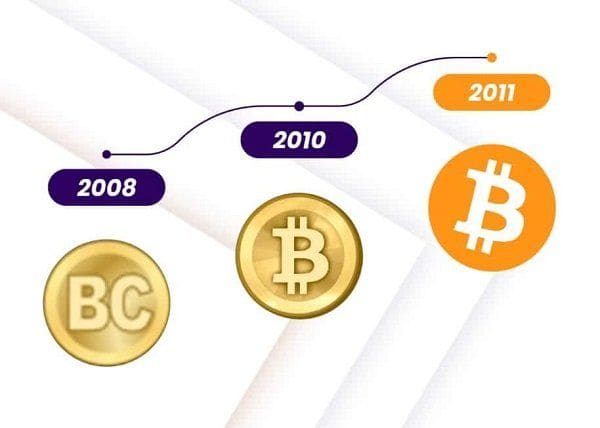
The work began quietly. Design and code started in 2007. The bitcoin.org domain was registered on 18 August 2008. On 31 October 2008 a nine-page document titled Bitcoin: A Peer-to-Peer Electronic Cash System, signed Satoshi Nakamoto, appeared on a cryptography mailing list. It described the entire design in plain language.
In January 2009 Nakamoto released the software as open source, meaning anyone could read the code, run it, and check that it did what the document claimed. This was not decoration. A currency that asks you to trust nobody has to let you verify everything, and you cannot verify a program you are not allowed to read.
Who Satoshi Nakamoto actually was remains unknown. Various people have been named, some have claimed the identity themselves, and none of it has ever been proven. It is genuinely one of the open questions of the field.
The genesis block
The network started on 3 January 2009, when Nakamoto mined the first block. It is called the genesis block, or block 0.
Inside its data sits a line of text:
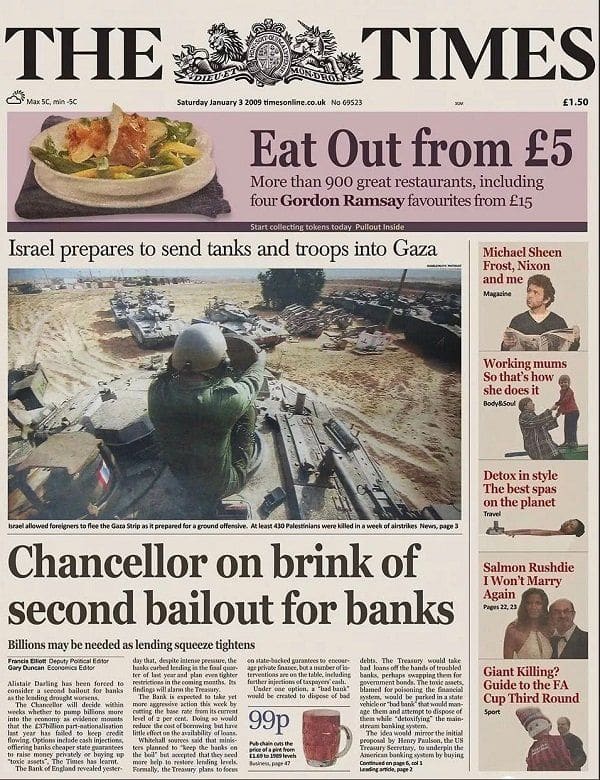
The Times 03/Jan/2009 Chancellor on brink of second bailout for banks
It is the front-page headline of The Times that day. It does two jobs at once. It proves the block cannot have been created any earlier than that date, so it works as a timestamp. And it is a comment: the first block of a currency built to work without banks carries a headline about bailing out the banks.
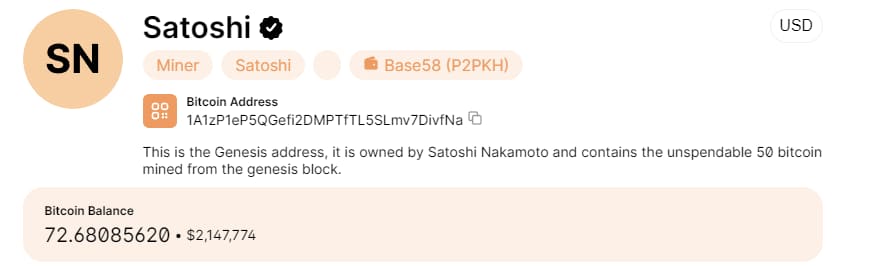
The genesis block is unusual for another reason. Every other block points back to the one before it. Block 0 has nothing behind it, so Nakamoto simply wrote 50 bitcoin into existence. Because of a quirk in how that first block was recorded, those 50 coins can never be spent by anyone, not even by whoever holds the keys. People still send small amounts to the address as a tribute, and those get stuck there too.
The first transactions
Six days later, on 12 January 2009, the first Bitcoin transaction took place: 10 BTC from Nakamoto to Hal Finney, a cryptographer who in 2004 had built Reusable Proofs of Work, one of the direct ancestors of Bitcoin's mining system. It was a test, to see whether the network moved money at all. It did.
The other date everyone remembers is 22 May 2010, when programmer Laszlo Hanyecz paid 10,000 BTC for two pizzas from Papa John's. It gets cited as the most expensive meal in history, but at the time it was the first proof that this thing could buy a physical object from a stranger. Someone had to go first.
Satoshi's coins, and why they never moved
Satoshi did not use a single wallet. Analysts who studied a distinctive pattern in the earliest blocks estimate that roughly 1.1 million bitcoin were mined by one participant during the first year, spread across many thousands of separate addresses, one per 50 BTC block reward.
None of those coins has ever been spent. Seventeen years later they sit exactly where they were mined, in plain view, in a ledger anyone can check. At 2026 prices, that is one of the largest static holdings of wealth in the world, and it has never been touched.
Why mine that much and then never touch it? The most convincing explanation has nothing to do with wealth. A new blockchain is at its most vulnerable on day one, when almost no computing power defends it and a single participant could dominate. By mining the early blocks himself, Satoshi kept the network safe through the period when it could most easily have been killed, then handed the code and the network to everyone and stepped away. In late 2010 he passed the reins to developer Gavin Andresen and stopped posting, with his last known communication dated to early 2011.
That is our reading rather than documented fact, but it fits the behaviour and the timing better than any alternative.
What the blockchain actually is
The blockchain is the public record of every Bitcoin transaction ever made. Think of it as a ledger anyone can read and nobody can quietly alter.
It is made of blocks, roughly like the chapters of a book. Each block holds a batch of transactions, and each block carries a cryptographic fingerprint, a hash, of the one before it. Change an old transaction and its block's fingerprint changes, which breaks the next block's reference, which breaks the one after that, all the way to today. Rewriting history means rebuilding every block from that point onward, faster than the rest of the world is extending the current chain. That is the entire security model in one sentence.
Copies of the ledger are held by thousands of computers around the world, the nodes. Each node independently checks every rule: that the coins being spent exist, that the signatures are valid, that no block violates the supply schedule. In early 2026 roughly 24,500 reachable nodes were recorded, while the total including those behind firewalls that do not accept incoming connections is estimated at between 50,000 and 100,000. No exact count is possible, precisely because nobody controls them centrally.
One point worth clearing up, because almost every beginner's guide confuses it: nodes and miners are not the same thing. Miners build new blocks and compete for the reward. Nodes verify and store. A node needs an ordinary computer and costs almost nothing, and it is the node that keeps the rules honest, because a miner who breaks them is simply ignored.
How a transaction works
A Bitcoin transaction is not a bank transfer. It has inputs and outputs.
The inputs point back to earlier transactions where you received coins, proving that what you are spending exists and belongs to you. The outputs say where the coins are going and how much each destination gets.
The closest everyday analogy is cash. If you pay for an 8 euro item with a 10 euro note, you do not tear the note; you hand over the whole thing and get 2 euros back. Bitcoin works the same way. Inputs are consumed whole, the recipient gets their amount, and the remainder comes back to you as change, usually to a new address of your own.
Double-spending is prevented by the ledger itself. Every input must reference a previous output that has not already been spent. If you try to spend the same coin twice, the second attempt points at something the network has already crossed off.
Keys: the only thing that is really yours
Ownership comes down to two pieces of data.
The Bitcoin address is public, roughly like an account number. It is what you give someone so they can pay you.
The private key is the secret that proves the address is yours. With it, you sign transactions that spend from that address.
The relationship only runs one way. Deriving your address from your private key is instant arithmetic. The reverse, going from a public address to the private key, is not merely difficult, it is beyond the reach of every computer that exists. The signature itself is clever too: the network verifies your signature using the corresponding public key, and the private key never leaves your hands or appears on the chain.
The other side of this is unforgiving. If you lose the private key, the coins cannot be recovered by anyone, ever. There is no support line and no password reset.
How much has been lost this way is not known precisely, and estimates vary considerably depending on methodology. A 2017 Chainalysis study put roughly one fifth of all bitcoin as permanently inaccessible. A more recent 2025 analysis by Ledger puts the range at 2.3 to 3.7 million coins, or roughly 11% to 18% of existing supply. Both are approximations, since nobody can reliably distinguish a lost key from an owner who simply has not moved in fifteen years.
This is why writing your recovery phrase on paper or metal and keeping it offline is not paranoia, and why nobody legitimate will ever ask you for it.
Mining and proof of work
Roughly every ten minutes a new block is added. Who gets to add it is exactly what mining decides.
Miners gather pending transactions into a candidate block and then race to solve a puzzle. They must find a number, the nonce, such that when the block's contents are hashed together with it using the SHA-256 algorithm, the result falls below a target the network sets. Because a hash is unpredictable, there is no clever shortcut: you guess, check, add one, guess again, billions of times. A winning hash looks like a long string beginning with many zeros.
The asymmetry is the point. Finding a valid nonce takes enormous work. Checking that someone else's nonce is valid takes a fraction of a second on any computer. That is why the network can trust the answer without repeating the effort, and why rewriting the past would cost more than it could ever return.
Every 2,016 blocks, roughly two weeks, the network recalculates how hard the puzzle should be, so that blocks keep arriving every ten minutes whether global mining power has doubled or halved.
Miners are paid in two ways: newly created bitcoin, plus the fees on the transactions they include. Fees are optional, but they determine your place in the queue. Miners rank transactions by fee relative to size, in satoshis per virtual byte, so a small transaction priced correctly confirms before a large stingy one. In the early years, when almost nobody used the network, fees were effectively zero.
There is a separate, more detailed article on this mechanism, Proof of Work, if you want the full picture.
Supply: 21 million and the halving
Every block contains one special transaction, confusingly called the coinbase, which has nothing to do with the exchange of the same name. That is where new bitcoin are created and paid to the winning miner. Every bitcoin in existence entered the world through one of these.
The amount is not fixed forever. Every 210,000 blocks, roughly every four years, it halves.
| Year | Block reward |
|---|---|
| 2009 | 50 BTC |
| 2012 | 25 BTC |
| 2016 | 12.5 BTC |
| 2020 | 6.25 BTC |
| 2024 | 3.125 BTC |
| ~2028 | 1.5625 BTC |
Keep halving and the total converges. Bitcoin's supply is capped at 21 million coins, and the schedule is enforced by every node on the network rather than by anyone's promise. This is the property people mean when they call it digitally scarce, and it is the core argument behind using it as a store of value rather than a payment method.
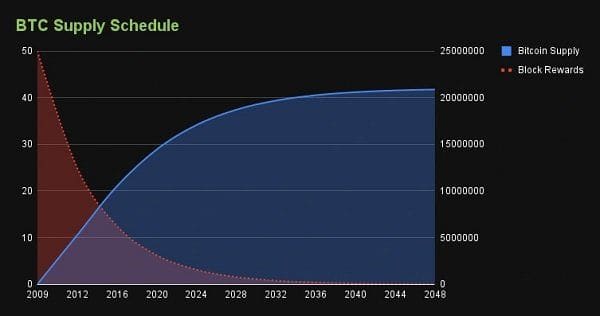
Where we stand today. In March 2026 the circulating supply passed 20 million coins for the first time, a milestone reached seventeen years after the genesis block. By early August 2026 it stood at just over 20.06 million, roughly 95.5% of everything that will ever exist. At 3.125 BTC per block, the network now issues about 450 new coins a day. The remainder, under one million coins, will be issued across the next century.
Once new coin issuance stops, miners will still be needed to confirm transactions, and they will have to be paid entirely from fees. Whether fees will be enough is a genuinely open question, and one of the more interesting long-term debates in the field. It is not theoretical: after the 2024 halving and with fees at low levels, 2026 saw global mining power contract as less efficient hardware was retired, and difficulty fell below the level of the previous year for only the second time in the network's history.
When the last bitcoin will be mined
Almost every source says 2140. The number comes from assuming blocks arrive exactly every ten minutes and halvings exactly every four years.
In practice that is not what happened. Because mining power grew almost continuously for fifteen years, blocks were on average found slightly faster than the ten-minute target, and each difficulty adjustment only caught up after the fact. Every halving so far has arrived slightly ahead of schedule. That drift compounds across more than a century.
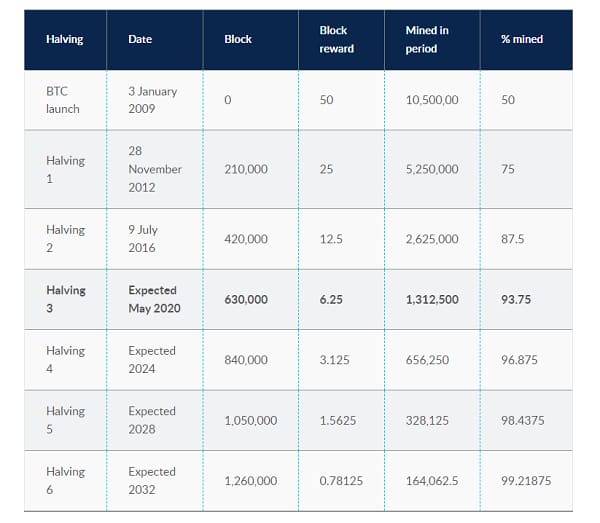
Look at the last column. By the sixth halving, over 99% of all bitcoin that will ever exist has already been issued. The century that follows is the network splitting hairs over the final fraction of a unit, which is worth keeping in mind every time you hear the date 2140.
Our view at CRYPTO NEWS 24 is that the last block will be mined meaningfully earlier than 2140. We would not put a year on it, because that depends on how mining power grows over the next century, which nobody knows, and 2026 showed it can also shrink. But 2140 should be read as the output of a simplifying assumption, not as a date in a calendar.
Units: from bitcoin to satoshi
One bitcoin, written BTC or more rarely XBT, has its own Unicode symbol: ₿.
It divides into eight decimal places. The smallest unit is the satoshi, named after the creator: one satoshi is one hundred-millionth of a bitcoin, or 0.00000001 BTC. The millibitcoin, or mBTC, is one thousandth of a bitcoin, which is 100,000 satoshis.
Divisibility matters more than it sounds. Very few people buy a whole bitcoin, and being able to hold an arbitrarily small piece is what keeps it usable regardless of what one coin is worth.
Who holds it today
The ownership picture changed radically within two years, and it is arguably the most significant development since launch.
Since January 2024, spot Bitcoin ETFs have operated in the United States, exchange-traded funds that hold actual coins on behalf of their investors. By mid-2026 they managed roughly 102 billion dollars in total, with BlackRock's iShares Bitcoin Trust holding around 67 billion of that on its own.
Corporate and state holders appeared alongside them. Strategy Inc. is reported to hold 847,363 BTC, while the US federal government is estimated to hold around 328,372 BTC, making it the largest known state holder in the world.
This cuts both ways. On one hand, institutional participation brought liquidity, regulatory recognition and easy access for investors who would never touch a wallet. On the other, an asset designed so that intermediaries were unnecessary is now held to a large degree through intermediaries, and concentration in a few large holders is exactly the kind of dependency the original document set out to avoid.
Where it is used in practice
- As a store of value. The most common use today. The supply cap and the absence of a central issuer led many to see it as a hedge, hence the phrase "digital gold".
- Peer-to-peer payments. The original purpose: sending value to anyone, anywhere, without asking permission.
- Cross-border remittances. No country-to-country exchange rates, no correspondent banks, and settlement in an hour rather than days.
- Speculation. A large share of activity is buying in the hope of selling higher. This is also where most losses happen.
- Collateral in decentralised finance. Mostly through "wrapped" versions that let bitcoin be used on other chains.
- Merchant payments and donations. Accepted by a range of businesses and organisations, with the borderless nature being the real advantage for the latter.
For everyday payments, the base chain processes roughly 600,000 transactions a day, a limit that is a deliberate design choice: it keeps the requirements for running a node low and therefore preserves decentralisation. Fast, cheap payments move to a second layer, chiefly the Lightning Network, which settles many transactions off-chain and records them in aggregate.
Two things it is not. Bitcoin is not anonymous, it is pseudonymous: every transaction is public forever, and once an address is linked to you, its entire history is linked to you as well. And Bitcoin has no staking. If someone offers you a yield on bitcoin, that yield is generated by whatever they do with your coins, which means you are taking on their credit risk. Ask what that activity is.
What has gone wrong
An honest article says this part out loud too.
The value overflow incident, 15 August 2010. A bug allowed the creation of 184 billion BTC in a single transaction, split across two outputs of roughly 92 billion each. It was spotted within hours, the code was fixed, and the network agreed to abandon the affected chain. It remains the only serious flaw ever exploited in Bitcoin itself, and the fix required humans to coordinate quickly, which is worth remembering whenever the system is described as fully automatic.
The version 0.8 split, March 2013. A new release accepted blocks that older software rejected. For several hours the network ran as two chains. It was resolved by miners voluntarily downgrading their software, which again means the solution was social rather than technical.
Mt. Gox, 2014. The largest exchange of the era, handling most of the world's volume, collapsed having lost hundreds of thousands of customer bitcoin. The compensation process ran for over a decade. The protocol was not at fault in any way: the failure belonged to the business holding the keys. It is the archetype of every subsequent platform collapse, and the reason the phrase "not your keys, not your coins" exists.
GHash.io, 2014. A mining pool reached roughly half of the network's power, the threshold at which an operator could in principle reorder or block transactions. It voluntarily capped itself at 39.99% and asked others to do the same. Nothing compelled it to. Concentration of mining power remains the most discussed structural risk in the network, and the problem has not been solved: a few large pools still control most of global hashing power today.
The open questions
Beyond what has gone wrong, there are three criticisms that remain unanswered and are worth knowing.
The security budget problem. As the block reward tends toward zero, network security will depend entirely on fees. If fees stay low, mining power shrinks and the cost of an attack falls. Nobody knows where that balances, and 2026 gave a first taste of the pressure.
Energy consumption. Proof of work consumes energy deliberately, because that is precisely what costs an attacker. Consumption estimates vary significantly depending on methodology and energy mix, and the debate over whether the result justifies the cost remains genuinely open.
Decentralisation in practice. The protocol is decentralised. Mining is concentrated in a few pools, ownership in a few large institutional holders, and development of the core software in a relatively small group of programmers. That nobody can unilaterally change the rules does not mean power is evenly distributed.
The risks
Price movements are violent in both directions. Bitcoin closed 2019 at around 7,200 dollars, ended 2020 near 29,000, set a record just under 69,000 in November 2021, then fell to roughly 15,500 during 2022. A further rise followed to an all-time high of about 126,200 dollars on 6 October 2025, and then a decline: by mid-August 2026 it was trading around 63,000 dollars, roughly half its peak within ten months.
That is not an anomaly, it is the pattern. Anyone telling you where it goes next is guessing.
Beyond volatility:
- Platforms get breached. The protocol's record is strong; the businesses built on top of it have lost billions. Coins on an exchange are that exchange's liability, not your property.
- There is no deposit guarantee. No scheme covers crypto the way it covers a bank account. If a platform collapses, you are a creditor.
- Regulation is still moving. MiCA is in full application, but the Greek tax framework is being finalised now and the details may change.
- Fraud is constant. Regulators have been pursuing Ponzi schemes using bitcoin's name since 2013, and the pattern has not gone out of fashion.
- Losing your keys is final. Worth repeating, because it is the most common way people actually lose money.
Sources
- P: Satoshi Nakamoto, Bitcoin: A Peer-to-Peer Electronic Cash System, bitcoin.org/bitcoin.pdf, Oct 2008
- P: Bitcoin Core, protocol documentation and release notes
- P: Blockchain.com block explorer, genesis block address 1A1zP1eP5QGefi2DMPTfTL5SLmv7DivfNa
- P: Bitnodes, reachable node count
- P: MacroMicro, Bitcoin circulating supply, data as of Aug 2026
- P: Regulation (EU) 2023/1114 (MiCA)
- S: Wikipedia, "Bitcoin" and "Bitcoin network"
- S: Investopedia, "Bitcoin" and "What Determines the Value of 1 Bitcoin"
- S: CoinDesk Learn, "What Is Bitcoin?" and "The 9 Biggest Screwups in Bitcoin History"
- S: Spark, "Bitcoin Network Statistics", node and transaction data 2026
- S: CoinLaw, "Bitcoin Statistics 2026", ETF and institutional holdings data
- S: Pickaxe, difficulty and hashrate analysis, Aug 2026
- S: Libertex, lost-coin estimates based on Ledger 2025 analysis
- S: Chainalysis via Investopedia, "20% of All BTC Is Lost, Unrecoverable, Study Shows", 2017
- S: OriginStamp and CoinCodex, analyses of Satoshi Nakamoto's addresses
- S: CoinDesk, "Are 51% Attacks a Real Threat to Bitcoin?", Jun 2014
- S: Wikipedia, "GHash.io"
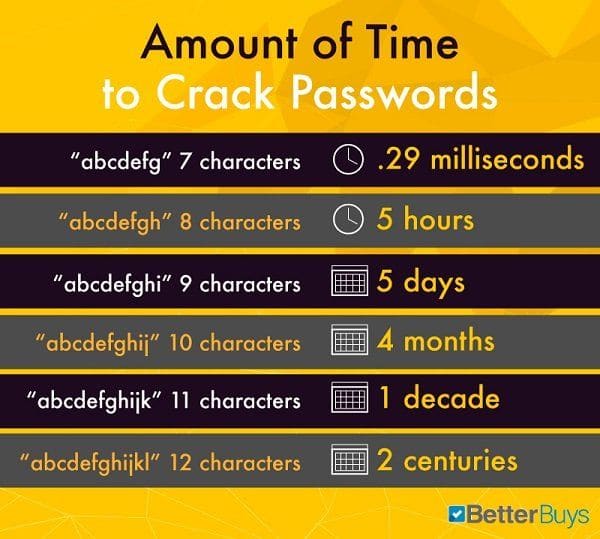
- S: Better Buys, password-cracking time estimates (source of the image above)