

Proof of work (PoW) is the mechanism that lets a network of strangers agree on what happened, with nobody in charge and nobody trusting anybody. It is the reason Bitcoin works.
It is also the most misunderstood part of the entire field. The usual description, that miners "solve complex mathematical problems", is technically true and almost completely uninformative. The puzzle has no useful answer. Nobody learns anything from the solution. What matters is not the answer, but the cost of finding it.
This article covers where the idea came from, what it is actually for, how it works step by step, a real block opened up, what happens in practice when security is insufficient, and the arguments on both sides. It is informational and is not investment advice.
It was not invented for money
Proof of work predates cryptocurrency by fifteen years.
In 1993 Cynthia Dwork and Moni Naor published a paper on combating junk email. Their idea was simple: force the sender's computer to do a small, deliberately annoying amount of work before a message is accepted. For someone sending one email, the cost is invisible. For someone sending ten million, it becomes ruinous. The economics of spam rest on sending being almost free, so make it slightly expensive and the business collapses.
The name came later. Markus Jakobsson and Ari Juels formalised the concept and established the term "proof of work" in a 1999 paper.
Between the two came the piece Bitcoin actually inherited. In 1997 Adam Back proposed Hashcash, which used exactly this approach against spam and denial-of-service attacks, built on cryptographic hashing. And in 2004 Hal Finney built Reusable Proofs of Work, an attempt to make the proofs themselves transferable. Finney would later receive the first Bitcoin transaction ever sent.
So when Satoshi Nakamoto needed a way for a leaderless network to agree on the order of transactions, the tool already existed. The insight was not inventing proof of work. It was realising where else it could be pointed.
What it actually proves
This is the point most explanations skip over.
Proof of work is not about proving that computation happened, and the computation itself is useless. Its real purpose is to make changing the past expensive.
Every block in a blockchain carries a cryptographic fingerprint of the one before it. Change one transaction in an old block and that block's fingerprint changes, which invalidates the next block's reference, and the next, all the way to today. To rewrite history you would have to redo the proof of work for that block and every block after it, while the rest of the network keeps extending the honest chain, and you would have to catch up.
That is why the network trusts the longest chain: not because length means anything in itself, but because length is a receipt for energy that was genuinely spent. The chain with the most work behind it is the one that would cost the most to forge.
Blocks, hashes and the chain
A blockchain is a ledger of transactions, grouped into blocks. Each block records amounts, addresses and a timestamp, and each is cryptographically tied to the one before it.
The tie is a hash. A hash function takes any quantity of data and produces a fixed-length fingerprint, for Bitcoin a 64-character hexadecimal number, using the SHA-256 algorithm. Two properties make it useful here:
- It is fast in one direction and impossible in the other. Producing a hash from data is instant. Going backward, from hash to data, is not feasible.
- It is extremely sensitive. Change one character of the input and the output is entirely different, bearing no resemblance to the original.
That sensitivity makes tampering detectable. There is no small correction in a blockchain.
One detail explains a great deal: miners do not hash the entire block. They hash only its header, a fixed 80-byte piece containing the version, the previous block's hash, the Merkle root of the transactions, the timestamp, the difficulty target and the nonce. The transactions themselves are compressed into a single number, the Merkle root. This is why mining a block with one transaction costs exactly as much as mining a block with ten thousand.
How a miner really finds a block
The network does not ask miners to compute anything useful. It asks them to find an input that produces a hash below a particular number. That is all.
Step by step:
- Transactions gather. When you send a payment, it enters a pool of unconfirmed transactions.
- The miner builds a candidate block. It selects transactions, checks that each is valid, and assembles them into a block.
- It starts trying. The header contains a field called the nonce, short for "number used once".
- It hashes and compares. It hashes the header. Is the result below the network's target? Almost certainly not.
- It changes and repeats. It tries another nonce and hashes again. And again. Billions of times per second.
- Somebody wins. Whoever first finds a hash meeting the condition broadcasts the block to the network.
- Everyone else checks. The other nodes hash the header once and see immediately whether it meets the condition. If it does, they add it and start work on the next one.
- The winner is paid. Newly created coin plus the fees on the block's transactions.
The target is expressed as a maximum value, which is why valid hashes begin with a run of zeros: a number with many leading zeros is a small number. The more zeros required, the harder the search.
Two things almost everyone gets wrong.
First, you do not get closer to the solution with each attempt. The result of every hash is entirely independent of the last. You have exactly the same chance with a nonce of 0 as with a nonce of 4,294,967,295. There is no progress, only repeated independent lottery draws.
Second, the nonce field is only 4 bytes, meaning it holds values from 0 to 4,294,967,295. A modern mining chip exhausts that entire range in a fraction of a second. When that happens without success, the miner must change something else inside the header, usually an auxiliary number inside the coinbase transaction called the extranonce, which alters the Merkle root, or the timestamp, and begin again. In practice this happens countless times before a block is found.
Step 7 is where the elegance lies. Finding the answer took an astronomical number of operations across the whole network. Verifying it takes a single hash on an ordinary laptop. The work is hard to perform and trivial to check, and that asymmetry is the entire foundation.
A real block, opened up
Abstractions slip away, so let us look at a real Bitcoin block.
On 9 February 2023, block 775,771 was added to the chain. Its hash:
00000000000000000003aa2696b1b7248db53a5a7f72d1fd98916c761e954354
Count the leading zeros. They are not decoration; they are that moment's difficulty requirement, made visible.
The nonce that produced it was 2,881,347,934.
And here care is needed, because almost every guide misreads this point. That number does not mean the machine tried 2.9 billion times. It is simply the value that happened to work, like the number on a winning lottery ticket. The machine had most likely exhausted the entire nonce range many times over, changing the extranonce or the timestamp on each pass, before landing on this value. The real number of attempts the network made for that block was orders of magnitude larger, and it is recorded nowhere.
The block contained 1,519 transactions. For the effort, the miner received the block subsidy of the day, 6.25 BTC, plus 0.1360 BTC in transaction fees.
That last figure deserves attention. In 2023, fees were a rounding error beside the subsidy. After the halving of April 2024 the subsidy fell to 3.125 BTC, and it will halve again around 2028. As it keeps shrinking, fees have to grow and fill the gap, or the economics of mining change. This is the open question hanging over the mechanism's coming decades.
Difficulty: how the network corrects itself
Mining power is not constant. Hardware improves, prices move, entire regions ban or welcome mining. Left alone, blocks would arrive faster and faster.
So the network adjusts. Every 2,016 blocks, roughly two weeks, every node recalculates the difficulty target using the same rule: if the last 2,016 blocks arrived faster than the ten-minute target, make the target smaller and the puzzle harder. If they arrived slower, make it easier.
Nobody administers this. There is no committee. Every node computes the same number from the same data and arrives at the same answer, which is why they all agree on which blocks are valid.
It is one of the most elegant points in the design: a system with no administrator that nonetheless keeps a steady pulse while the machinery beneath it changes completely.
And 2026 showed the mechanism works downward too. For fifteen years, difficulty climbed almost monotonically. After the 2024 halving, with the subsidy cut in half and fees low, less efficient machines began to be retired. During 2026 global hashpower contracted and difficulty fell below the previous year's level for only the second time in the network's history, sitting at roughly 127.5 trillion in mid-August 2026. This is not a malfunction; it is precisely the mechanism doing its job. When mining becomes uneconomic, the network makes it cheaper so that it keeps running.
From laptop to ASIC
In 2009 you could mine Bitcoin on your computer's processor. Satoshi did exactly that.
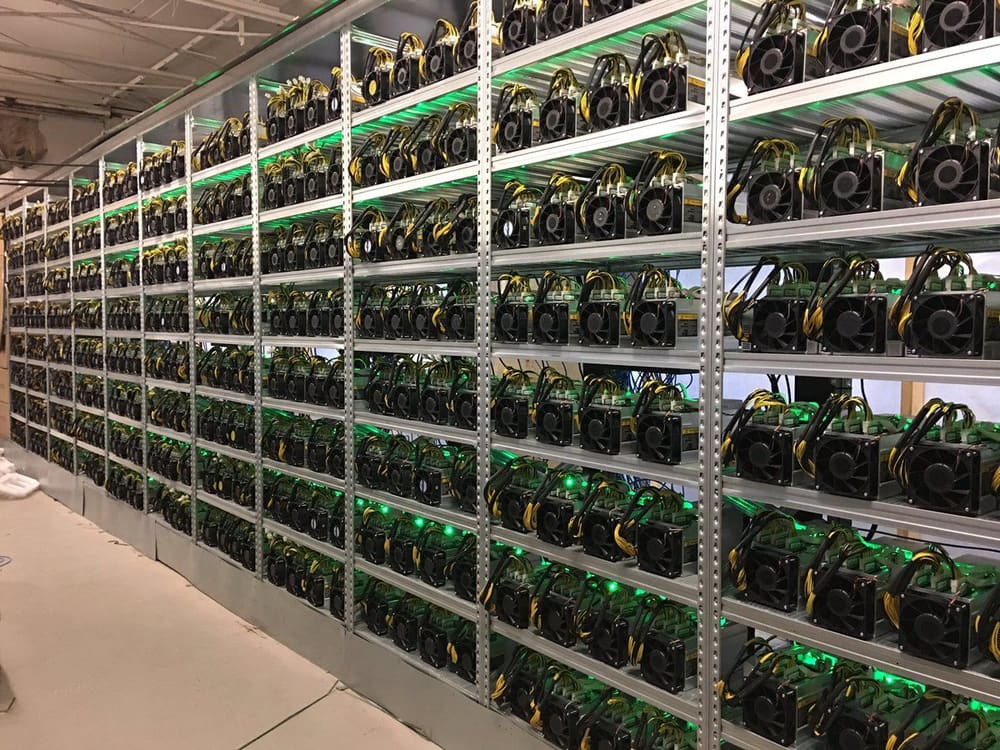
The path from there to here explains almost everything one weighs up about proof of work. First came graphics cards, which perform the same simple operation thousands of times in parallel and proved far faster than processors. Then came FPGAs, programmable circuits. And from 2013, ASICs, application-specific integrated circuits: chips designed to do one thing, SHA-256, and nothing else. A modern ASIC is millions of times more efficient than a processor at that particular job, and entirely useless for anything else.
This had two consequences. Network security soared, since attacking it now requires an industrial quantity of specialised hardware. And mining stopped being something done at home, which led directly to the concentration problem described below.
Some networks tried to prevent this with algorithms designed to resist ASICs, such as Litecoin's Scrypt or Monero's RandomX, which demands a great deal of memory and favours ordinary processors. That resistance has proved difficult to maintain: for most popular networks, sooner or later somebody builds specialised hardware. Monero periodically changes its algorithm for precisely this reason.
The two families of proof of work
Not all proof-of-work protocols share the same shape. They fall into two groups.
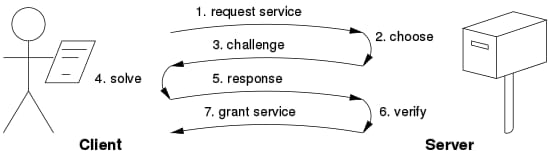
Challenge and response. The provider and the requester communicate directly. The provider sets a challenge, the requester solves it and sends back the answer, the provider verifies and grants the service. Because there is a live connection, the provider can scale the difficulty according to its own load. This is the shape used when a server wants to throttle whoever is talking to it.
Solution verification. No prior connection. The requester sets the problem itself, solves it, and sends problem and solution together. The verifier does two jobs: it checks that the problem was formulated legitimately, and then it checks the solution. This is how Hashcash works, and it is how Bitcoin works.
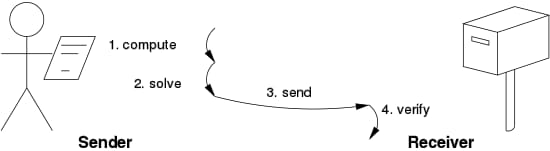
The difference matters more than it appears. Challenge-and-response protocols usually have a known solution within a bounded search space, so solving time does not vary much. Solution-verification protocols like Bitcoin's are probabilistic and unbounded: a miner might find a block in one second or in one hour. That variance is why miners join pools, and why pools became the source of the network's concentration problems.
What it gets right
Security with a price tag. To rewrite transaction history you need more than half the network's computing power, and you need it for as long as the rewrite takes. Not theoretically impossible. Practically extremely expensive, and the cost is public, measurable, and rises along with the network.
Permissionless decentralisation. No authority validates transactions. Anyone, anywhere, can point machines at the problem and take part. There is nobody to apply to, and nobody who can remove you.
Incentives that align themselves. Miners are paid in the asset they secure. Attacking the network devalues the very reward for attacking it. The economics point in the same direction as the security, which is rarer in systems design than it sounds.
Track record. Bitcoin's proof of work has run without interruption since 2009. Whatever its cost, that is the largest live test any consensus mechanism has passed.
When security is not enough: the 51% attack in practice
The 51% attack sounds theoretical when discussed in relation to Bitcoin. It is not. Bitcoin is simply too expensive to attack.
On smaller proof-of-work networks it has happened repeatedly. Ethereum Classic suffered successful chain-reorganisation attacks in 2019 and again, across a series of episodes, during 2020. Bitcoin Gold was attacked in 2018 and 2020, with double spends that cost exchanges millions of dollars.
The pattern is instructive. Both used algorithms shared with larger networks, so an attacker could simply rent hashpower temporarily on the open market and turn it against them. Proof of work's security is not a property of the mechanism; it is a property of scale. A small PoW network can be less secure than a centralised system, not more.
This is also why the question of Bitcoin's security budget, meaning what happens as the subsidy trends toward zero, is not academic.
What it gets wrong
Energy. The criticism is real and there is no honest way to sidestep it. Security comes from work, and work means electricity. Millions of machines burn energy computing hashes that are thrown away. Defenders say the expenditure buys something genuine and increasingly relies on surplus or stranded energy that would otherwise be wasted; critics say the same guarantee is now available for a fraction of the power. It is worth noting that consumption estimates differ significantly from one another, depending on which energy mix and which methodology each assumes, so any specific figure should be read with caution.
Speed. Bitcoin settles a handful of transactions per second. Conventional payment networks handle thousands. Ten-minute blocks and the size limit are deliberate choices in favour of decentralisation, since small blocks mean ordinary computers can still run a full node, but the ceiling is real. Most of the scaling work has moved to layers above the base chain, chiefly the Lightning Network.
Concentration. Anyone can mine, but competitive mining now requires specialised hardware, cheap electricity and scale. Power has accumulated in a few large pools, and in 2014 one pool briefly approached half the network before capping itself voluntarily. The problem has not been solved: in 2026 a few pools still control most of global hashpower. "Permissionless" in theory did not remain evenly distributed in practice.
An important distinction here, because it often gets lost: a pool coordinates hashpower, it does not own it. Individual miners can switch pools at any time, and they have done so when a pool approached a dangerous share. The risk is real but not permanent.
The alternative now exists. In September 2022 Ethereum moved from proof of work to proof of stake and cut its consumption by roughly 99.95%. That transition permanently changed the conversation: the question is no longer whether a chain can be secured differently, but what you give up when you do.
So which is better
The honest answer is that they secure networks in different currencies.
Proof of work is secured by physics: an attacker needs real hardware and real electricity, both bought in the outside world where they are visible. Proof of stake is secured by capital: an attacker must own a large share of the asset, and risks having it destroyed for behaving dishonestly.
There is a subtler difference that is rarely mentioned. Under proof of work, after a successful attack the attacker still owns the hardware and can try again. Under proof of stake, their capital is destroyed. On the other hand, under proof of work the cost of the attack is external, whereas under proof of stake the attacker must first acquire a large portion of the network itself, which drives up its price as they buy.
Proof of work's cost is external and visible. Proof of stake's cost is internal and largely invisible, which is not the same as non-existent. The Bitcoin community treats the physical grounding of proof of work as the whole point and shows no appetite for moving, while most newer chains launched with proof of stake without even considering the alternative.
Anyone claiming the matter is settled is selling something.
Sources
- P: Cynthia Dwork and Moni Naor, "Pricing via Processing or Combatting Junk Mail", 1993
- P: Markus Jakobsson and Ari Juels, "Proofs of Work and Bread Pudding Protocols", 1999
- P: Adam Back, "Hashcash: A Denial of Service Counter-Measure", 1997 and 2002
- P: Satoshi Nakamoto, Bitcoin: A Peer-to-Peer Electronic Cash System, Oct 2008
- P: Bitcoin Developer Reference, block header structure and the nonce field
- P: Bitcoin Wiki, "Block hashing algorithm", nonce and extranonce behaviour
- P: learnmeabitcoin, technical documentation on the nonce field and the mining process
- P: Ethereum Foundation, developer documentation, "Proof-of-work (PoW)" and "The Merge"
- S: Wikipedia, "Proof of work" (source of the two diagrams above)
- S: Wikipedia, "GHash.io"
- S: Reporting on the 51% attacks against Ethereum Classic (2019, 2020) and Bitcoin Gold (2018, 2020)
- S: Pickaxe, Bitcoin network difficulty and hashrate analysis, Aug 2026
- S: Investopedia, "Proof of Work (PoW)"
- S: CoinDesk Learn, "What Is Proof-of-Work?"
- P: Block explorers, hash, nonce, fees and transaction count for block 775,771