

An NFT is a public entry on a blockchain (a shared digital ledger kept by many independent computers). The entry records which address holds a specific, numbered token (a digital unit that moves from address to address). The letters stand for "non-fungible token". Each such token differs from every other one, so its ownership is recorded separately [1].
The problem it tackles is an old one. A digital file can be copied with no loss at all, so the file itself cannot show which copy is the "original" or who holds it. NFTs do not protect the file. They build a register of holders around it that belongs to no single company. The idea became widely known in March 2021, when a token linked to a digital collage sold at auction for $69,346,250 [2].
This article explains where the idea came from and how the standard works. It follows one real token from its creation to its sale, using its transactions on the blockchain. It covers who the holder must trust, what has gone wrong, which misconceptions circulate, and what risks a buyer takes on. The article is for information only and is not investment advice.
The problem it solves
Cryptocurrencies record quantities of identical units: the ledger only needs to know how many each address holds. The authors of the ERC-721 standard wrote that this model falls short for unique items. Ethereum's standard for fungible tokens, ERC-20, is "insufficient", because each unique item is distinct while the units of an ordinary token are identical [1].
Their own examples were not only digital. They listed houses, unique artwork, collectible cards, and even "negative value" assets such as loans [1]. What these share is that each item has to be tracked on its own, not simply counted.
The thought had appeared earlier. In 2012 Meni Rosenfeld described "colored coins": certain bitcoins are "marked" so that they stand for something else, such as certificates, shares, or what he called "smart property" [3]. Two years later, the digital artist Kevin McCoy thought, as he later said, that bitcoin's scarcity mechanism could give digital artists systems of provenance and ownership for their works [4].
What a blockchain can actually guarantee is the entry "address Y holds token X". What that entry means for the file itself is the question that runs through this whole article.
Where the idea came from
Colored coins and names that expire, 2012 to 2014
Rosenfeld's paper Overview of Colored Coins was published on 4 December 2012. It proposed using Bitcoin's existing infrastructure to move items that are not money [3].
The first work usually called an NFT today was not made on Bitcoin but on Namecoin. Namecoin is an early blockchain where users claim and transfer "names", unique combinations of letters and numbers. Ownership of a name expires periodically, and anyone can then claim it again [4]. That detail turns out to be decisive in the story that follows.
Ethereum: CryptoPunks, CryptoKitties and ERC-721, 2017 to 2018
In June 2017 Larva Labs released CryptoPunks: 10,000 small pixel-art characters that, at first, anyone could claim for free by paying the transaction fee [5]. The release date is disputed. Larva Labs gives 23 June 2017 [5]. The researcher David Gerard writes that the first launch took place on 9 June, that on 17 June the company warned holders not to sell, and that a new version of the contract followed [6]. The contract was custom-built, since no standard existed yet. ERC-721 describes it as "partially ERC-20 compatible" [1].
In late 2017 came CryptoKitties, digital cats that users bought and "bred". On 3 December 2017 TechCrunch reported that the game ran on five smart contracts (programs that run inside the blockchain) written by the company Axiom Zen. According to the same report, it accounted for about 15% of Ethereum's traffic [7].
Dieter Shirley, of Axiom Zen, the company behind CryptoKitties, had already published a proposal for a common standard. The first draft is dated 20 September 2017, and the public discussion opened on 22 September. The text already used the abbreviation "NFTs" [8].
The final form is ERC-721, created on 24 January 2018 and written by William Entriken, Dieter Shirley, Jacob Evans and Nastassia Sachs. Its opening line defines it as "a standard interface for non-fungible tokens, also known as deeds" [1]. The authors explain that the term "NFT" was satisfactory to nearly everyone they surveyed. They had also considered "distinguishable asset", "title", "ticket" and other terms [1]. The idea therefore predates cryptocurrency: it is the title deed and the registry, moved into code.
After ERC-721
In June 2018 Witek Radomski and others proposed ERC-1155. Under it, a single contract can manage many token types, fungible or not [9]. According to Radomski, the standard was finalised in June 2019 [10].
ERC-2981 followed. It is a standard that simply declares who should receive creator royalties (a percentage of each resale) and how much. The text itself states that paying them is voluntary [11].
On 20 January 2023 Casey Rodarmor announced that the "inscriptions" of the Ordinals protocol were ready for Bitcoin mainnet (the main, live network). In inscriptions the content itself, an image for example, is written inside the transaction [12].
Quantum: the first NFT and the name that expired
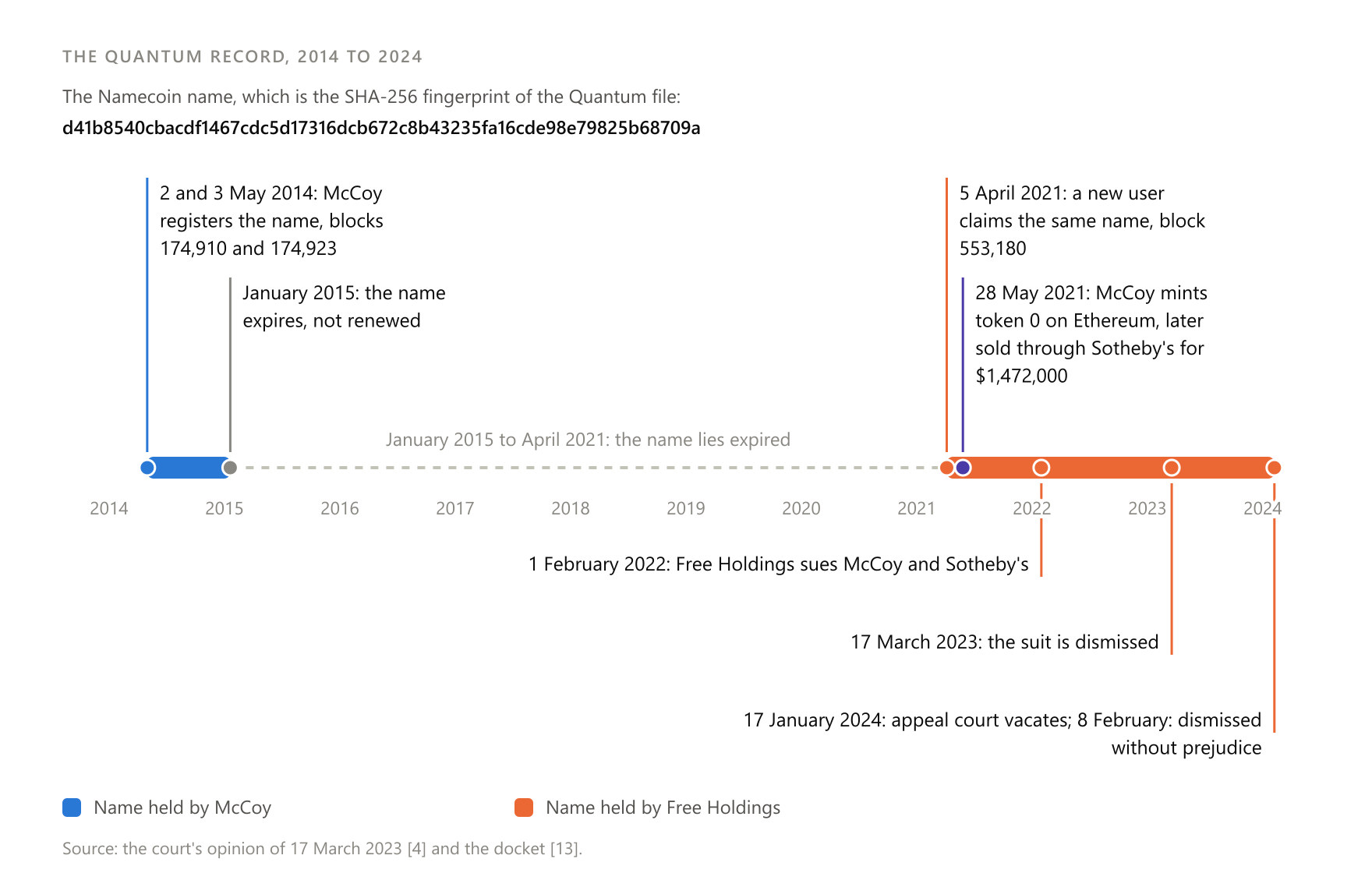
In May 2014 Kevin McCoy registered a moving digital work called Quantum on Namecoin. The court record shows two commands. The first ran on 2 May 2014 at block 174,910. The second, which completed the registration, ran on 3 May at block 174,923 [4]. The name used was the fingerprint of the file itself. The record page stated that what is transferred is "a DEED to property but NOT property itself" [4].
In January 2015 the name expired because it was not renewed. Both sides in the later lawsuit accept this [4]. For six years nothing happened.
On 5 April 2021, at block 553,180, a new user claimed the same name. On 30 April that user wrote into the record a claim of title to the file at a URL on McCoy's website, adding that "title transfers to whoever controls this blockchain entry" [4]. Behind the user was a company, Free Holdings. The company said it had tried to contact McCoy on Twitter and that he had not replied [4].
On 28 May 2021 McCoy created a new token for the same work, this time on Ethereum under ERC-721, with token number 0. Sotheby's presented it as "Originally minted on May 3, 2014 on Namecoin blockchain, and preserved on a token minted on May 28, 2021 by the artist" [4]. The work was auctioned in June 2021 for $1,472,000 [4].
On 1 February 2022 Free Holdings sued McCoy and Sotheby's. It argued that its own Namecoin record was the "first NFT" and that the auction's marketing had harmed it [4]. On 17 March 2023 Magistrate Judge James L. Cott dismissed the suit. He found that the company had not shown standing and that, even if it had, every one of its claims would fail. He described the suit as "an attempt to exploit open questions of ownership in the still-developing NFT field" [4]. The court noted that the Namecoin community holds three interpretations of what a re-registered name is: the same NFT, a new NFT, or a new NFT that carries the old one's history [4].
Free Holdings appealed. On 17 January 2024 the Court of Appeals for the Second Circuit vacated the judgment and sent the case back with directions to dismiss the complaint without prejudice. On 8 February 2024 the complaint was dismissed on that basis [13].
That is what the documents show. What follows is our reading.
The case shows, without any theory, that the token and the work are two different things. Namecoin holds two registrations of the same name, and Ethereum holds a third token for the same file. No blockchain decided which is the "first NFT". People decided, then the auction house, and in the end a court. Our view at CRYPTONEA 24 is that this is not a failure of the technology. It is an exact description of what the technology does: it keeps a register, not a meaning.
How it works, from zero
The analogy: a land registry
Picture a land registry where every property has a number, and next to the number the owner is written down. Beside that there is a note: "the property is located at such-and-such address". An NFT works the same way.
The "book" is a smart contract. The number is the token's identifier, an integer that, under the standard, never changes for as long as the contract exists. The pair "contract address and token number" is unique across the whole network [1].
The contract answers two basic questions: who holds the token with this number, and how many tokens a given address holds. It also carries out transfers [1].
Who can transfer
A transfer can be started by three parties: the holder, an address the holder has approved for that specific token, or an operator (an address the holder has authorised in general). With a single approval, setApprovalForAll, an operator can manage all of the holder's NFTs in that contract [1]. This is how NFT marketplaces work and, as we will see, how many scams work too.
Creating new tokens ("minting") and destroying them are not described in the standard. Each contract implements them as it likes [1].
The note with the address
Where is the image? The standard provides an optional function, tokenURI. It returns an address that leads to a file of metadata (data that describes the token: a name, a description and a link to the image) [1].
The authors state explicitly that this address "MAY be mutable". They rejected storing all metadata on the blockchain as "too expensive" [1]. The metadata schema has no field that confirms the content of the image [1].
The cryptographer Moxie Marlinspike put it this way: in many NFTs the link simply points to a server. Whoever controls that server, or later buys the domain name, can change the image, regardless of who holds the token [14].
The digital fingerprint
One way to "tie" a token to specific content is a hash (a digital fingerprint). An algorithm such as SHA-256 runs over the whole file and produces a short 256-bit value. The value changes completely if even a single bit of the file changes [15].
The IPFS storage network uses this idea as an address: every file is located by an identifier derived from its own content. Whoever downloads it can confirm they received the right file by computing the hash again [16]. IPFS does not, however, guarantee that the file will exist forever. Content stays available only while some node "pins" it, meaning it keeps the content and serves it to the network [16].
Where the analogy breaks down
A land registry rests on laws, notaries and courts that recognise the entry as a title. An NFT has none of these on its own.
The blockchain does not guard the "property". The note with the address can change. Nothing stops someone from opening a second "book" under the same name: any contract can use the same name and symbol as another, and which one is "official" lies outside the standard [1].
There is one more difference: the register is fully public. The authors write that privacy "cannot be attained", because anyone can ask for the holder of every number [1].
One real example: token 40913, step by step
Christie's described the item in its March 2021 auction as token number 40913: a jpg file of 21,069 by 21,069 pixels (319,168,313 bytes), the work EVERYDAYS: THE FIRST 5000 DAYS by the artist Beeple, "Minted on 16 February 2021" [17]. Below is the token's path on Ethereum as shown on Etherscan, a public tool for reading the blockchain.
Step 1: the mint
On 16 February 2021, at 05:58:01 UTC, transaction 0x84760768…ae772b3 was included in block 11,866,040 [18].
It was not sent by Beeple's address but by another one, 0x981F0Bd6…bbD492. That address called a function of the MakersTokenV2 contract, naming Beeple as holder and setting the total supply at a single copy [18]. Who controls that address is not shown in our sources.
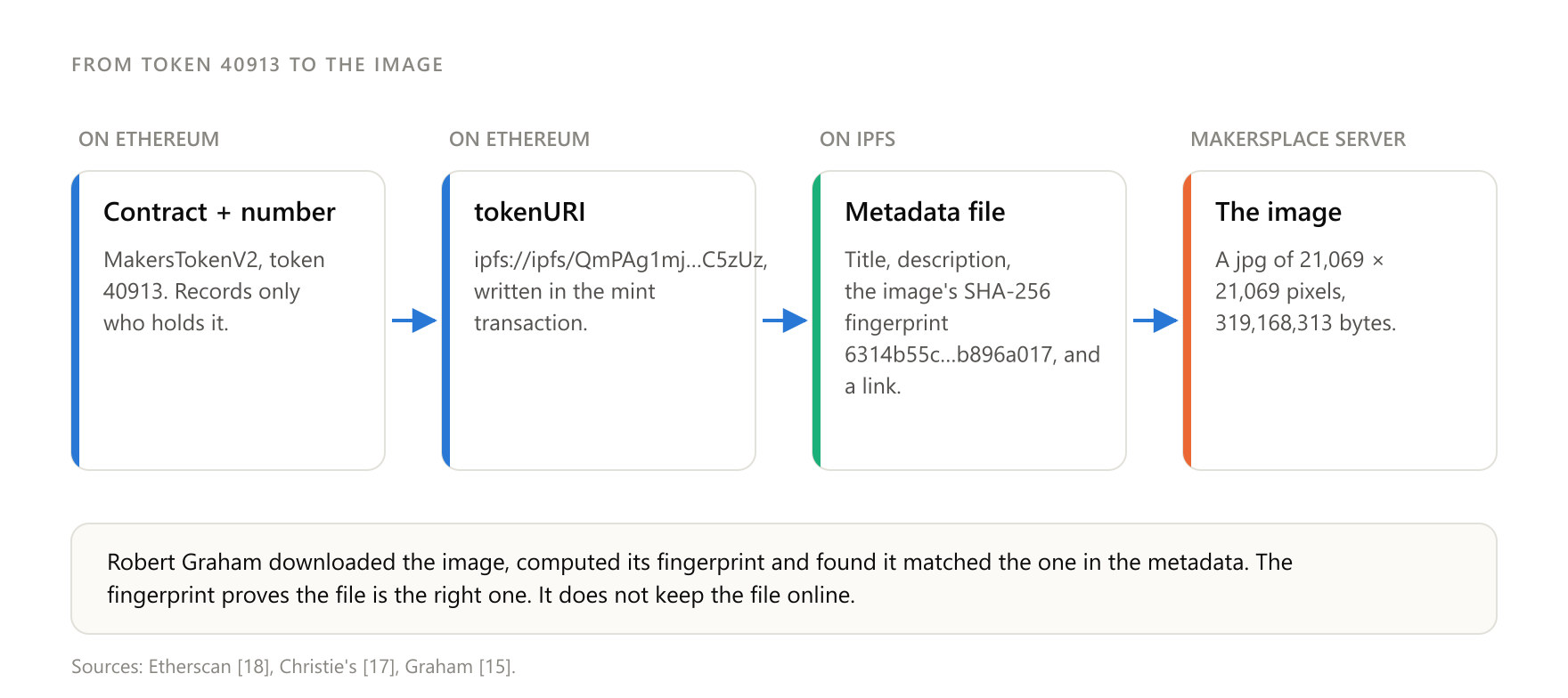
The transaction's log records two things. The first is the tokenURI ipfs://ipfs/QmPAg1mj…C5zUz. The second is a Transfer event from the zero address to Beeple for token 40913, which is how the standard announces that a token has been "born" [18].
The transaction fee is paid in gas (a unit that measures the computational work of a transaction on Ethereum). The fee equals the gas used multiplied by the price per unit, in gwei, which are billionths of an ETH. The mint used 471,905 units of gas at 156 gwei, which comes to 0.07361718 ETH. At that day's ETH price ($1,782.83, as recorded by Etherscan) [18], the cost was about $131.25 (our calculation: 0.07361718 x 1,782.83).
Step 2: what the token points to
The metadata file that tokenURI points to contains the work's title, a description, and a field holding the SHA-256 fingerprint of the image file (6314b55c…b896a017). It also contains a link to the image through a server run by the MakersPlace platform [15].
The security researcher Robert Graham reports that he downloaded the file, computed its fingerprint and found that it matched [15]. The chain, then, runs: token, metadata file on IPFS, fingerprint, image.
Step 3: the first transfer after the auction
On 13 March 2021, at 02:58:09 UTC, transaction 0xa342e9de…b15e5bf was included in block 12,027,619. Beeple called the standard's safeTransferFrom function and sent the token to address 0x58bF1FBe…108C5361A [19].
Inside the transaction the token number appears in hexadecimal as 0x9fd1, which equals 40913 (our calculation). The transfer used 87,371 units of gas at 117 gwei, or 0.010222407 ETH [19]. At $1,921.18 per ETH, that comes to about $19.64 (our calculation).
Only the holder, or someone the holder had authorised, could make this transfer [1]. In practice that means whoever controls the private key (the secret number used to sign every transaction) for Beeple's address [15].
Step 4: the second transfer
At 04:16:33 the same day, transaction 0x01d0967f…72f502d49 in block 12,027,953 sent the token to an address that Etherscan labels "Metakovan", the buyer's pseudonym. It cost 0.014416215 ETH at 165 gwei [20], or about $27.70 (our calculation). Between the two transfers lay 334 blocks, or 1 hour, 18 minutes and 24 seconds (our calculation).
What the blockchain does not show
The hammer price was $60.25 million and, with fees, $69.3 million [21], or exactly $69,346,250 [2]. Christie's accepted payment in Ether only from wallets at specific platforms [17]. Graham writes that the payment could not be found on the blockchain, most likely because it was made by other means [15].
Along this whole path, the blockchain recorded three things: the token's birth and two changes of holder. No image file moved anywhere.
The numbers that matter
| Parameter | Value | What it controls | Who can change it |
|---|---|---|---|
| Token number | 256-bit integer, fixed for the life of the contract [1] | The identity of each NFT | No one, under the standard |
| ERC-721 interface ID | 0x80ac58cd [1] | Lets apps recognise an NFT contract | Fixed, the standard is final |
| ERC-1155 interface ID | 0xd9b67a26 [9] | Contracts with many token types | Fixed |
| tokenURI | "MAY be mutable" [1] | Where the name and image are found | Whoever controls that contract |
| Operator approval | One approval covers all NFTs in a contract [1] | Access for marketplaces, and for attackers | The holder |
| Creator royalties (ERC-2981) | Declared; payment is voluntary [11] | Whether the artist is paid on resales | Each marketplace decides |
| OpenSea fee | 1% on sales, included in the price shown to buyers, and 10% on mints in primary drops. Swaps carry no OpenSea fee. Help page updated 12 May 2026, checked 4 October 2026 [22] | Cost of trading | OpenSea |
| Creator royalties on OpenSea | Optional for new collections since 31 August 2023 [23] | The creator's income | OpenSea |
| Gas in the example | 471,905 for the mint, 87,371 for each transfer [18] [19] | The transaction fee | Depends on the contract's code |
The ERC-721 standard itself has been marked "Final" and does not change [1]. Everything else that matters to a holder, such as the image address, fees and royalties, is decided by the creator of each contract and by the marketplaces.
Who you trust when you hold an NFT
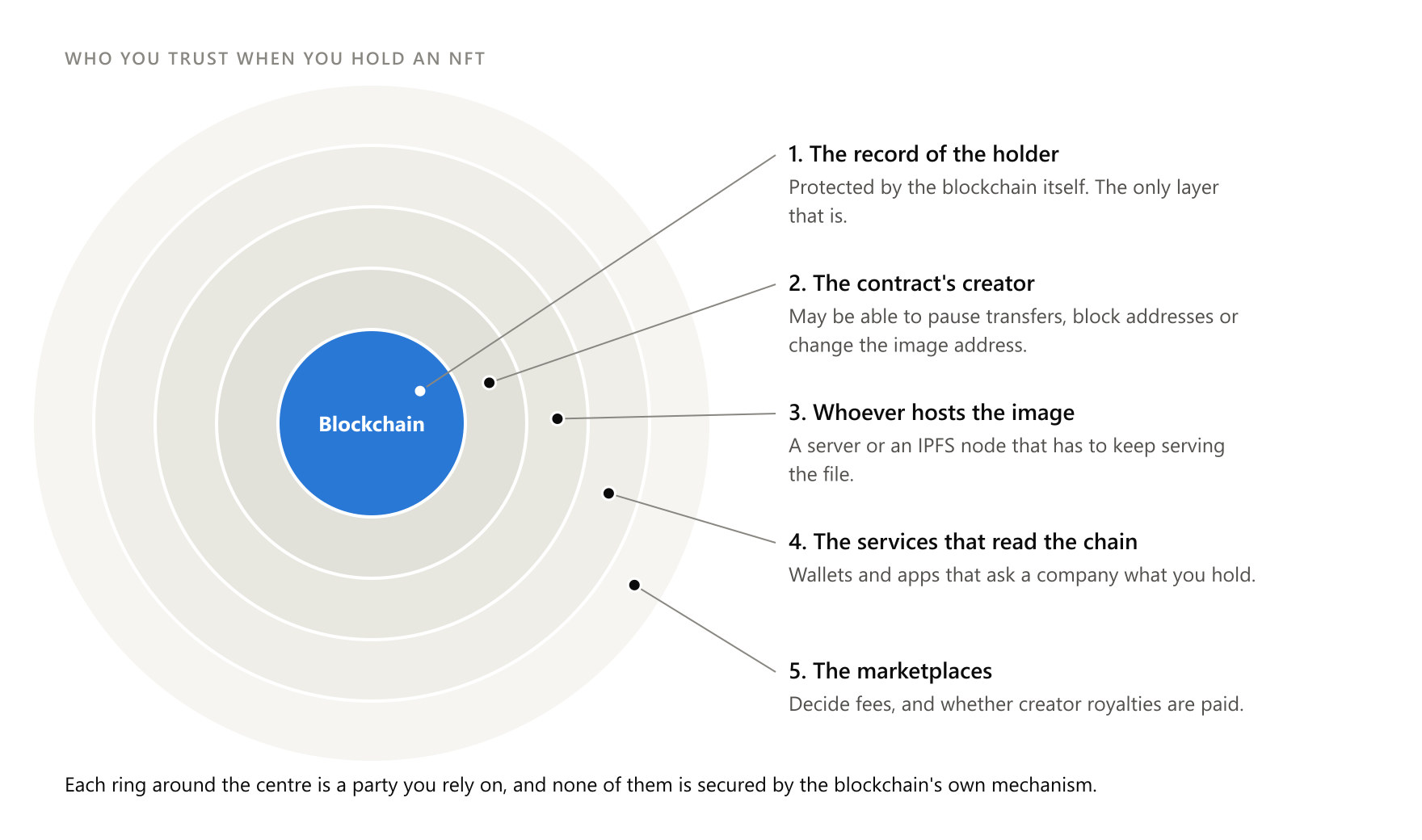
The blockchain solves only one trust problem: who holds which number. Around it sit at least four more layers.
First, the creator of the contract. The standard explicitly allows a contract to pause transfers or block addresses, citing the CryptoKitties contract as prior art [1]. In our example, the mint was carried out by an address other than the artist's [18]. Casey Rodarmor, who built a competing system, argues that "the vast majority" of NFTs have back-door admin keys and content stored off the blockchain [12]. That is the claim of an interested party, not a measurement.
Second, whoever hosts the image. Marlinspike made an NFT that showed a different image depending on who looked at it: one on OpenSea, another on Rarible, and a poop emoji in the buyer's wallet. He noted that this breaks no standard [14].
In January 2025 Nike shut down its RTFKT unit, which had created the CloneX collection [24]. On 24 April 2025 the CloneX images, hosted on Cloudflare, were replaced by a content-restriction notice [25]. They were later restored, and the project's last remaining lead announced a move to the Arweave storage network [24].
Even IPFS, which guarantees that a file has not been altered, needs someone to keep it available [16]. Beeple's image, for example, reaches users through a MakersPlace server [15].
Third, the services that "read" the blockchain. In January 2022 Marlinspike wrote that the MetaMask wallet displayed users' NFTs by querying OpenSea. When OpenSea removed his NFT, it also disappeared from his wallet (the app that holds the keys), even though it was still on the blockchain [14]. That description dates from 2022 and may no longer apply in the same way.
Fourth, the marketplaces. Creator royalties are paid only if the marketplace chooses to pay them [11]. Since August 2023 OpenSea has made them optional [23].
Who runs the pieces of the system
There is no single organisation that "runs NFTs". There are companies, foundations and open protocols that control different pieces.
| Organisation | Role | Legal form and seat | Leadership | Funding |
|---|---|---|---|---|
| OpenSea | NFT marketplace | Ozone Networks, Inc., doing business as OpenSea [26]; seat not confirmed | Co-founder and CEO Devin Finzer (January 2022) [27] | $300 million in January 2022, at a valuation of about $13 billion [27] |
| Metaplex Foundation | Stewards Solana's NFT programs | Director-led memberless foundation in the Cayman Islands, with a U.S. subsidiary [28] | Founder and director Stephen Hess [28] | $46 million round led by Multicoin Capital and Jump Crypto [29] |
| Infinite Node Foundation | Holds the CryptoPunks intellectual property since May 2025 [30] | Nonprofit | Chair Micky Malka [30] | $25 million founding grant [31] |
| Dapper Labs | Created CryptoKitties, the Flow blockchain and the Cadence language [32] | Not confirmed | Not confirmed | Not confirmed |
| IPFS | Open storage protocol | No single operator: content is served by whoever keeps it [16] | Not applicable | Not applicable |
How much they are used
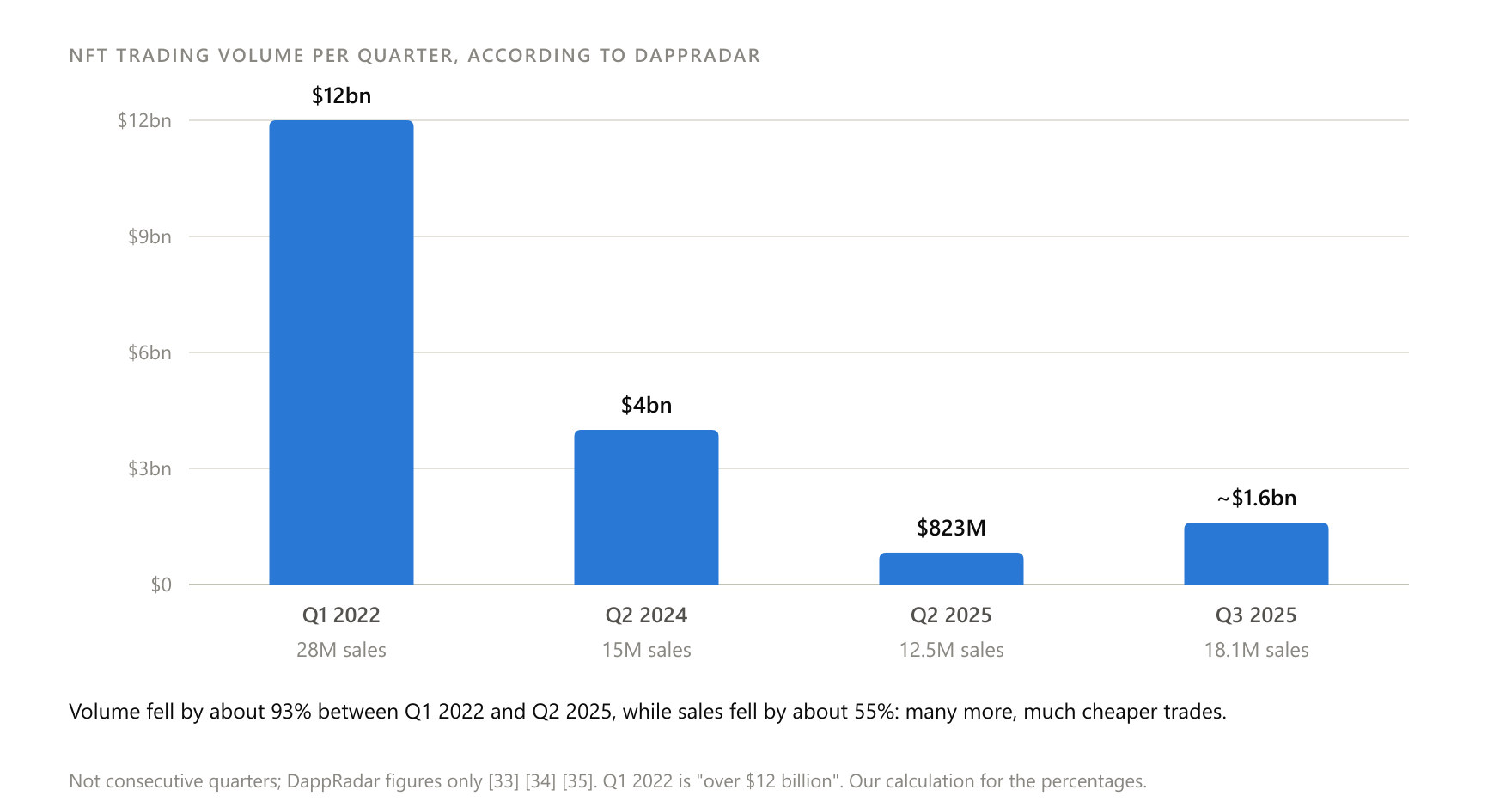
Market data come from two analytics providers, DappRadar and CryptoSlam. In the data we found they cover different periods, so we present them separately and do not compare them directly. We did not find a DappRadar quarterly report for 2026.
| Provider | Period | Trading volume | Sales |
|---|---|---|---|
| DappRadar | Q1 2022 | Over $12 billion [33] | 28 million [33] |
| DappRadar | Q2 2024 | $4 billion [34] | 15 million [34] |
| DappRadar | Q2 2025 | $823 million [34] | 12.5 million [34] |
| DappRadar | Q3 2025 | About $1.6 billion [35] | 18.1 million [35] |
| DappRadar | October 2025 | $546 million [36] | 10.1 million [36] |
| CryptoSlam | Week ending late August 2026 | $63.33 million [38] | Not reported |
| CryptoSlam | Week ending 3 October 2026 | $40.88 million, 23.48% lower than the previous week [37] | Not reported |
Volume in Q2 2025 was about 93% lower than in Q1 2022 (our calculation: 823 million divided by 12 billion is about 6.9%). At the same time, sales became many and cheap. According to DappRadar, the average sale fell from about $321 in January 2025 to $54 in October of the same year [36].
Ethereum remains the largest network by value. In the week ending 3 October 2026 it recorded $17.08 million [37]. CryptoSlam publishes separately the volume it attributes to fake trades. In one week of August 2026, for example, it recorded $35.56 million of "organic" sales on Ethereum plus a further $1.66 million as wash trading [38].
Central controls and changes
ERC-721 will not change, since it is final [1]. There is no single upgrade path for "NFTs", however, because every contract has its own rules.
A contract can give its creator the power to pause transfers, block addresses or change the metadata address [1]. Minting can be carried out by another address that names the artist as holder [18].
Change can also run the other way. In August 2021 Larva Labs announced that the images and attributes of all CryptoPunks had been stored fully on Ethereum [39]. On Solana, the Token Metadata program moves the right to mint new units into a special account. That way no one can mint a second copy outside the program [40].
The versions on each network
| System | Year | Unit of ownership | Where the content lives |
|---|---|---|---|
| Colored coins | 2012 [3] | Marked bitcoins [3] | Off the blockchain |
| Namecoin names | 2014 [4] | A name record that expires [4] | Value on the blockchain, file elsewhere |
| CryptoPunks | 2017 [5] | Custom-built contract [5] | On Ethereum since August 2021, according to Larva Labs [39] |
| ERC-721 | 2018 [1] | One number per contract [1] | Usually an HTTP or IPFS address [1] |
| ERC-1155 | 2018 [9] | Many token types in one contract [9] | One address per type [9] |
| Solana, Token Metadata | Not confirmed | Token with a supply of 1 and zero decimals [41]; locked by a special account [40] | Address pointing to a file off the blockchain [44] |
| Solana, compressed NFTs | 2023 [43] | A leaf of a Merkle tree [42] | Only the root in the network's state; data in its history, read through an indexer [42] [43] [44] |
| Flow | Not confirmed | A resource in the Cadence language [32] | Not confirmed |
| Ordinals | 2023 [12] | A single satoshi [12] | Inside the Bitcoin transaction [12] |
The differences are mainly about where the content lives and who controls the contract. In Solana's compressed NFTs, each NFT's data is turned into a hash and becomes a "leaf" of a Merkle tree (a tree of hashes that sums up a lot of data in a single fingerprint, the "root"). The data is secured by the network's history [42], but only the root stays in its current state [43]. The network's ordinary read commands cannot see these NFTs. A dedicated indexing service is needed [43].
The Ordinals protocol follows the opposite logic: the content is written inside the Bitcoin transaction, with no smart contract [12].
The alternatives and what is traded away
A plain database
The obvious alternative is a company that keeps the register in its own database. Marlinspike argued that OpenSea would be "better" without the web3 parts: faster, cheaper, easier to use. In 2022, to accept a bid on his NFT, he would have paid between $80 and more than $150 in transaction fees [14]. The blockchain provides a register that does not depend on one company. It pays for that in cost and speed.
Fully on the blockchain, or by link
The safest option for the image is to store it inside the blockchain itself. ERC-721's authors judged that "too expensive" [1]. Ordinals and CryptoPunks do it [12] [39], but for small images or at higher cost. Solana offers cheaper minting with compressed NFTs. The cost estimates differ: Solana's developers give about 12,000 SOL for a million ordinary NFTs against about 5 SOL for compressed ones [42]. An independent analysis puts the cost at about 13.5 SOL for a million compressed NFTs [43]. The price is a dependence on indexing services [44].
Energy
Until September 2022 Ethereum ran on proof of work (security through energy-hungry computation). On 15 September 2022 it switched to proof of stake (security through locked-up capital). The project's official website, ethereum.org, estimates that energy consumption fell by about 99.95% [45].
Estimates of current consumption differ. The Crypto Carbon Ratings Institute (CCRI) models it at about 0.0026 TWh a year, or 2.6 GWh (our calculation), and the reduction at more than 99.988% [46]. That study was commissioned by the company ConsenSys [47]. The Cambridge Centre for Alternative Finance calculates about 7.87 GWh a year, roughly 0.90 MW of continuous power, "more than 99.9%" below the level before the switch [48]. Its model's range runs from 1.26 to 11.49 GWh [49]. The same study gives about 13.48 GWh a year for Solana, based on CCRI data [49].
The estimates diverge because the studies use different methods and dates. For NFTs minted before 2022, the environmental cost of the proof-of-work era remains part of their history.
Congestion
A popular project burdens every user of the network. In December 2017 CryptoKitties raised its own fee for "birthing" a cat from 0.001 to 0.002 ETH because of congestion [7].
| Approach | Where the register lives | Where the content lives | What is traded away |
|---|---|---|---|
| A company's database | With the company | With the company | Independence from the operator |
| ERC-721 with an HTTP link | Blockchain [1] | On a server [14] | Permanence and integrity of the image |
| ERC-721 with IPFS | Blockchain [1] | IPFS, while someone keeps it [16] | Availability without a custodian |
| Fully on the blockchain | Blockchain [39] | Blockchain [39] | Cost and file size [1] |
| Solana compressed NFTs | Root in the network's state [43] | Off the blockchain [44] | Dependence on indexers [43] |
| Ordinals | Bitcoin [12] | Inside the transaction [12] | Space in Bitcoin's blocks |
What has gone wrong
January 2015 to February 2024: the name that expired
Quantum's Namecoin record expired in 2015 because it was not renewed. It was re-registered by a third party in 2021 [4]. The dispute went to court, and the case closed on 8 February 2024 with the complaint dismissed [13].
June 2017: the CryptoPunks relaunch
CryptoPunks had to be issued again, under a new contract, a few days after their first release [6]. The exact technical cause is not documented in the sources we checked.
December 2017: CryptoKitties congestion
The game took about 15% of Ethereum's traffic, and transactions were delayed for everyone [7]. At least one company briefly postponed the public sale of its tokens for this reason [50]. The problem eased as demand fell.
January 2022: an NFT that vanished from the wallet
Marlinspike made an NFT whose image changed depending on the viewer. OpenSea removed it without explanation, and from then on it no longer appeared in his wallet, even though its record remained on the blockchain [14]. The design issue it exposed has not been solved at the level of the standard.
February 2022: fake trades
On 2 February 2022 the analytics firm Chainalysis published its findings on wash trading (when a seller sells to themselves to make an item look in demand and valuable). The firm identified 262 users who had sold an NFT more than 25 times to addresses they had funded themselves.
Of these, 110 made a combined $8,875,315, 152 lost $416,984, and the group as a whole made $8,458,331. The most active of them made 830 such sales and still ended up $8,383 down because of fees. The analysis covered only trades in ETH and WETH [51].
20 February 2022: phishing at OpenSea
OpenSea's chief executive reported that 32 users had signed a malicious payload sent by an attacker, and that some of their NFTs had been stolen [52]. The attacker had gathered about $1.7 million in ETH from selling them. Some NFTs were returned [53]. For the remaining NFTs, our sources report no outcome.
April 2022: reselling the first tweet
The NFT of Jack Dorsey's first tweet had been bought in March 2021 for $2.9 million [54]. On 6 April 2022 its holder listed it for about $48 million [55]. According to CoinDesk, the auction closed with seven offers, the highest about $277 [54]. Fortune reported a highest offer of $6,200 at the time of its own publication [55]. The top bid reported by CoinDesk equals about 0.01% of the purchase price (our calculation: 280 divided by 2,900,000).
25 April 2022: the Bored Ape Yacht Club Instagram account
Attackers took over the collection's official Instagram account and posted a link to a fake giveaway of free "land" in an upcoming game. Users who connected their wallets and approved the transaction lost 91 NFTs in total. Their value, based on the collections' floor prices, was at least $2.8 million [56]. Yuga Labs estimated the loss at about $3 million [57].
The collection's co-founder stressed that the account had two-factor authentication enabled [56]. Sources disagree on the exact number of Mutant Ape NFTs stolen: six according to the co-founder, seven according to an independent investigator [56] [57].
August 2023: the end of mandatory creator royalties
OpenSea announced that from 31 August 2023 creator royalties would be optional for new collections. Enforcement for existing collections that used its enforcement tool continued until 29 February 2024. The company explained that other marketplaces used its own Seaport contract. That made it technically impossible to block them without also blocking the marketplaces that did pay royalties [23].
Yuga Labs' chief executive, Daniel Alegre, replied that "Yuga believes in protecting creator royalties so creators are properly compensated for their work" [58]. Yuga Labs announced that it would stop supporting Seaport in its upgradeable contracts and new collections by February 2024 [59].
January and April 2025: the CloneX images
After RTFKT closed, the CloneX images were temporarily replaced by a restriction notice from the hosting service [24] [25]. The images were restored, and a move to decentralized storage was announced [24].
Common misconceptions
"Buying the NFT means buying the image"
Graham summed up what the buyer of token 40913 acquired: the ability to transfer it to someone else. Not the artwork and not the copyright [15]. Quantum's 2014 record said the same thing: the "deed", not the "property" [4].
Chainalysis, by contrast, writes that NFTs "typically give the holder ownership over the data or media" the token is associated with [51]. The real answer depends on the terms of each project, not on the technology.
"The image is stored on the blockchain"
Usually not. The standard provides a link, and its authors judged full storage too expensive [1] [14]. Exceptions exist, such as CryptoPunks after 2021 [39] and Ordinals inscriptions [12].
"The NFT makes the artwork unique"
Anyone can mint another token pointing to the same file [15]. Quantum has records on two blockchains, and its Namecoin name was registered in turn by two different parties [4]. What is unique is the number inside the contract, not the file.
"Holding the token means controlling the collection"
The intellectual property of the CryptoPunks collection changed hands twice: in March 2022 to Yuga Labs and in May 2025 to the Infinite Node Foundation [30]. Those sales did not involve the tokens themselves, which move only with the signature of their holder or someone the holder has authorised [1].
"NFT means digital art"
The standard was written from the start for houses, cards and loans too [1].
"Recorded prices show the value"
Fake trades can inflate the price history [51], and a past price does not guarantee a buyer [54].
The open questions
Decentralization that re-centralizes
Moxie Marlinspike argues that users do not run their own servers. So wallets and apps ask a handful of companies what is on the blockchain, without verifying the answers. The result, in his view, is a system with central control that also moves as slowly as any decentralized protocol [14].
What the buyer actually holds
Robert Graham concludes that the link between the token and the artwork exists "in people's minds" rather than in code [15]. This criticism has no technical answer. It can only be answered with contracts and laws outside the blockchain.
Enforcing creator royalties
The standard makes them voluntary [11]. OpenSea argued that its enforcement tool could not work because the rest of the ecosystem did not adopt it [23]. Yuga Labs replied that protecting creators is a precondition [58]. The question remains open.
The permanence of an NFT
Rodarmor argues that only NFTs that are decentralized, immutable, on-chain and unrestricted deserve to be called "digital artifacts" [12]. ERC-721's authors chose links precisely because full storage is costly [1]. The balance between cost and permanence has not been settled.
The risks for the reader
The biggest practical risk is not technical but the signature. With a single approval, an address can gain the right to move all of your NFTs in a contract [1]. The thefts at OpenSea and the Bored Ape Yacht Club happened because users signed or approved something they did not understand [52] [56]. Treat every signature request from an unknown website as a possible scam, even when the link comes from an official account. The same applies to any request to enter your recovery phrase (the words that restore a wallet) anywhere other than on your own device.
Transfers cannot be reversed. The standard warns that with the transferFrom function, an NFT sent to an address that cannot handle it "MAY BE PERMANENTLY LOST" [1].
The image can change or disappear if the link leads to a server someone controls or stops paying for [14] [24]. A platform can withdraw an NFT from its display, and that can affect how it appears in wallets [14]. The contract may give its creator powers such as freezing transfers or changing metadata [1].
The market can be thin. Price history may include fake trades [51] [38], and what someone paid does not guarantee there will be a next buyer [54]. Holding the token usually does not transfer copyright [15]. Finally, the rules governing digital assets can change.
Sources
- P: William Entriken, Dieter Shirley, Jacob Evans, Nastassia Sachs, ERC-721: Non-Fungible Token Standard, eips.ethereum.org/EIPS/eip-721, January 2018
- P: Christie's, Beeple: The First 5000 Days, onlineonly.christies.com.cn/s/beeple-first-5000-days/overview/2020, March 2021
- P: Meni Rosenfeld, Overview of Colored Coins, bitcoil.co.il/BitcoinX.pdf, December 2012
- P: U.S. District Court for the Southern District of New York, Free Holdings Inc. v. McCoy and Sotheby's, Opinion and Order, 22-CV-881 (JLC), nysd.uscourts.gov/sites/default/files/2023-03/Free%20Holdings%20vs%20mccoy.pdf, March 2023
- P: Larva Labs, CryptoPunks, larvalabs.com/cryptopunks, undated (project source)
- S: David Gerard, The early history of NFTs, part 4: Game sprites on the blockchain: CryptoPunks, davidgerard.co.uk/blockchain/2022/06/16/the-early-history-of-nfts-part-4-game-sprites-on-the-blockchain-cryptopunks/, June 2022
- S: TechCrunch, People have spent over $1M buying virtual cats on the Ethereum blockchain, techcrunch.com/2017/12/03/people-have-spent-over-1m-buying-virtual-cats-on-the-ethereum-blockchain/, December 2017
- P: GitHub (ethereum/EIPs), Issue #721: ERC: Non-fungible Token Standard, github.com/ethereum/EIPs/issues/721, September 2017
- P: Witek Radomski et al., ERC-1155: Multi Token Standard, eips.ethereum.org/EIPS/eip-1155, June 2018
- P: Enjin, Witek Radomski, ERC-1155: The Final Token Standard on Ethereum, enjin.io/blog/erc-1155-token-standard-ethereum, June 2019 (project source)
- P: ERC-2981: NFT Royalty Standard, eips.ethereum.org/EIPS/eip-2981, undated
- P: Casey Rodarmor, Inscribing Mainnet, rodarmor.com/blog/inscribing-mainnet/, January 2023 (project source)
- S: PacerMonitor, Free Holdings Inc. v. McCoy et al, 1:22-cv-00881, pacermonitor.com/public/case/43419771, February 2024
- S: Moxie Marlinspike, My first impressions of web3, moxie.org/2022/01/07/web3-first-impressions.html, January 2022
- S: Robert Graham (Errata Security), Deconstructing that $69million NFT, blog.erratasec.com/2021/03/deconstructing-that-69million-nft.html, March 2021
- P: IPFS Docs, The lifecycle of data in IPFS, docs.ipfs.tech/concepts/lifecycle, undated (project source)
- P: Christie's, Beeple (b. 1981), EVERYDAYS: THE FIRST 5000 DAYS, onlineonly.christies.com.cn/s/beeple-first-5000-days/beeple-b-1981-1/112924, February 2021
- P: Etherscan, Transaction 0x84760768…ae772b3, etherscan.io/tx/0x84760768c527794ede901f97973385bfc1bf2e297f7ed16f523f75412ae772b3, February 2021
- P: Etherscan, Transaction 0xa342e9de…b15e5bf, etherscan.io/tx/0xa342e9de61c34900883218fe52bc9931daa1a10b6f48c506f2253c279b15e5bf, March 2021
- P: Etherscan, Transaction 0x01d0967f…72f502d49, etherscan.io/tx/0x01d0967faaaf95f3e19164803a1cf1a2f96644ebfababb2b810d41a72f502d49, March 2021
- S: The Art Newspaper, Beeple NFT work sells for astonishing $69.3m at Christie's after flurry of last-minute bids nearly crashes website, theartnewspaper.com/2021/03/11/wtaf-beeple-nft-work-sells-for-astonishing-dollar693m-at-christies-after-flurry-of-last-minute-bids-nearly-crashes-website, March 2021
- P: OpenSea Help Center, What fees do I pay on OpenSea?, support.opensea.io/en/articles/8867091-what-fees-do-i-pay-on-opensea, May 2026 (project source)
- P: OpenSea, Changes to creator fees on OpenSea, opensea.io/blog/articles/on-creator-fees, August 2023 (project source)
- S: Cointelegraph, RTFKT's CloneX avatars reappear after issue blacks out NFTs, cointelegraph.com/news/rtfkt-clone-x-avatars-visible-again-after-cloudflare-issue, April 2025
- S: TechSpot, Nike faces $5M lawsuit after CloneX NFTs go dark due to hosting error, techspot.com/community/topics/nike-faces-5m-lawsuit-after-clonex-nfts-go-dark-due-to-hosting-error.291981/, April 2025
- P: OpenSea, Terms of Service, opensea.io/tos, September 2025 (project source)
- S: The Block, OpenSea raises $300 million at $13 billion valuation, with backing from Coatue and Paradigm, theblock.co/post/129250/opensea-eyeing-raise-that-would-value-it-at-13-billion-with-backing-from-coatue-and-paradigm-sources, January 2022
- S: Blockworks, Token Transparency: Metaplex, H1 2026, blockworks.com/token-transparency/filing/metaplex, 2026
- S: Blockworks, Metaplex Foundation Closes $46M Funding Round, blockworks.com/metaplex-foundation-closes-46m-funding-round/, undated
- S: The Block, Yuga Labs sells CryptoPunks IP to nonprofit Infinite Node Foundation, theblock.co/post/354114/yuga-labs-sells-cryptopunks-ip-to-nonprofit-infinite-node-foundation, May 2025
- S: The Defiant, Yuga Labs Sells CryptoPunks IP to Infinite Node Foundation, thedefiant.io/news/nfts-and-web3/yuga-labs-sells-cryptopunks-ip-to-infinite-node-foundation, May 2025
- S: Quantstamp, Securing the Flow Ecosystem, quantstamp.com/blog/securing-the-flow-ecosystem, 2021
- S: DappRadar, NFT financials falling in Q3 but on-chain metrics remain bullish, dappradar.com/blog/nft-financials-falling-in-q3-but-on-chain-metrics-remain-bullish, 2022
- S: Decrypt, Cheaper NFTs Mean Sales Are Surging, But Trading Volume is Plummeting: DappRadar, decrypt.co/328668/cheaper-nfts-mean-sales-are-surging-but-trading-volume-is-plummeting-dappradar, July 2025
- S: CryptoPotato, NFTs Are Back: DappRadar Reports Record 18 Million Sales in 2025's Biggest Market Comeback, cryptopotato.com/nfts-are-back-dappradar-reports-record-18-million-sales-in-2025s-biggest-market-comeback/, October 2025
- S: DappRadar, Over 10 Million NFTs Sold as Web3 Moves Beyond JPEGs, dappradar.com/blog/over-10-million-nfts-sold-as-web3-moves-beyond-jpegs, November 2025
- S: The Cryptonomist, NFT sales trends drop 23.48% to $40.88M as Panini America surges 557%, en.cryptonomist.ch/2026/10/03/nft-sales-trends/, October 2026
- S: crypto.news, NFT sales fall 44.7% to $63.3M as Ethereum leads, crypto.news/nft-sales-fall-44-7-to-63-3m-as-ethereum-leads/, August 2026
- P: Larva Labs, On-chain Cryptopunks, larvalabs.com/writing/2021-8-18-18-0/on-chain-cryptopunks, August 2021 (project source)
- P: Metaplex, Token Metadata: Overview, metaplex.com/docs/smart-contracts/token-metadata, undated (project source)
- P: Metaplex, SPL Tokens and Token Programs, metaplex.com/docs/solana/spl-tokens-and-token-programs, 2026 (project source)
- P: Solana Developers, compressed-nfts, github.com/solana-developers/compressed-nfts, undated (project source)
- S: Spark, Solana State Compression: How Compressed Accounts Cut Payment Application Costs 1000x, spark.money/research/solana-payment-state-compression-costs, undated
- S: QuickNode, What Is the Metaplex DAS API?, quicknode.com/docs/solana/solana-das-api, undated
- P: ethereum.org, The Merge, ethereum.org/roadmap/merge, undated (project source)
- P: ethereum.org, Ethereum energy consumption, ethereum.org/en/energy-consumption/, undated (project source)
- S: Decrypt, Ethereum Energy Use, Carbon Footprint Down 99% After Merge, decrypt.co/109848/ethereum-energy-carbon-footprint-down-99-percent-merge, September 2022
- P: Cambridge Centre for Alternative Finance, Ethereum After the Merge: A Change in Power, jbs.cam.ac.uk/faculty-research/centres/alternative-finance/publications/ethereum-after-the-merge-a-change-in-power/, 2026
- S: ForkLog, Cambridge Centre for Alternative Finance estimates Ethereum energy use after The Merge, forklog.com/en/?p=100151, 2026
- S: CoinDesk, ICO Delayed by Ethereum's CryptoKitties Congestion, coindesk.com/markets/2017/12/05/ico-delayed-by-ethereums-cryptokitties-congestion, December 2017
- S: Chainalysis, Crime and NFTs: Chainalysis Detects Significant Wash Trading and Some NFT Money Laundering In this Emerging Asset Class, chainalysis.com/blog/2022-crypto-crime-report-preview-nft-wash-trading-money-laundering/, February 2022
- S: CoinDesk, OpenSea Investigating 'Exploit Rumors' as Users Complain of Missing NFTs, coindesk.com/business/2022/02/20/opensea-investigating-exploit-rumors-as-users-complain-of-missing-nfts, February 2022
- S: Fortune, OpenSea co-founder says phishing attacker made $1.7 million in crypto from selling stolen NFTs, fortune.com/2022/02/21/opensea-co-founder-phishing-attacker-crypto-selling-stolen-nfts, February 2022
- S: CoinDesk, 'Jack Dorsey's First Tweet' NFT Went on Sale for $48M. It Ended With a Top Bid of Just $280, coindesk.com/business/2022/04/13/jack-dorseys-first-tweet-nft-went-on-sale-for-48m-it-ended-with-a-top-bid-of-just-280/, April 2022
- S: Fortune, The auction for an NFT of Jack Dorsey's first tweet, listed at $48 million, closed with a high bid of just $280, fortune.com/2022/04/14/jack-dorsey-nft-first-tweet-auction-plunge-value-drop, April 2022
- S: The Block, Bored Ape Instagram account hacked: NFTs worth $2.8 million stolen, theblock.co/post/143328/bored-ape-instagram-account-hacked-nfts-worth-2-8-million-stolen, April 2022
- S: Decrypt, Bored Ape Yacht Club Instagram hacked, Ethereum NFTs stolen, decrypt.co/98614/bored-ape-yacht-club-instagram-hacked-ethereum-nfts-stolen, April 2022
- S: The Art Newspaper, OpenSea NFT marketplace ending resale royalties policy, theartnewspaper.com/2023/08/23/opensea-nft-marketplace-ending-resale-royalties-policy, August 2023
- S: CryptoSlate, Yuga Labs of Bored Apes fame draws away from OpenSea over royalty fee policy, cryptoslate.com/yuga-labs-of-bored-apes-fame-draws-away-from-opensea-over-royalty-fee-policy/, August 2023
This article is educational and for general information. The facts in crypto move quickly, so verify them before you act on anything here. This is not financial advice.