
Midnight is a blockchain (a public ledger of transactions kept jointly by many computers) built to protect sensitive data. It was announced on 18 November 2022 by Input Output Global (IOG), with its chief executive Charles Hoskinson on stage [1]. The first block of the main network was created on 17 March 2026, and the mainnet (the main, "live" network) opened on 30 March 2026 [2]. The network's native token (a digital unit of value) is called NIGHT and has a fixed total supply of 24 billion [2].
The problem it wants to solve is an old one. On most public blockchains everything is visible: who paid whom, how much and when. That transparency lets everyone check that nobody is cheating, but it also exposes financial details, medical records and trade secrets. According to the project itself, this makes the major public blockchains unsuitable for many real-world uses [2].
The difficulty is that the network has to verify a transaction without seeing what is in it. Midnight's tool for this is zero-knowledge proofs: cryptographic proofs that something is true which reveal no additional information [2][3].
This article explains where Midnight comes from, how NIGHT was distributed, how the ledger, transactions and fees work, who produces blocks, who makes decisions, and what has already gone wrong. It is informational and is not investment advice.
Where it started: the research before the network
Midnight's technical roots lie in a 2021 research paper titled "Kachina: Foundations of Private Smart Contracts". It was written by Thomas Kerber, Aggelos Kiayias and Markulf Kohlweiss and presented at the IEEE Computer Security Foundations Symposium (CSF), held from 21 to 25 June 2021 [4]. The paper proposed a single security model for private smart contracts (programs that run automatically on a blockchain) and, as an example, used it to build a private payment system along the lines of Zerocash [4]. The paper's page at the University of Edinburgh links it to the research programme PRIViLEDGE ("Privacy in Distributed Ledgers"), which was funded by European Union bodies and led by Kiayias [4].
In January 2022 the paper "Minotaur: Multi-Resource Blockchain Consensus" was filed on the Cryptology ePrint archive [5]. Its seven authors come from IOG, universities and a research institute. They include Matthias Fitzi of IOG and Aggelos Kiayias, who lists both the University of Edinburgh and IOG [5]. The paper was published at ACM CCS 2022 and, according to its acknowledgements, was supported in part by the US National Science Foundation and the US Army Research Office [5]. It describes how a network can combine different security "resources", such as computing power and locked-up tokens, into a single mechanism [5]. It returns later in this article, because it is part of Midnight's future plans.
Who paid for development as a whole is not set out in any published accounts. IOG is the research and development company behind Cardano, and Hoskinson has said he put about $200 million of his own money into subsidising Midnight's development, with IOG handling the technical work [6].
The launch: a distribution without a sale
NIGHT was not sold at any stage of its initial distribution. The issue price was zero, no money was raised, and the tokens were handed out for free [7].
The first phase was called the Glacier Drop. It was based on a "snapshot" of balances on eight networks, taken retroactively with a date of 11 June 2025: Cardano, Bitcoin, Ethereum, Solana, the XRP Ledger, BNB Chain, Avalanche and Brave [7]. The date was chosen to fall before the whitepaper was published, so that anyone with inside knowledge could not prepare for it [7]. To qualify, an address had to hold at least $100 worth of its network's native coin, be in the user's own custody rather than on an exchange, and not appear on sanctions lists [7][8]. 50% of the supply was set aside for Cardano holders, 20% for Bitcoin holders, and the rest was split among the other networks in proportion to the value of the holdings [7]. The same person could claim with several addresses [7].
The claim window ran from 5 August to 20 October 2025. According to the project, more than 3.5 billion NIGHT were claimed by more than 170,000 addresses, while exchanges including Kraken, OKX, Bitpanda and NBX received allocations to pass on to their customers [8].
The second phase, the Scavenger Mine, was open to anyone with an internet connection and an ordinary computer [8]. Participants solved computational tasks through the project's claim website [7]. The phase lasted 21 days and ended on 19 November 2025. The project's own sources disagree on the start date: the whitepaper gives 29 October [2], while the guide published in December gives 30 October [8]. Because of the turnout, the phase's allocation was raised from 626 million to 1 billion NIGHT, split equally across the 21 days [8]. The project reports more than 8 million unique addresses [8]. That figure counts addresses, not people, and the project does not publish how many different individuals are behind them.
The larger pool had to come from somewhere. According to the issuer's regulatory whitepaper, it came out of the tokens originally meant for Lost-and-Found, the third phase for those who missed their claim. The same cut also funded an extra 60 million NIGHT for Midnight TGE Ltd, the company that issued the token [7]. The December 2025 launch guide adds that tokens originally meant for the Reserve (the amount set aside for block production rewards) and for the treasury (the network's common fund) were redirected to TGE, so that exchanges could pass NIGHT on to their customers [8]. The result: the Reserve fell from 7.2 to 6 billion NIGHT, TGE's share rose from 2.4 to 3.66 billion, and Lost-and-Found shrank from 626 million to about 252 million [8], and then to 192.6 million in the May 2026 edition of the whitepaper [2].
All 24 billion NIGHT were created (minted) on Cardano on 25 November 2025, in a single minting transaction [2][9]. According to the launch guide, on 4 December 2025 they were transferred to the core recipients and to the redemption contracts [8]. From 10 December 2025, claimed tokens have been "thawing" in four instalments of 25% each: the first falls on a random day within the first 90, and the rest follow every 90 days [7]. Trading began on Kraken on 9 December 2025 [10].
The network itself started out fairly centralised. The first block (the genesis block) was created on 17 March 2026 at 03:17:00 UTC, and the mainnet opened on 30 March 2026 [2]. From day one, blocks have been produced by 13 selected nodes in a federated model (one with pre-selected participants). The Midnight Foundation runs two of them, contracts and pays the operators of the rest, and these nodes receive no NIGHT rewards [7]. Nine companies have been named as node operators: Worldpay, Bullish, MoneyGram, Pairpoint by Vodafone, eToro, AlphaTON Capital, Google Cloud, Blockdaemon and Shielded Technologies [6]. The documents we examined do not explain how the remaining nodes up to 13 are allocated.
A change few people remember: from sidechain to partner chain
When IOG presented Midnight on 18 November 2022, at its ScotFest event at the University of Edinburgh, it described it as a sidechain of Cardano: a secondary chain that would "inherit" Cardano's security and decentralisation [1]. The same announcement said developers would start writing smart contracts in TypeScript, and that IOG was funding a zero-knowledge research lab led by Markulf Kohlweiss [1].
A year later the description changed. On 3 November 2023, after the Cardano Summit, IOG published a post signed by Mike Ward announcing a new framework for partner chains: independent blockchains that work alongside Cardano on their own infrastructure [11]. Midnight would be the first to use it [11]. The framework would be built on Substrate, an open-source toolkit from Parity Technologies, and according to IOG it was the product of more than four years of research [11]. The post promised that Cardano's stake pool operators (the operators of the nodes that secure it) would provide security, that the Minotaur mechanism would let validators (the nodes that check and produce blocks) from other ecosystems contribute, and that "trustless bridges" would connect partner chains to Cardano and to other networks [11].
The network that launched in 2026 largely matches that description. Midnight's node is built on the Polkadot SDK (Substrate) and uses Partner Chain components to connect to Cardano [12]. The whitepaper describes the "Babel Station", a future service for paying for transactions with other tokens, or even with government-issued money [2]. Participation by stake pool operators is planned for later [2]. The "multi-resource" consensus mechanism is still described as a future plan [3][7]. The protocol's official bridge will at first work in one direction only, from Cardano to Midnight, with a two-way bridge expected after launch [2].
That is what the documents show. What follows is our reading.
The move from "sidechain" to "partner chain" was more than a change of name. The Midnight of 2022 was presented as an extension of Cardano. The Midnight of 2023 acquired its own chain, its own token and its own consensus mechanism, with Cardano as a partner. Most of the 2023 plan was delivered. Two pieces, however, remain plans: block production by stake pool operators, and the mechanism that would open consensus to other networks. Those are exactly the pieces that would make the network more open. And the trustless bridges IOG promised in 2023 had not arrived when, in July 2026, a third-party bridge for NIGHT was attacked, as we describe below.
The ledger: a public side and a private side
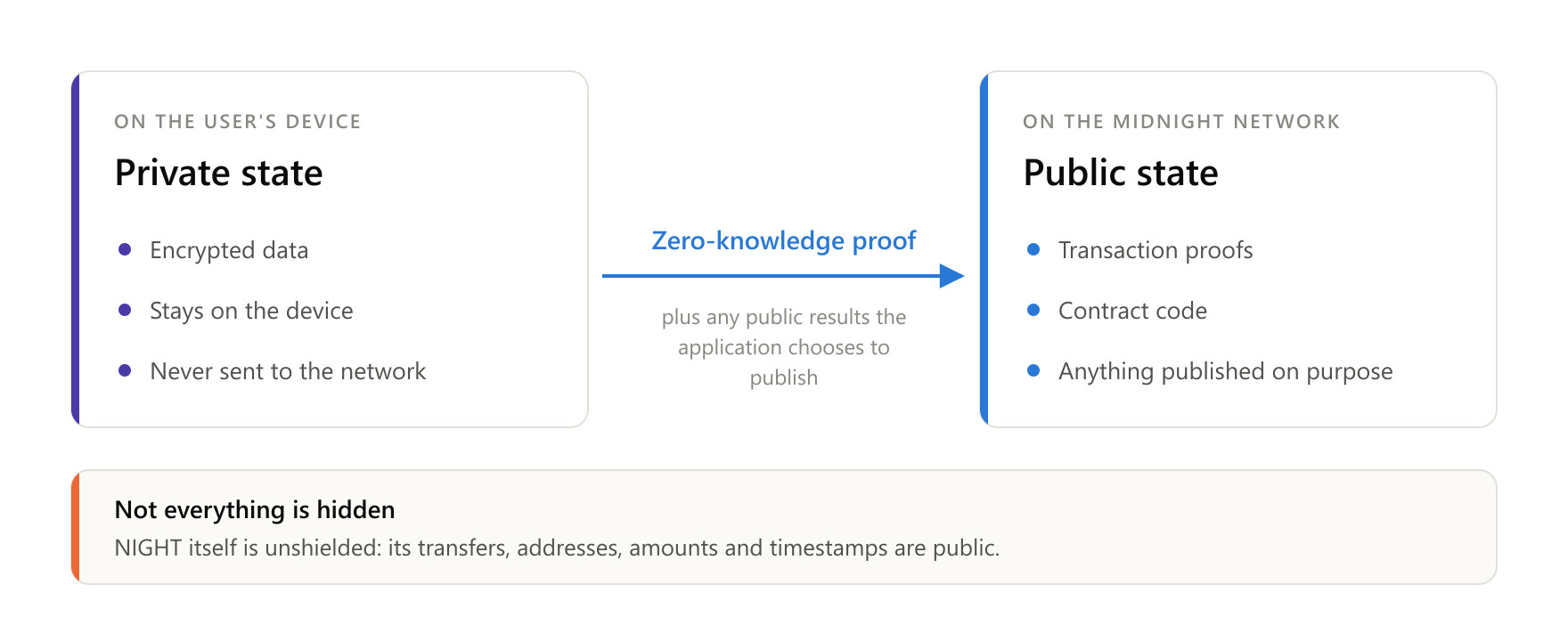
An ordinary blockchain has one side, the public one. Midnight keeps two parallel states. The public state sits on the blockchain and everyone can see it: transaction proofs, contract code, and anything published on purpose. The private state is encrypted data that stays on the user's own device and is never sent to the network [13]. What connects the two is zero-knowledge proofs [13].
Here is an everyday analogy. Picture the door of a venue that only admits adults. The staff member does not need to see your ID card, your address or your exact date of birth. A sealed certificate that you are over 18 is enough. That is precisely one of the project's own example uses: age verification from a digital driving licence without revealing unrelated details [3].
The theoretical basis for this structure is Kachina [7]. For shielded tokens, which hide sender, recipient and amount, Midnight uses a scheme called Zswap, which is based on the Zerocash protocol and supports many kinds of assets and swaps between them [7]. Smart contracts are written in Compact, a language based on TypeScript, with the aim that developers should not need deep knowledge of cryptography [3].
A common misconception is that "everything is hidden" on Midnight. It is not. NIGHT itself is unshielded: its transactions, addresses, amounts and timestamps are publicly visible on the blockchain [2]. The privacy covers applications' data and transaction metadata, not the token itself.
Two units instead of one: NIGHT and DUST
On most blockchains the transaction fee (often called "gas") is paid in the same token the user holds. If the token's price goes up, so does the cost of using the network. Midnight splits these two roles between two different units [2].
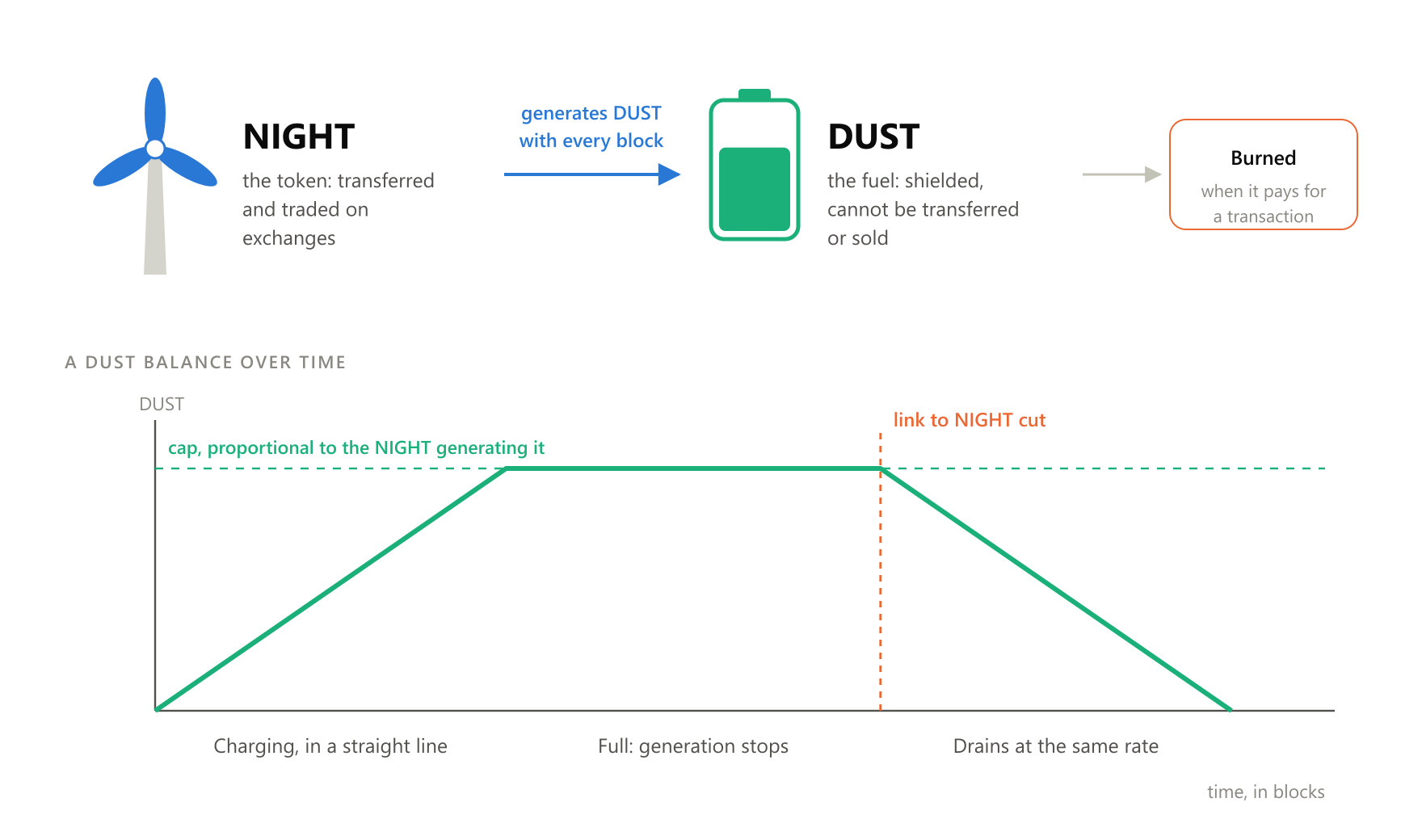
NIGHT is the token that is transferred and traded on exchanges. Its main job is to generate DUST, a shielded "resource" used to pay for transactions [2]. To start generating DUST, a NIGHT holder names a DUST address as the recipient. From then on, with every new block, the DUST balance at that address grows in a straight line up to a cap that is proportional to the amount of NIGHT generating it [2]. Once the cap is reached, generation stops until some of the DUST is used [2].
The whitepaper itself offers an analogy: NIGHT tokens are like wind turbines, and DUST addresses are like batteries that charge up to a maximum capacity [2]. When the connection is cut, because the holder transferred their NIGHT, named a different address or stopped generation, the battery slowly drains: DUST declines in a straight line, at the same rate it was generated, until it reaches zero [2].
DUST cannot be transferred, bought or sold. When it is used in a transaction it is "burned" and does not return to circulation [2]. Because it decays over time, it cannot work as a store of value [2]. A NIGHT holder can direct DUST generation to an address that belongs to someone else, so that an application can cover its users' costs without them holding either NIGHT or DUST [2]. The project argues that this makes the cost of using the network more predictable, because it is not tied directly to NIGHT's price [2].
A transaction: a proof instead of data
A Midnight transaction starts on the user's device. First, the user performs the calculations on their private data locally, without sending it anywhere [13]. Next, a zero-knowledge proof that the calculation was done correctly is produced; the project's architecture provides a separate "proof server" for this [3][13]. The proof is then sent to the blockchain together with whatever public results need to be published. Finally, the network's nodes check the proof without learning the data, and the public and private states are updated [13]. According to the project's documentation, proofs are 128 bytes in size and are verified in milliseconds [13].
The fee is paid in DUST and is calculated with a published formula: Fee = Congestion rate × Transaction weight + Minimum fee [2]. The weight initially measures how much storage space the transaction takes up [2]. The minimum fee exists so that every transaction has some cost, making it harder for anyone to flood the network with millions of small transactions [2]. The congestion rate is adjusted with every block, with the aim of keeping blocks 50% full on average: when they fill up more, the fee rises; when they fill up less, it falls [2].
The DUST paid as a fee is burned. It does not go to block producers, and there is no "tip" for faster service [7].
Double-spending is prevented differently for each unit. For DUST, the cap and the decay mean that, however many times a holder switches address, the total DUST linked to a given amount of NIGHT can never exceed the cap [2]. For shielded tokens, that job is done by the Zswap scheme [7]. The whitepaper notes one more defence: producing a proof takes far more computing work than checking one, so anyone sending useless transactions in bulk bears the cost first [2].
Keys and wallets: what you actually own
As with any blockchain, you do not really "own" NIGHT in an account: you control private keys that allow the tokens to be moved. If the keys are lost or stolen, the tokens may be lost for good, and transfers to the wrong address cannot be reversed [7].
Midnight has two kinds of address. A DUST address is separate from the NIGHT address that feeds it and cannot be derived from it [2]. Applications' private data is stored locally on the user's device, and in the project's architecture the user interacts with the network through the Lace wallet, as a Chrome extension [3].
The NIGHT distribution introduced a condition that turned out to matter. Anyone who claimed tokens in the Glacier Drop or the Scavenger Mine had to name a new, unused Cardano address as the destination, and thawing tokens can only be sent to that address [7]. In September 2026 that condition affected users of the SecondFi wallet, which had been breached in June 2026, with about 16.1 million ADA stolen from 374 wallets [14]. SecondFi told users who had named addresses from that wallet, and who had a NIGHT instalment scheduled, not to redeem it, because redemption can only go to the original address, whose key is considered exposed [14].
The alternative is custody by a third party. People holding tokens on exchanges could not claim themselves, and some exchanges received NIGHT to pass on to their customers [8]. Self-custody gives full control and full responsibility; custody hands that control to the provider.
How blocks are made: 13 nodes today, more tomorrow
Midnight's node is built on the Polkadot SDK (Substrate) and keeps constant track of Cardano through a database populated from it [12]. Two mechanisms share the work: AURA decides who makes the next block, taking turns in a fixed rotation, and GRANDPA "finalises" blocks so that they cannot be changed [12][7]. According to the documentation, a block is produced every 6 seconds, a "session" lasts 1,200 slots (2 hours), and an epoch contains 300 blocks [12].
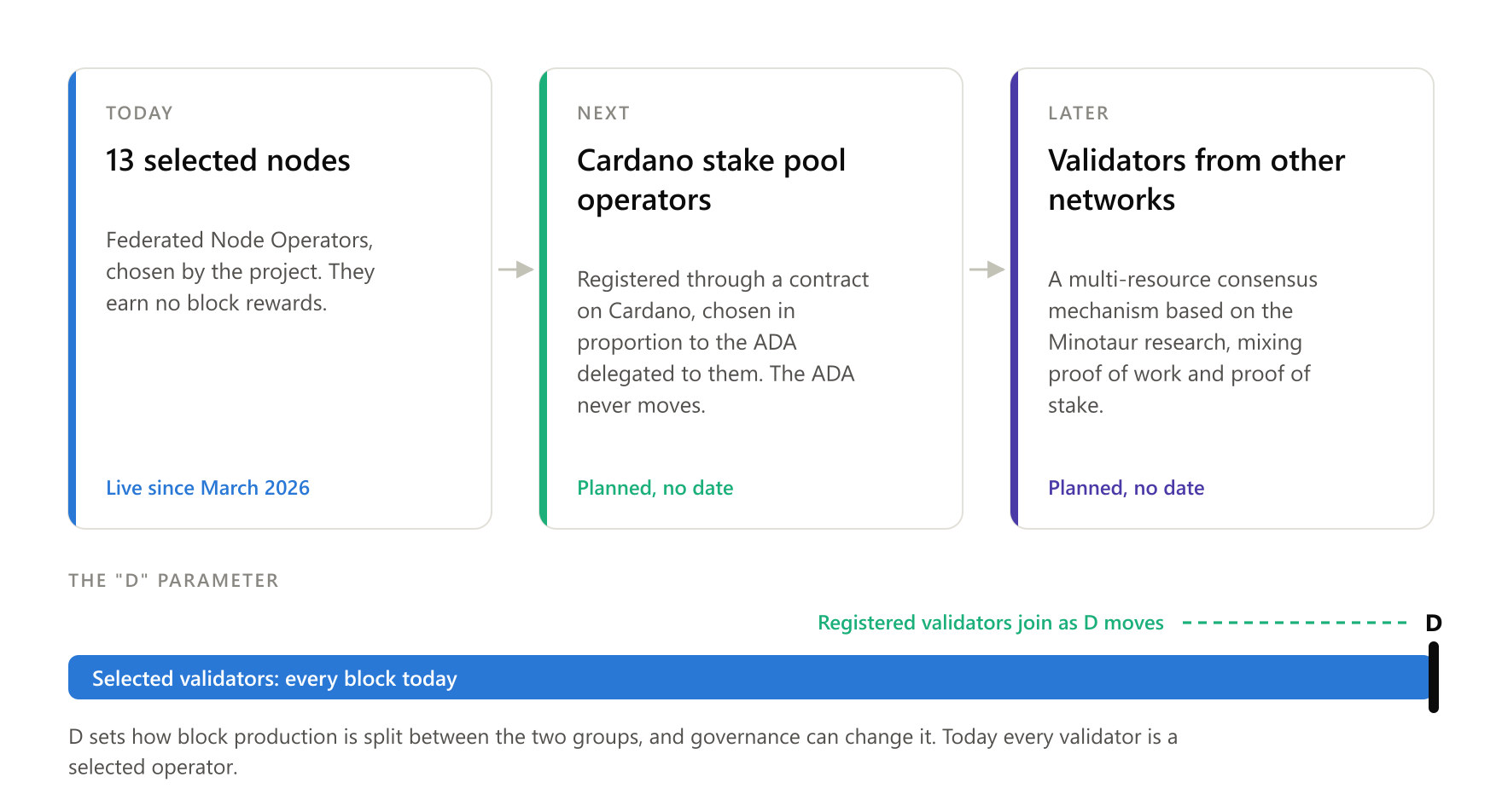
Not every node produces blocks. There are full nodes that check transactions and hold the current state, archive nodes with the entire history, boot nodes for first-time connections, and RPC nodes for applications [12]. Only validators produce blocks. Today they are selected operators (Federated Node Operators), and participation by Cardano stake pool operators will come later; a parameter called "D" sets how block production is split between the selected and the registered validators [12].
The official documents do not all agree on this point. The documentation page "What is Midnight?" says validators take part freely through stake delegation and earn rewards [13]. The issuer's regulatory whitepaper says the network started exclusively with selected nodes that receive no rewards [7]. We read the first description as a goal, not as the current state.
The transition plan is that Cardano's stake pool operators will register through a contract on Cardano and be chosen as Midnight block producers in proportion to the ADA their holders have delegated to them; the ADA does not move and stays under its holders' control [2]. In the longer term, the issuer's regulatory whitepaper says the network intends to use a new "multi-resource" consensus mechanism that would let validators from other blockchain networks produce blocks on Midnight [7], and the litepaper lists it on its roadmap [3]. IOG had already written in 2023 that the Minotaur mechanism would let validators from other ecosystems contribute [11].
The Minotaur paper shows how this could work. It combines proof of work (security from computing power) and proof of stake (security from locked-up tokens) through a shared "virtual stake". The network stays secure as long as an attacker controls less than half of the weighted total of resources, the mechanism generalises to any number of resources, and a network can start as pure proof of stake and gradually change the weighting [5]. As of 27 September 2026, none of this is live: it is a plan with no announced date.
Staking: it does not exist yet
Staking (locking tokens to take part in securing the network in return for a reward) does not exist for NIGHT. Block production rewards were not available at mainnet launch either [7]. The regulatory whitepaper leaves open the possibility of staking mechanisms being developed in future [7].
When rewards do start, they will come only from the Reserve: no new tokens will be created and no NIGHT fees will be added, because fees are paid in DUST and burned [2][7]. Each block will be allotted a fixed percentage of whatever NIGHT remains in the Reserve. Of that, a fixed share, the "subsidy rate" (95% at launch), will go to the producer however empty the block is, while the remainder will be split between the producer and the treasury according to how full the block is [2]. For a block that is 50% full, the producer would receive 0.95 + 0.05 × 0.5 = 97.5% of the base reward and the treasury 2.5% (our calculation).
To be clear about what this means: the future "yield" will not be revenue from using the network, but a transfer of tokens that already exist from the Reserve into circulation, which dilutes those who already hold NIGHT. Our view at CRYPTONEA 24 is that this distinction should stay clear in any discussion of "yields" on Midnight.
Who runs it
| Organisation | What it does | Legal form and seat | Who leads it | Funding |
|---|---|---|---|---|
| Midnight Foundation | Supports ecosystem development, runs 2 of the 13 nodes and pays the rest, sits on the governance committee [7] | Cayman Islands, with an address care of Harneys Fiduciary (Cayman) Limited [7] | President Fahmi Syed [15] | Not disclosed in the sources we examined |
| Midnight TGE Ltd | Issuer of NIGHT, a subsidiary of the Foundation [7] | Company limited by shares, British Virgin Islands, registered 12 December 2024 [7] | Director Claire Louise Abrehart [7] | Interest-free intra-group loan facility of up to $25 million from the Foundation [7] |
| Shielded Technologies | Main technical contributor to the protocol and the Compact language, runs a node [15] | Not disclosed in the sources we examined | Chief technology officer Bob Blessing-Hartley [15] | Not disclosed |
| Input Output Global (IOG) | Originator of the project [1], holds the copyright to the technical documentation [12] | Outside the scope of this article | Chief executive Charles Hoskinson [15] | Outside the scope of this article |
Shielded Technologies is presented as a team that emerged from Input Output's cryptography expertise [15]. Midnight TGE Ltd is a subsidiary of the Foundation, is funded by it, and holds its own NIGHT allocation for commercial partnerships [7]. The Foundation plays the most central role in the current phase: it holds the largest NIGHT allocation, pays the node operators and sits on the committee that decides changes [7].
Around these organisations are the node operators. The first announced, in February 2026, were Google Cloud, Blockdaemon, AlphaTON Capital and Shielded Technologies [15]. They were followed by Pairpoint by Vodafone, eToro and MoneyGram [16], and later by Worldpay and Bullish [6]. The sources we examined record no public disagreement between the organisations.
How decisions are made
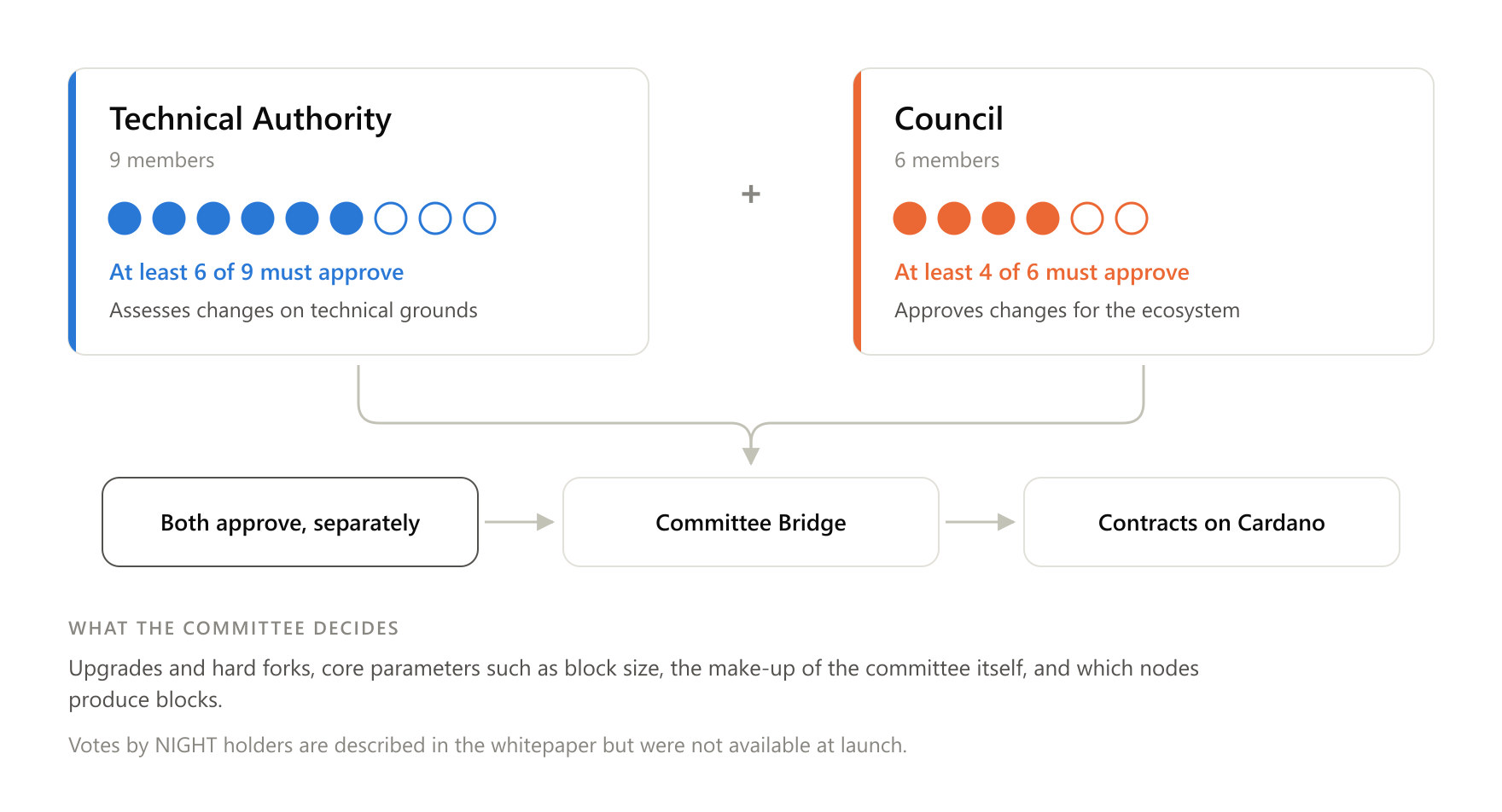
In the current phase, changes to the protocol and to the related parameters on Cardano are decided by a committee using multi-signature approval, made up of two bodies [2][7]:
| Body | Members | Approval required | Role |
|---|---|---|---|
| Technical Authority | 9 | At least 6 of 9 | Assesses changes on technical grounds |
| Council | 6 | At least 4 of 6 | Approves changes on behalf of the ecosystem |
Every change needs approval from both bodies [2][7]. The committee's remit is broad: it covers upgrades and hard forks (rule changes that require every node to upgrade), core parameters such as block size, the make-up of the committee itself, and which nodes produce blocks [7]. Changes to the contracts on the Cardano side pass through a "Committee Bridge". The firm TxPipe reviewed the upgrade mechanism in a report dated 8 January 2026, and the bridge in an audit completed on 8 April 2026 [7]. We did not find the names of the members of either body published in the sources we examined.
Decentralised governance (the way a network decides on its own changes) exists only on paper. The whitepaper describes future Midnight Improvement Proposals (MIPs), votes by NIGHT holders and funding from the treasury [2], but none of this was available at launch [7]. Because no vote has taken place, there are no participation figures. The regulatory whitepaper also notes that elements such as monetary policy may not currently fall within the committee's remit, and could in future be changed by vote [7].
Supply: every NIGHT already exists
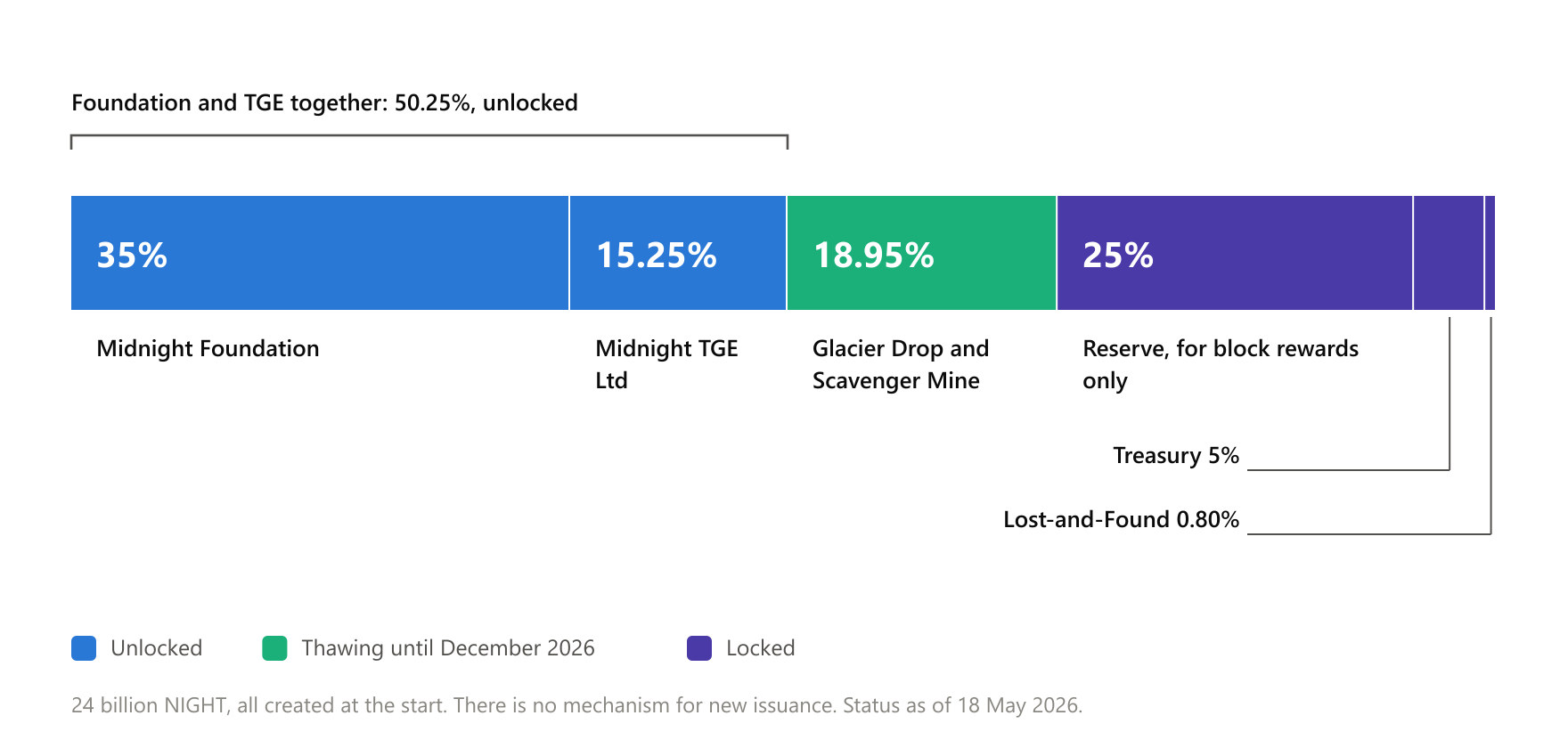
Unlike Bitcoin, where new coins are created with every block, NIGHT has no mechanism for new issuance: all 24 billion were created at the start [2]. One NIGHT is divided into one million STAR, and amounts are recorded on the blockchain in STAR [2]. The final allocation, as published in May 2026 [2]:
| Category | STAR | Share | Status (18 May 2026) |
|---|---|---|---|
| Midnight Foundation | 8,400,000,000,000,000 | 35% | Unlocked |
| Reserve | 6,000,000,000,873,988 | 25% | Locked, for rewards only |
| Glacier Drop and Scavenger Mine | 4,547,399,400,634,954 | 18.9475% | Thawing gradually until December 2026 |
| Midnight TGE Ltd | 3,660,000,000,000,000 | 15.25% | Unlocked |
| Treasury | 1,200,000,000,000,000 | 5% | Locked until governance exists |
| Lost-and-Found | 192,600,598,491,058 | 0.8025% | Locked, phase not yet started |
The six amounts add up to exactly 24,000,000,000,000,000 STAR (our calculation). The Foundation and TGE together hold 50.25% of total supply, as the whitepaper itself states [2]. The project's sources give different figures for the treasury: the December 2025 guide said 1.141 billion [8], while the May 2026 whitepaper says 1.2 billion [2]. The later document takes precedence.
Circulating supply will grow from the Reserve, which will release a fixed percentage of its remaining balance with each block. Because the balance shrinks, the rewards shrink too, along a curve that the project says could last hundreds of years [2]. The exact pace depends on an initial "inflation rate" of the circulating supply, which the whitepaper represents with the symbol π without giving its value [2]. For that reason, public data cannot tell us when the Reserve will run out. With a block every 6 seconds, a year contains 5,256,000 blocks (our calculation).
Two common misconceptions are worth clearing up. The first concerns "circulating supply". CoinGecko shows 16.607 billion NIGHT in circulation [17]. That figure equals 24 billion minus the Reserve, the treasury and Lost-and-Found, that is 24 minus 6 minus 1.2 minus 0.1926, which makes 16.6074 billion (our calculation). In other words, it counts as "circulating" tokens that have been claimed but have not yet thawed. The second concerns the word "deflationary". The earlier litepaper described NIGHT as "deflationary" [3]. The newer whitepaper describes it as "disinflationary": circulating supply keeps rising, but ever more slowly [2]. NIGHT is not burned. What gets burned is DUST.
The parameters that set the network's economics
| Parameter | Value or rule | Who changes it |
|---|---|---|
| Subsidy rate | 95% at launch, expected to move towards 50% | Governance [2] |
| Block fullness target | 50% | Governance [2] |
| Minimum fee | No numerical value published | System parameter [2] |
| Congestion rate | Adjusted with every block | Automatically, based on fullness [2] |
| Reserve distribution rate | Fixed percentage per block, from a formula that includes the unpublished rate π | Code of the Reserve contract [2][7] |
| "D" parameter | Split of blocks between selected and registered validators | Governance [12] |
Since there is no proposal system yet, there are no live proposals to change these parameters.
Units and names
| Unit | Subunit |
|---|---|
| NIGHT (ticker NIGHT) | 1 NIGHT = 1,000,000 STAR [2] |
| DUST | 1 DUST = 1,000,000 SPECK [2] |
The four phases of the roadmap take their names from the phases of the moon in the Hawaiian calendar: Hilo, Kūkolu, Mōhalu and Hua [2][8]. The origin of the names "Midnight", "STAR" and "SPECK" is not explained in the documents we examined.
How it has changed: a timeline
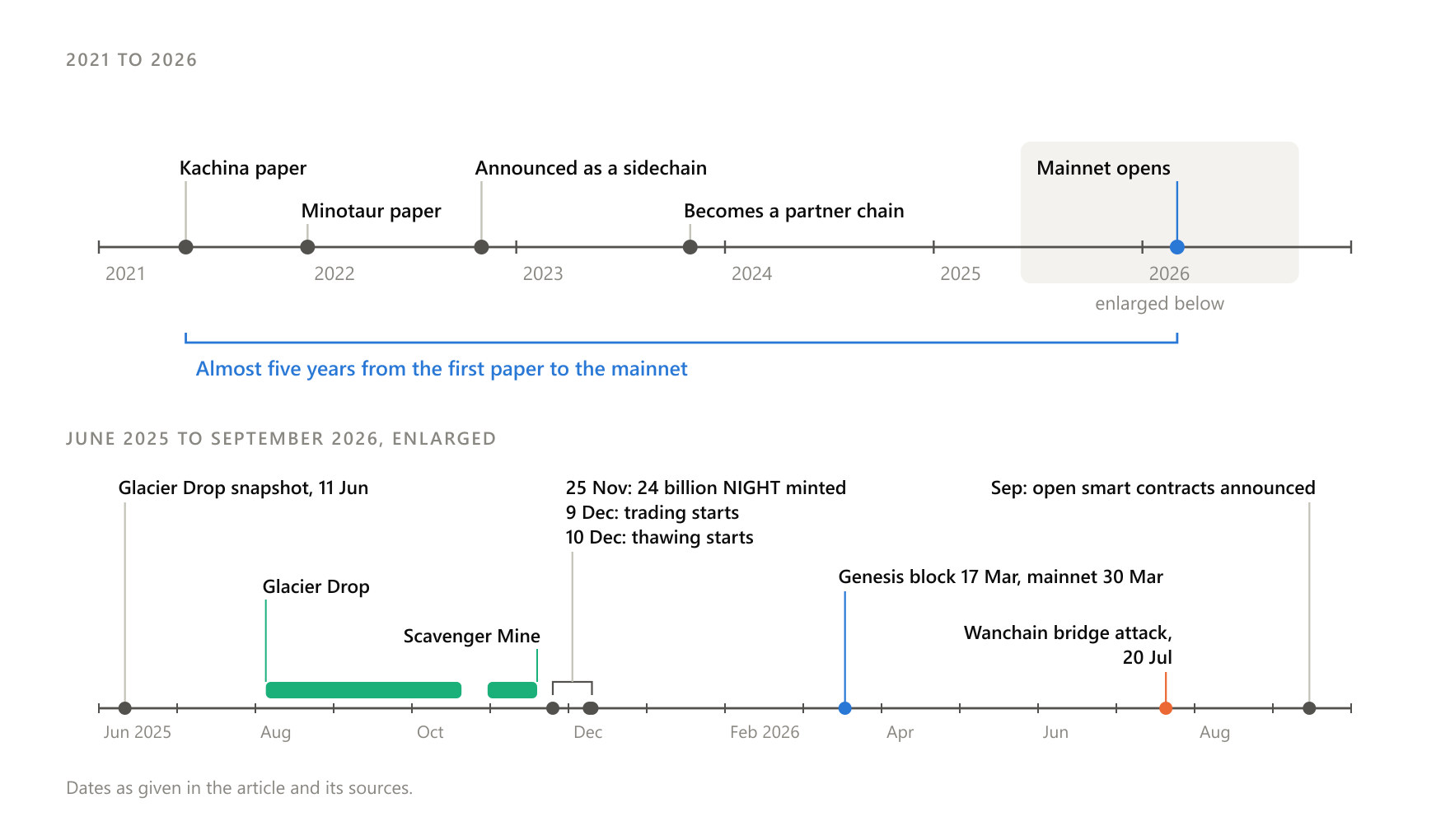
| Date | Event |
|---|---|
| 21 to 25 June 2021 | Kachina paper presented at CSF 2021 [4] |
| 31 January 2022 | Minotaur paper filed [5] |
| 18 November 2022 | Midnight announced as a Cardano sidechain [1] |
| 3 November 2023 | Midnight presented as the first partner chain [11] |
| 11 June 2025 | Retroactive snapshot for the Glacier Drop [7] |
| 5 August to 20 October 2025 | Glacier Drop [8] |
| 29 or 30 October to 19 November 2025 | Scavenger Mine [2][8] |
| 25 November 2025 | 24 billion NIGHT minted on Cardano [9] |
| 9 December 2025 | Trading begins [10] |
| 10 December 2025 | Thawing begins [7] |
| 17 March 2026 | Midnight genesis block [2] |
| 30 March 2026 | Mainnet opens [2] |
| 20 July 2026 | Attack on the Wanchain bridge [18] |
| September 2026 | Smart contract deployment for everyone announced as coming soon [19] |
As plans without binding dates, the whitepaper describes the Mōhalu phase, with stake pool operator participation and a marketplace for DUST capacity, the Hua phase, with applications that run across several blockchains, the two-way bridge with Cardano, and the start of Lost-and-Found [2]. The regulatory whitepaper adds the multi-resource consensus mechanism [7].
Who holds it today
On 27 September 2026 (Cardano epoch 658, block 13,994,553), the Cardanoscan explorer recorded 135,096 addresses holding NIGHT on Cardano [9]. Concentration is high: the top 10 addresses hold 62.6% and the top 100 hold 83% [9].
Three of the largest addresses hold amounts that match allocation categories exactly: the first holds 6,000,000,000.873988 NIGHT, the same as the Reserve, one holds 1,200,000,000 NIGHT, the same as the treasury, and one holds 192,600,598.491058 NIGHT, the same as Lost-and-Found [9][2]. Linking these addresses to those categories is our own reading, based on the matching amounts.
These figures cover the Cardano side only. They do not include NIGHT on the Midnight network itself, or how exchanges divide holdings internally. In the sources we examined, we found no investment fund or ETF holding NIGHT.
Where it is used, and what it is not
The most concrete announced use involves the British bank Monument Bank. In March 2026 the Midnight Foundation announced that the bank planned to tokenise up to £250 million of retail customer deposits on Midnight [6][20]. In September 2026 it was reported that the start had been pushed back to November [20]. There has been no report that the programme has launched.
On the network itself, applications have so far been limited. According to AMBCrypto, only a few approved applications could run, and smart contract deployment for anyone is expected to open soon [19]. The project's litepaper describes as aims digital identity with selective disclosure of details, turning assets into tokens, and voting that proves participation without recording how anyone voted [3]. These are the project's intentions, not uses in operation.
It also helps to be clear about what Midnight is not. It is not a privacy coin: NIGHT moves in public, with visible addresses and amounts [2]. DUST is not a currency: it cannot be bought, sold or transferred [2]. And "wrapped" NIGHT is not NIGHT: when third parties issue representations of it on other blockchains (wrapped tokens), these do not carry the rights or utility of the original token [7]. To check that you hold the genuine token on Cardano, its policy ID begins 0691b2fe and ends 5af1fa, and its asset name is NIGHT [9].
What has gone wrong
The Wanchain bridge
On 20 July 2026, between 14:46 and 14:55 UTC, an attacker used four transactions to withdraw about 515.2 million NIGHT from the reserve of Wanchain's Cardano-to-BNB Chain bridge [18]. A bridge locks tokens on one blockchain and issues matching "wrapped" tokens on another; this reserve backed the wrapped NIGHT on BNB Chain [18].
The likely cause, according to a preliminary analysis by the security firm BlockSec, was a flaw in how the bridge's validator built the message to be signed: it joined 14 fields together without separators. That allowed a legitimate signature for a transfer of about 3,110 NIGHT to be reused for a withdrawal of 203,001,692 NIGHT [18]. An analogy for the flaw: picture a receipt where amounts are written with no commas between them, so that "12" followed by "3" reads the same as "1" followed by "23".
No new tokens were created: existing tokens were moved, and total supply did not change [18]. The amount is about 2.15% of total supply (our calculation, matching the Crypto Times estimate [18]). Preliminary community tracing found about 300 million NIGHT sold on Cardano decentralised exchanges [18], while AMBCrypto reported 290 million [21]. The Midnight Foundation said the Midnight network itself, its validators and its consensus were not affected [18][21]. Exchanges took precautionary measures on linked accounts and addresses, but the amount actually frozen was not disclosed [18]. NIGHT's price fell to an all-time low of $0.01524, according to CoinGecko [17].
Wanchain suspended the bridge [18] and gave the attacker until 12:00 UTC on 6 August 2026 to return the funds in exchange for a negotiated settlement [22]. As of 27 September 2026, no outcome of the recovery has been reported, and no plan to restore backing for the wrapped NIGHT has been reported either.
The SecondFi wallet
The breach of the SecondFi wallet in June 2026 did not involve Midnight itself. It was caused by a flaw in how signatures were generated, which allowed private keys to be calculated from public data [14], and it left holders of future NIGHT instalments with no safe way to redeem them [14]. No resolution has been reported.
In the sources we examined, no outage of the Midnight network itself is recorded.
Where the ecosystem falls short
Six months after the mainnet opened, several core pieces are still not live. Smart contract deployment is not yet open to everyone [19]. Block production rewards, governance and treasury funding are not active [7]. The two-way bridge with Cardano does not exist yet [2], and the Lost-and-Found phase has not started [2]. The most high-profile use by a traditional financial institution, Monument Bank's, has been delayed [20].
We found no published data on activity on the mainnet itself, such as the number of transactions, active applications or users. Without such data, it is not possible to judge how much the network is used today.
The open questions
The first question is concentration. The Foundation and TGE together hold 50.25% of supply, and both allocations have been unlocked since 10 December 2025, with no lock-up at protocol level [2]. The project itself states that the Foundation has discretion over how it uses its tokens, and that it may take decisions that conflict with the interests of some holders, or favour some holders over others [2][7]. It also says it intends to publish large transfers from these wallets, while making clear this is not a binding obligation [2].
The second question is control of the network. Today blocks are produced by 13 selected nodes, and changes are decided by a 15-member committee; the Foundation takes part in both and pays the other node operators [7]. The issuer's regulatory whitepaper acknowledges the risk: a small group of participants could act in concert, in its own interest rather than that of other holders [7]. The move to open participation has been described, but it has no date.
The risks
First, the price history as dated facts. Trading began on 9 December 2025 [10]. Providers differ slightly on the all-time high: CoinGecko records $0.1185 [17], while OKX records $0.12 on 22 December 2025, in UTC+8 time [23]. The all-time low of $0.01524 came after the attack on the Wanchain bridge in July 2026 [17][18]. On 27 September 2026, CoinGecko showed a price of $0.02604, a market capitalisation of $432.4 million and a fully diluted value of $624.9 million [17]. OKX's page, last updated on 26 September 2026, showed $0.02593 [23].
The general risks apply as they do to any crypto-asset. The price can move sharply in either direction. Exchanges and wallets can be breached or stop operating. NIGHT is not covered by any investor compensation or deposit guarantee scheme [7]. There is also the risk of fraud and impersonation: the project warns about fake websites and scams around the distribution [7], and the Foundation repeated its phishing warning after the July attack [18]. Finally, lost or stolen access is usually not recoverable [7]. The rules that apply to crypto-assets can also change.
Then there are the risks specific to Midnight. The first is concentration: 50.25% of supply sits with two organisations, in unlocked tokens [2]. The second is central control: in the current phase, the network and its decisions are in the hands of a few [7]. The third is bridges: as the Wanchain case showed, a third-party bridge can be emptied without anything being wrong with the network itself [18]. The fourth is the fixed redemption address: instalments claimed in the initial distribution can go only to the address that was declared [7]. The fifth is supply still to come: instalments thawing until December 2026 [2], future rewards from the Reserve [2], and TGE's stated intention to return unused tokens to the Reserve [2]. Lastly, the core features the project promises, namely open block production, governance and a two-way bridge, are described as future ones and may be delayed or may change [7].
Sources
- P: Input Output Global, IOG announces new blockchain to protect data and safeguard technology freedoms, iog.io/news/iog-announces-new-blockchain-to-protect-data-and-safeguard-technology-freedoms, November 2022 (project source)
- P: Midnight TGE Ltd, Midnight tokenomics and incentives whitepaper, Version 1.81, 45047878.fs1.hubspotusercontent-na1.net/hubfs/45047878/Midnight-Tokenomics-And-Incentives-Whitepaper.pdf, May 2026 (project source)
- P: Midnight, Nightpaper: A litepaper introducing Midnight, midnight.network/whitepaper, undated (project source)
- P: Kerber, Kiayias, Kohlweiss, Kachina: Foundations of Private Smart Contracts (IEEE CSF 2021), research.ed.ac.uk/en/publications/kachina-foundations-of-private-smart-contracts/, June 2021 (project source)
- P: Fitzi et al., Minotaur: Multi-Resource Blockchain Consensus (ACM CCS 2022), ia.cr/2022/104, January 2022 (project source)
- S: The Block, Cardano's Charles Hoskinson unveils privacy-preserving Midnight partner chain, theblock.co/news/ecosystems/2026-03-30-cardanos-charles-hoskinson-unveils-privacy-preserving-midnight-partner-chain-395749, March 2026
- P: Midnight TGE Ltd, NIGHT MiCA White Paper, 45047878.fs1.hubspotusercontent-na1.net/hubfs/45047878/NIGHT%20MiCA%20White%20Paper.pdf, August 2026 (project source)
- P: Midnight, Guide to the NIGHT token launch and Redemption, midnight.network/blog/guide-to-the-night-token-launch-and-redemption, December 2025 (project source)
- P: Cardanoscan, NIGHT, cardanoscan.io/token/0691b2fecca1ac4f53cb6dfb00b7013e561d1f34403b957cbb5af1fa4e49474854, September 2026
- S: Kraken, NIGHT is available for trading!, blog.kraken.com/product/asset-listings/night-is-available-for-trading, December 2025
- P: Input Output Global (Mike Ward), Partner chains are coming to Cardano, iohk.io/en/blog/posts/2023/11/03/partner-chains-are-coming-to-cardano/, November 2023 (project source)
- P: Midnight Docs, Nodes in Midnight, docs.midnight.network/nodes, September 2026 (project source)
- P: Midnight Docs, What is Midnight?, docs.midnight.network/what-is-midnight, September 2026 (project source)
- S: crypto.news, SecondFi warns users not to claim NIGHT tokens from compromised wallets, crypto.news/secondfi-warns-users-not-to-claim-night-tokens-from-compromised-wallets/, September 2026
- P: Midnight, Introducing Midnight mainnet trusted node operators, midnight.network/blog/introducing-midnight-mainnet-trusted-node-operators, February 2026 (project source)
- P: Midnight, Expanding list of mainnet node operators revealed, midnight.network/blog/expanding-list-of-mainnet-node-operators-revealed, February 2026 (project source)
- S: CoinGecko, Midnight (NIGHT), coingecko.com/en/coins/midnight-3, September 2026
- S: The Crypto Times, The $10M Wanchain Bridge Exploit: How a Signature Flaw Drained 515M NIGHT Tokens, cryptotimes.io/insights/wanchain-night-bridge-exploit-signature-flaw/, July 2026
- S: AMBCrypto, Midnight prepares open smart contract deployment on mainnet, ambcrypto.com/midnight-prepares-open-smart-contract-deployment-on-mainnet-details/, September 2026
- S: Crypto Briefing, Monument Bank plans to tokenize £250M in retail deposits on Midnight blockchain, cryptobriefing.com/monument-bank-tokenize-deposits-midnight/, September 2026
- S: AMBCrypto, Midnight's 515M NIGHT hack sends token down 32%, ambcrypto.com/midnights-515m-night-hack-sends-token-down-32-will-0-015-hold/, July 2026
- S: FinanceFeeds, Wanchain Gives Hacker Until 12:00 UTC on August 6 to Return Stolen Funds, financefeeds.com/wanchain-gives-hacker-until-1200-utc-on-august-6-to-return-stolen-funds/, July 2026
- S: OKX, Midnight Price Today, okx.com/en-us/price/midnight-night, September 2026
This article is educational and for general information. The facts in crypto move quickly, so verify them before you act on anything here. This is not financial advice.