
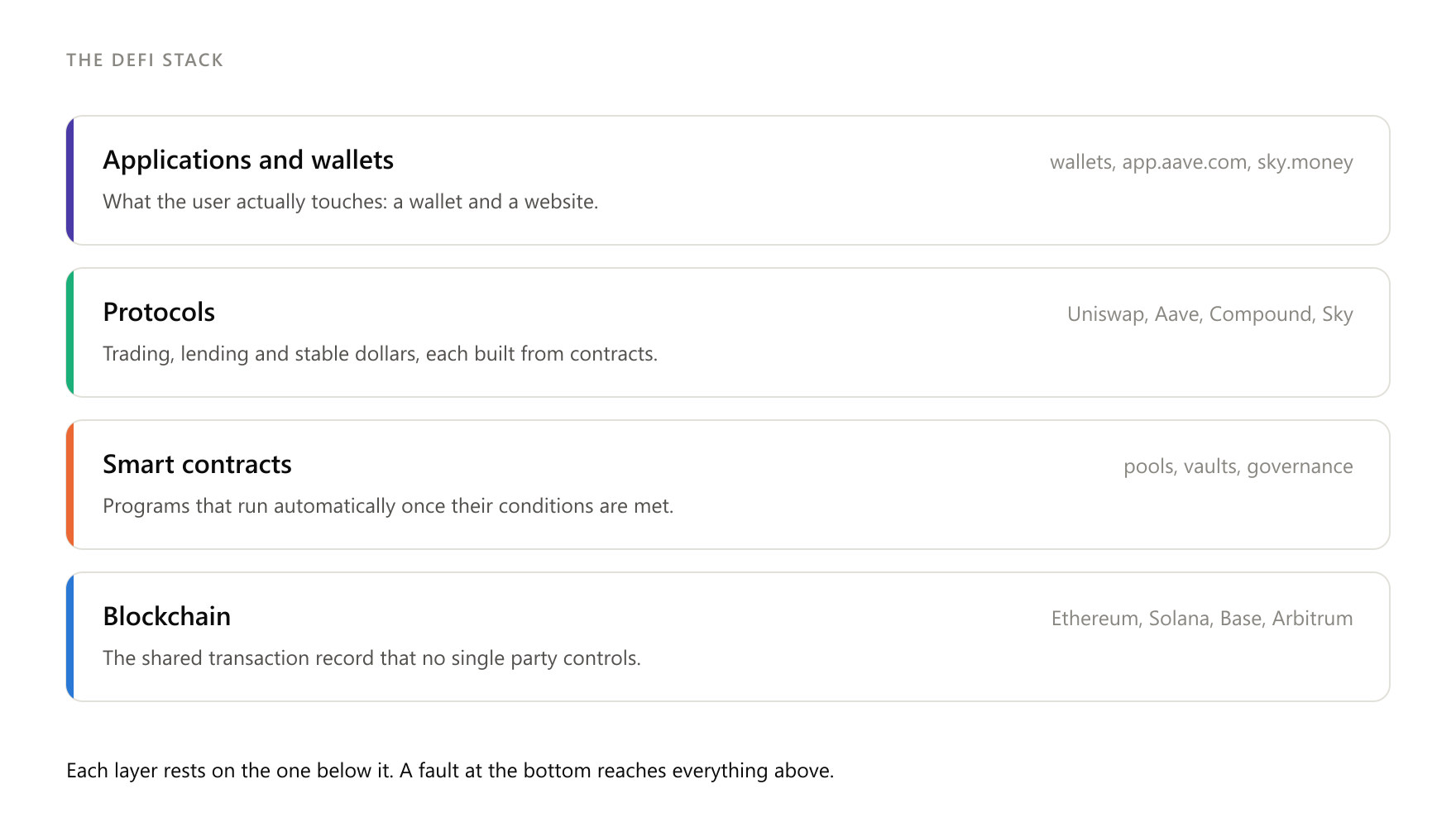
DeFi (decentralised finance) is a set of financial services, such as trading, lending and saving, that run on public blockchains (shared digital transaction records that no single party controls) through smart contracts (programs that execute automatically once predefined conditions are met), instead of through banks and intermediaries [1].
There is no account to open and no one to approve you. A wallet (software or a device that holds your keys) and an internet connection are enough [1].
The problem it tries to solve is old: how two strangers can do business without trusting each other. In the traditional system that job is done by banks, exchanges and courts. In DeFi it is done by code, and that is the source of both its advantages and its risks.
This article covers where the idea came from, how trading and lending work in practice, who actually controls the protocols, and what has gone wrong so far. It is informational and is not investment advice.
The problem: trading without anyone in the middle
Every financial transaction has a trust gap. If you swap one asset for another, who sends first? If you lend, what happens if the borrower disappears? The financial system filled up with intermediaries to bridge that gap: custodians who hold the assets, central clearinghouses that settle trades, and escrow agents who hold the money until the terms are met [2].
In DeFi those roles are taken over by smart contracts. According to Fabian Schär, a professor at the University of Basel, contracts are used here mainly for two jobs. The first is to swap two assets simultaneously and inseparably: either both transfers happen or neither does. The second is to hold collateral in something like an escrow account that is released only when the conditions are met [2].
The hard part is not trading but lending. A bank lends because it knows who you are and can pursue you in court. On a blockchain the borrower is just an address. The Bank for International Settlements (BIS) notes that precisely because borrowers are anonymous, overcollateralisation dominates DeFi lending: you borrow less than you have put up as security [3]. And because there is no central counterparty, there is also no one to freeze an account or reverse a mistake [1].
Where the idea came from
The vending machine of 1996
In 1996 the computer scientist Nick Szabo published "Smart Contracts: Building Blocks for Digital Markets" in the magazine Extropy (issue 16). The version circulating online today is, in his own words, a partial rewrite of that article [4]. In it he defined a smart contract as a set of promises in digital form. He called the vending machine "the primitive ancestor of smart contracts": you put in coins, and the machine hands out the product and the change without a shop assistant [4].
Szabo came even closer to today's DeFi. He described a "smart lien" on a car bought with a loan: if the borrower stops paying, the code automatically hands control of the car's keys back to the bank. He also noted that no prudent bank lends without collateral that covers the loan [4]. The idea predates crypto: Bitcoin arrived in 2009 [5].
Ethereum: a blockchain that runs programs
Bitcoin could move value but could not run complex programs. The Ethereum white paper, which proposed a blockchain with a built-in programming language for creating "contracts", was published by Vitalik Buterin in 2014 [6]. The network went live on 30 July 2015 [7]. The BIS treats this as a key milestone: the ability to run smart contracts was what set the DeFi ecosystem in motion [5].
An exchange without an order book
On 6 July 2017 Hayden Adams was laid off from his job as a mechanical engineer at Siemens. A friend who was then working at the Ethereum Foundation persuaded him to learn to write smart contracts. As practice, Adams built an "automated market maker" as Vitalik Buterin had described one publicly [8].
Adams himself writes that the idea first came from Alan Lu of Gnosis. Martin Koppelmann, also of Gnosis, passed it on to Buterin. It was Buterin who suggested the name "Uniswap", instead of the "Unipeg" Adams had in mind [8].
The project was funded by an Ethereum Foundation grant, and its contracts went through formal verification by the firm Runtime Verification. On 2 November 2018, the last day of the Devcon 4 conference in Prague, Uniswap went live on the Ethereum main network. On launch day it held about $30,000 of liquidity from a single provider, split across three tokens [8].
A name in a chat
The term "DeFi" was born in August 2018 in a Telegram conversation that included Inje Yeo of Set Protocol, Blake Henderson of 0x and Brendan Forster of Dharma [9][10]. Other names on the table were "Open Horizon", "Lattice Network" and "Open Financial Protocols". Henderson liked "DeFi" because it sounded like "defy" [10]. In a June 2019 interview, Yeo describes himself as "the one who coined the word DeFi" [9].
The summer of 2020
The first version of the Aave lending protocol went live on Ethereum on 8 January 2020 [11]. A few months later, on 15 June 2020, Compound began distributing its governance token COMP to its users (a token is a digital unit issued on an existing blockchain). About 2,880 COMP a day were spread across eight markets, and 42% of the total supply of 10 million COMP was set aside for users over four years [12]. Five days later, Compound overtook MakerDAO in funds locked in its contracts: about $500 million against $486 million, according to DeFi Pulse [13]. Balancer had started paying such token rewards earlier, on 29 May [14].
By 2021 the phenomenon had an academic definition. Writing for the Federal Reserve Bank of St. Louis, Schär described it as an alternative financial infrastructure that replicates existing services in a more open, interoperable and transparent way [15].
Black Thursday: when the machine worked exactly as designed
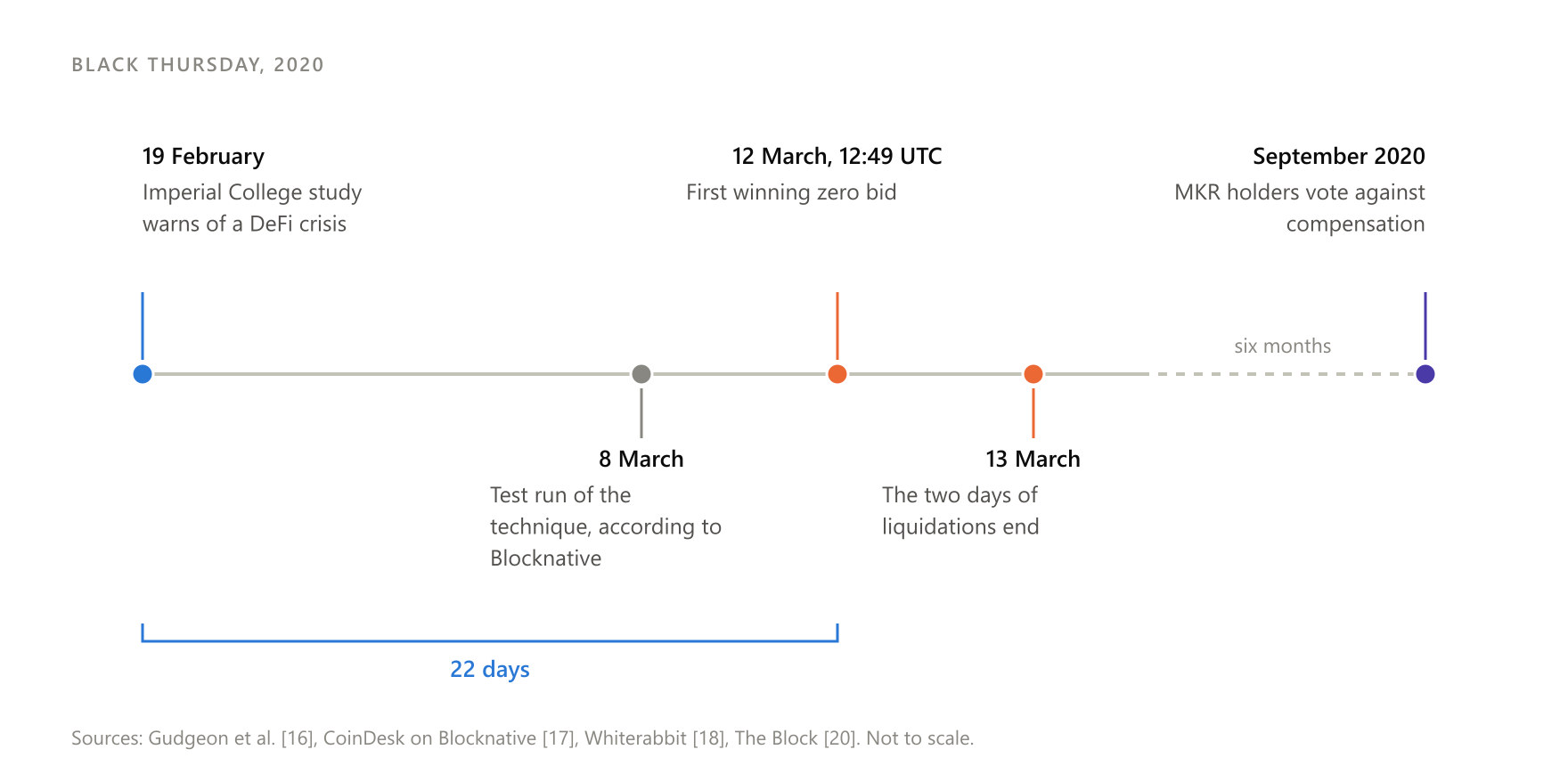
On 19 February 2020, five researchers at Imperial College London (Lewis Gudgeon, Daniel Perez, Dominik Harz, Benjamin Livshits and Arthur Gervais) posted a study on arXiv titled "The Decentralized Financial Crisis" [16]. The abstract, as revised in June 2020, warns that DeFi is at risk of "the very sort of financial meltdown it is supposed to be preventing" [16].
The authors showed two things. The first was an attack on MakerDAO's governance using flash loans in just two transactions, which would have allowed the theft of $0.5 billion of collateral. They write that about two weeks after they disclosed it, Maker changed its parameters. The second was a stress test: a lending protocol with $400 million of debt could become undercollateralised within 19 days if liquidity dried up [16].
Three weeks later, MakerDAO faced its biggest test. Its mechanism worked like this. Users locked ETH as collateral and received the stablecoin DAI as a loan. For ETH the minimum collateral ratio was 150%. When the collateral's value fell below that line, liquidation followed: bots called keepers bid DAI to buy the collateral in auctions that lasted 10 minutes [17].
On 12 March 2020 the price of ETH fell almost $100 from $193 [17]. The Ethereum network jammed. Every transaction first waits in the mempool (the waiting area for transactions before they are included in a block) and pays gas (the network's transaction fee) to get into the next block. As traffic grew, gas prices shot up [17].
In its analysis in April 2020, the Maker Foundation attributed the delays and failed transactions to network congestion and high gas prices [17]. The original post is no longer available at its address: when we checked on 3 October 2026, the address redirected to the sky.money home page [21].
In those conditions, someone tried something simple: a bid of zero. The first winning zero bid was recorded at 12:49 UTC on 12 March [18]. If no other bid arrived before the timer ran out, the bidder got the ETH for free.
The analytics firm Whiterabbit measured the results of 12 and 13 March on the blockchain. Of 3,994 liquidations, 1,462 (36.6%) went through at a 100% discount. Four addresses collected a combined 62,892.93 ETH, and the value taken reached $8.32 million. The largest vault (collateral account) lost about 35,000 ETH [18].
In July 2020 Blocknative, a company that records mempool data, published an explanation. According to Blocknative, the mempool had been deliberately flooded with very low-gas transactions, which it called "Hammerbots". Each Ethereum address sends transactions with a sequence number, the nonce, and a transaction cannot enter a block until the previous one has. Maker's open-source keeper code did not check whether its transactions were stuck, so ordinary bids stayed behind while the zero bids went through [17]. Blocknative also claimed to have found a test run of the technique on 8 March [17].
There is no single figure for the shortfall the episode left in the system. Whiterabbit puts it at 5.67 million DAI of uncollateralised debt [18]. The Block reports bad debt of about $4 million [20]. Cointelegraph cites total losses of 6.65 million DAI [19].
The Maker community rejected an emergency shutdown of the system. Instead it held a debt auction: newly minted MKR (Maker's governance token) were sold for DAI to cover the shortfall, diluting existing holders [18].
The maximum lot size in auctions rose from 50 to 500 ETH and the rounds were lengthened. The change was delayed by a day, however, because of the GSM, a mechanism that imposes a mandatory wait between a vote and its execution. According to Whiterabbit, it had been switched on three weeks earlier [18]. Auctions were later extended to six hours [17]. In September 2020 MKR holders voted not to compensate the vault owners who had been liquidated [20].
That is what the documents show. What follows is our reading.
Black Thursday was not a "hack" in the usual sense. The code did exactly what it was written to do. The flaw was an unstated assumption: that the network would work normally at the moment it was needed most.
There is also a coincidence of timing worth noting. The Imperial researchers write that Maker changed governance parameters about two weeks after they disclosed their findings in early February. Whiterabbit writes that the GSM delay mechanism had been switched on about three weeks before 14 March. No document explicitly links the two. If they are linked, a defence against one attack slowed the response to another.
Blocknative, for its part, says it has no evidence that the attackers did more than seize an opportunity. Whether the price fall itself was engineered remains unknown [17].
Our view at CRYPTONEA 24 is that this story shows something the marketing leaves out. Even an "autonomous" system needed people, votes and decisions within hours to keep working.
How it works: three vending machines that talk to each other
Szabo's analogy still holds up. Picture DeFi as a row of vending machines in a public square. Each one does a single job, has no attendant, and anyone can open the lid and read how it works. Each machine can also feed the one next to it.
The trading machine
A DEX (decentralised exchange) such as Uniswap does not match buyers with sellers the way a stock exchange does. Instead of an order book it uses an AMM (automated market maker): a liquidity pool where users have deposited two tokens, from which every trader takes one by handing in the other [1].
The people who deposit in these pools are called liquidity providers (LPs) and earn a share of the fees. Uniswap Labs describes it with the same image: it is like stocking a vending machine and earning a cut every time someone takes a snack [22].
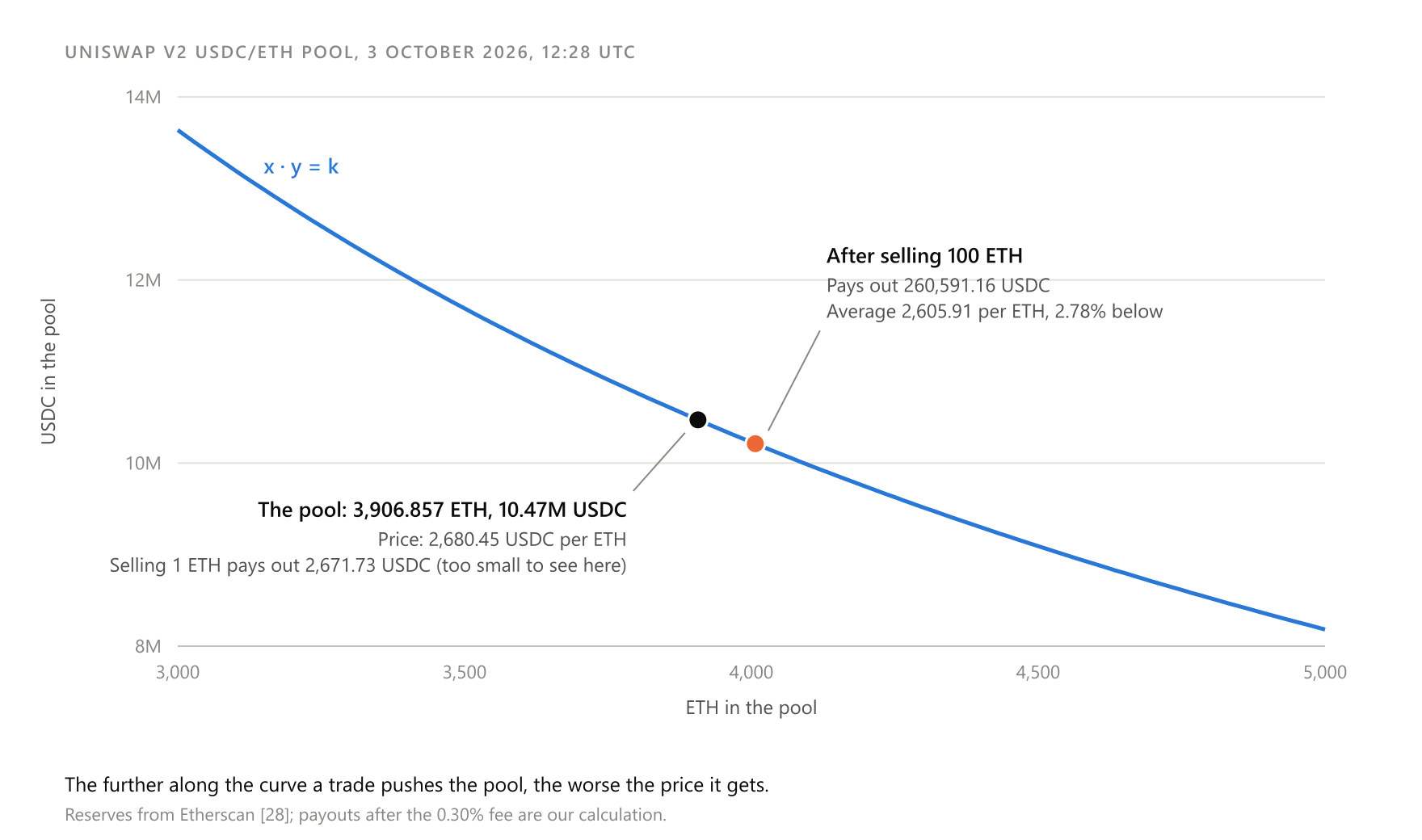
Nobody sets the price. A rule produces it. In Uniswap V2 the product of the two reserves (x · y = k) must stay at least constant after every swap, once the fee is taken out. That fee is 0.30% in every pool [23]. The more of one token you buy, the more expensive it gets for you. Whenever the pool's price drifts from the market price, someone always steps in with arbitrage (profiting from a price difference) and pulls it back.
The lending machine
In lending protocols such as Aave or Compound you deposit tokens into a shared pool and earn interest. You can also borrow from the pool by putting up collateral. Interest rates are set algorithmically by supply and demand [1].
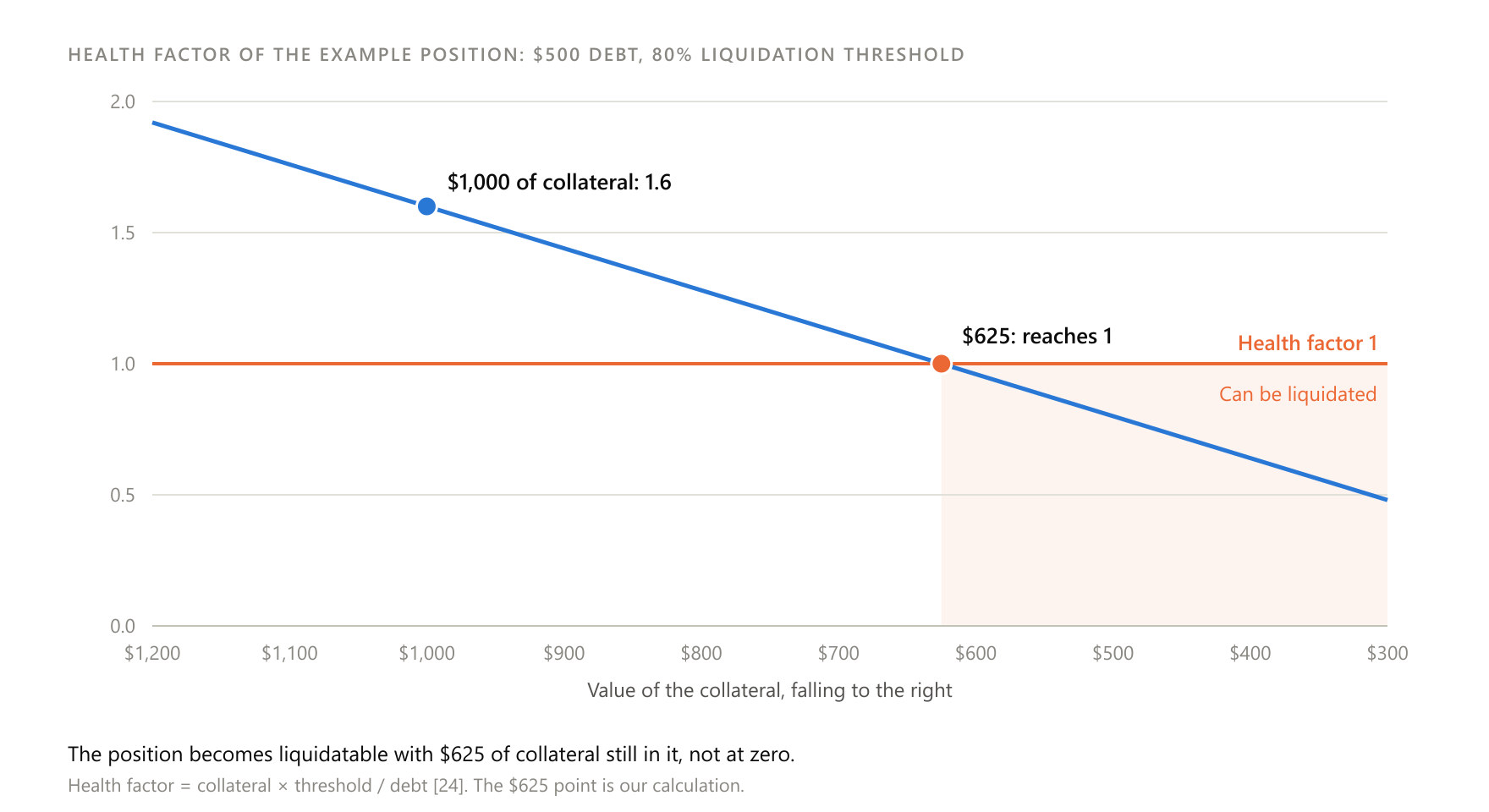
On Aave, the safety of an account is measured by its health factor. It is calculated as the value of the collateral, multiplied by each asset's liquidation threshold, divided by the value of the debt [24].
Take an example. With $1,000 of collateral at an 80% threshold and $500 of debt, the factor is 1,000 × 0.8 / 500 = 1.6 (our calculation). The prices used come from an oracle (a service that brings outside data, such as prices, onto the blockchain). When the factor falls below 1, the position can be liquidated: an outside liquidator repays part of the debt and receives collateral at a discount, the so-called liquidation bonus [25].
There is also a product that banks do not have: the flash loan. It is a loan that exists only within one transaction and must be repaid before that transaction completes. If it is not repaid, the whole transaction is cancelled [26]. The BIS describes it as essentially risk-free for the lender. It estimates that the largest platform offering such loans had issued about $5.5 billion of them between mid-2020 and late 2021 [5].
The stable-dollar machine
Stablecoins (cryptocurrencies designed to hold a steady value, usually one dollar) are DeFi's cash. There are two main kinds. USDC and USDT are issued by companies, which can freeze funds [1]. DAI rests on an overcollateralised pool of crypto assets and is managed entirely by contracts on the blockchain [5]. The BIS notes that most stablecoins belong to the first kind, so DeFi depends to a large extent on centralised entities and on the traditional banking system [5].
Bricks that click together
DeFi's most distinctive property is composability: one contract can call another within the same transaction. Schär stresses that this reduces counterparty risk, since all the steps either happen together or not at all [2]. The BIS calls it "DeFi Lego" [5]. As we will see, the same property also makes problems contagious.
Where the analogy breaks down
A vending machine does not change its own mechanism. DeFi protocols often do, through votes by token holders or through administrator keys.
The machine knows how many coins you put in, but it does not know the price of the product in the outside world. DeFi needs oracles for that, and an oracle can lag or be manipulated.
At a vending machine, nobody sees your choice before you press the button. On a blockchain, your transaction is visible in the mempool before it executes. In 2019 Daian and colleagues documented bots that, like Wall Street's high-frequency traders, jump ahead of ordinary users' trades. They named the value that can be extracted this way MEV (miner, now maximal, extractable value: value extracted from the ordering of transactions) [27].
Finally, a vending machine can give your money back if it jams. A blockchain transaction, once executed, cannot be undone.
One real example: Uniswap's USDC/ETH pool
At address 0xB4e16d0168e52d35CaCD2c6185b44281Ec28C9Dc on Ethereum sits one of the oldest Uniswap V2 pools, the one that swaps USDC for WETH (ETH in token form). It was created by the Uniswap V2 factory contract in block 10,008,355, at 20:22:25 UTC on 5 May 2020 [28].
At 12:28 UTC on 3 October 2026 the pool held 10,472,149.96 USDC and 3,906.857 WETH, worth about $20.97 million in total. At the same moment Etherscan showed an ETH price of $2,685.90 [28].
The pool's price comes from dividing the two reserves: 10,472,149.96 / 3,906.857 = 2,680.45 USDC per ETH (our calculation). That is about 0.2% below Etherscan's reference price. Small gaps like this are what arbitrageurs close.
Suppose someone sells 1 ETH into the pool at that moment. First the 0.30% fee is taken off, and the remaining 0.997 ETH goes into the formula: 0.997 × 10,472,149.96 / (3,906.857 + 0.997) = 2,671.73 USDC (our calculation).
The difference from the pool's price is $8.72. Of that, $8.04 is the fee and $0.68 is the trade's own effect on the price. Since December 2025 the V2 fee has been split 0.25% to liquidity providers and 0.05% to the protocol [23]. So of the $8.04, about $6.70 goes to liquidity providers and $1.34 to the protocol (our calculation).
If the sale were 100 ETH, the same formula gives 260,591.16 USDC, an average price of $2,605.91, or 2.78% below the pool's price (our calculation). That is what "liquidity" means in practice: in a pool of this size, a large sale moves the price noticeably.
This is a calculation on real, time-stamped reserves, not one specific trade that was executed. In practice most swaps pass through intermediate contracts and aggregators that split an order across many pools.
The numbers that matter
In Uniswap V2 the total 0.30% fee is written into every pool's code. The protocol's share is also fixed, at one sixth of the fee. It is switched on for all pools at once, but only if governance sets a recipient address [23]. In V3 there are several fee tiers, and the protocol's share is set per pool: a quarter of the fee in the 0.01% and 0.05% tiers, and a sixth in the 0.30% and 1% tiers [23].
These changes were switched on by the "UNIfication" proposal, submitted jointly by Uniswap Labs and the Uniswap Foundation. The proposal also provided for burning 100 million UNI from the protocol's treasury [29]. The vote closed in December 2025 with more than 125 million votes in favour and 742 against [30].
On Aave V3, liquidation starts when the health factor falls below 1. As a rule a liquidator can repay up to 50% of the debt. If the factor falls below 0.95, up to 100% [31]. The liquidation threshold and the bonus are set per asset. Assets are added by decision of Aave Governance or of administrators it selects [24].
On Aave V4, live on Ethereum since 30 March 2026 with three liquidity "hubs" and eleven "spokes" [11], the rule changed. A liquidator repays only as much as is needed to bring the account back to a target factor set by governance. The bonus grows the lower the factor is [31].
As Black Thursday showed, timing matters as much as the protocol's parameters. In March 2020 Maker's auctions lasted 10 minutes and were later extended to six hours [17]. The network's cost also swings widely: when we took our measurements, gas on Ethereum was 0.066 gwei [28], while in periods of congestion it soars.
Who you are actually trusting
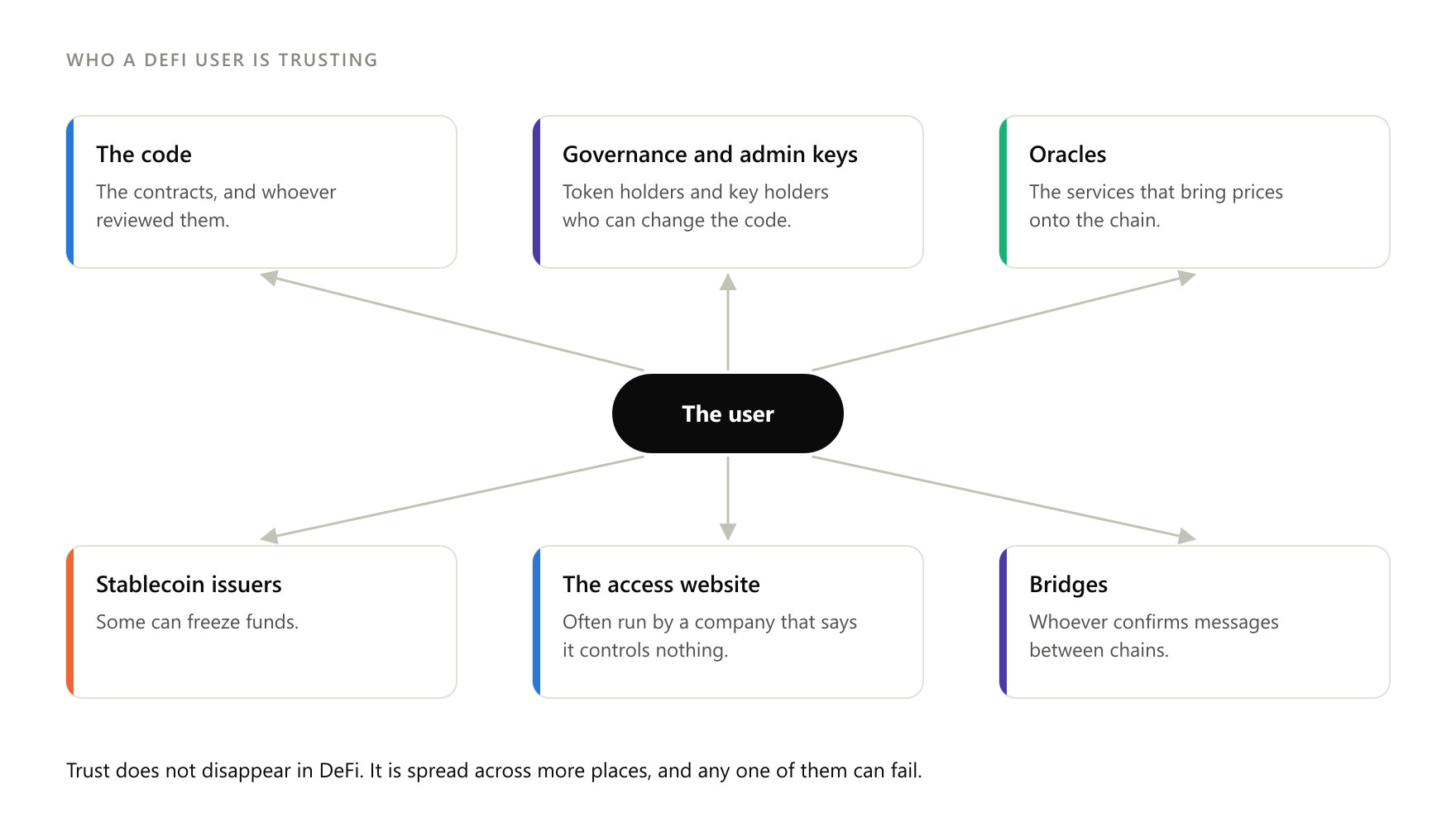
DeFi is often described as "trustless". In practice trust does not disappear. It is spread across more places.
First you trust the contracts' code and whoever has reviewed it [1]. Then you trust whoever can change it: governance token holders and, where they exist, holders of administrator keys. You trust the oracles that supply prices, and the issuers of the stablecoins you use, since some of them can freeze funds [1].
You also trust the website you go through. sky.money, for example, is run by Skybase International, which says it controls neither the contracts nor the governance of the Sky protocol [32]. Aave Labs likewise says it does not control or operate any version of the Aave protocol [11].
Finally, when funds move from one blockchain to another, you trust the bridge (a system that moves assets between blockchains) and whoever verifies its messages. In April 2026 one such bridge lost about $292 million because it required only a single confirmation [33].
Who runs it
Behind the large protocols there are companies with headquarters, founders and investors, as well as voters who decide on changes.
| Organisation | What it does | Legal form and seat | Led by | Funding |
|---|---|---|---|---|
| Uniswap Labs | Develops Uniswap. Since UNIfication it also takes over work of the Uniswap Foundation [29] | Universal Navigation Inc. Its terms of service are governed by New York law [34] | Hayden Adams, CEO [35] | Series A $11 million (August 2020) [36], Series B $165 million (October 2022) [35] |
| DUNI | The legal form of Uniswap's governance. Its members are participating UNI holders [37] | Wyoming nonprofit association (DUNA). Approved on 10 September 2025 [37] | UNI holders decide. Cowrie, as administrator, carries out only what governance approves [38] | Treasury in UNI [37] |
| Avara / Aave Labs | Aave Labs develops Aave. Avara is the parent company [39] | Formerly Aave Companies, originally ETHLend [39]. Legal form and seat: not verified from an official source | Stani Kulechov, founder and CEO of Aave Labs [40] | In April 2026 the Aave DAO approved $25 million in stablecoins and 75,000 AAVE [41] |
| Aave DAO | Votes on protocol changes | AAVE holders, Governance v3 since 25 December 2023 [11] | Token vote | DAO treasury |
| Sky (formerly MakerDAO) | Protocol behind DAI and USDS | Renamed on 27 August 2024 [42]. sky.money is run by Skybase International [32] | Rune Christensen, MakerDAO's founder [42] | No verifiable figures found |
| Compound Labs | Develops Compound | San Francisco. Founded in 2017 by Robert Leshner and Geoffrey Hayes [43] | No verifiable current leadership found | Seed $8.2 million (May 2018) [43], Series A $25 million (November 2019) [44] |
| LayerZero Labs | Messaging infrastructure between blockchains | Vancouver. Founded 2021 [45] | Bryan Pellegrino, CEO [46] | Series A $135 million (March 2022), Series B $120 million (April 2023) [46] |
How big it is
The most common measure of size is TVL (total value locked): the value of the tokens locked in protocols' contracts. According to DefiLlama, total TVL on 3 October 2026 was $96.78 billion. Stablecoins in circulation were worth $306.42 billion, and trading volume on DEXs over the previous 24 hours was $9.34 billion. DEXs accounted for 19.11% of volume relative to centralised exchanges, and the site tracked 6,674 protocols [47].
The protocols with the largest TVL that day were Lido ($27.12 billion), Aave ($19.57 billion) and Morpho ($11.38 billion). Sky had $6.09 billion, Uniswap $4.06 billion and Compound $1.65 billion [47].
The number depends on the definition. DefiLlama does not count what has been borrowed from a lending protocol, so that TVL is not inflated when the same tokens are deposited, borrowed and deposited again. It also does not count staking on the blockchains themselves [48]. Other data providers use different definitions. We could not verify comparable, time-stamped figures from a second provider for 3 October 2026, so we present one source together with its methodology.
The swings are large, and so are the differences between measurements. On 15 April 2020 DeFi held more than $702 million [16]. In 2021 TVL went above $180 billion [1]. For the third quarter of 2025, DappRadar recorded a record $237 billion [49], a figure not directly comparable with those produced by DefiLlama's method. On DefiLlama data, TVL stood at $69.18 billion on 30 June 2026 and $95.42 billion on 26 September [50]. Much of this movement comes from token prices rather than from new deposits.
Data providers are not permanent either. DappRadar itself announced in November 2025 that it was shutting down, citing financial unsustainability [51].
Who can change the code
A smart contract cannot be changed once it is on the blockchain, unless it was designed to be upgradeable through special contracts or through governance [1]. In the large protocols that is the norm. UNIfication changed who receives Uniswap's fees [29]. On Aave, governance and the administrators it selects adjust the risk parameters [24].
The absence of controls is a risk too. In October 2021 a Compound upgrade wrongly distributed rewards worth $90 million, and its founder wrote that there were no administrative controls to stop the distribution [5].
At the other extreme, where administrator keys exist, they become targets. In April 2026 Drift's administrative powers passed to attackers through a multisig (an account that needs signatures from several keys). The account needed two of five signatures and had no timelock (a mandatory wait before a decision takes effect) [52].
Even ownership of the name can be disputed. In December 2025 Aave Labs decided to keep certain revenue from app.aave.com, the website most users go through, revenue that had previously gone to the Aave DAO. A proposal followed asking Labs to transfer brand assets such as naming rights, social media accounts and the aave.com domain to the DAO. On 25 December 2025 it was rejected: 55% against, 41% abstaining and 3.5% in favour [40]. In April 2026 the DAO approved, with about 75% support, $25 million in stablecoins and 75,000 AAVE for Labs. The broader framework provides that, in exchange, all revenue from Aave-branded products, including swaps on aave.com, goes to the DAO treasury [41].
Who uses it and how the versions differ
Most of DeFi's funds sit on Ethereum. A significant share is also on networks such as Solana, Base, BSC, Tron and Arbitrum [47].
| Category | Protocol | Versions and milestones | TVL on 3 October 2026 |
|---|---|---|---|
| Trading (AMM) | Uniswap | Mainnet on 2 November 2018 [8]. V2 pools since May 2020 [28]. Protocol fees since December 2025 [29] | $4.06 billion [47] |
| Lending | Aave | v1 January 2020, v2 December 2020, v3 March 2022, V4 March 2026 [11] | $19.57 billion [47] |
| Lending | Compound | COMP distribution since June 2020 [12] | $1.65 billion [47] |
| Lending | Morpho | $11.38 billion [47] | |
| Collateralised stablecoin | Sky (formerly MakerDAO) | DAI. Renamed, and USDS launched, in 2024 [42] | $6.09 billion [47] |
| Liquid staking | Lido | DefiLlama counts it in DeFi TVL | $27.12 billion [47] |
Compared with the alternatives
DeFi is not compared only with banks. It is also compared with CeFi (centralised finance): crypto's own centralised exchanges and platforms. According to the BIS, the key difference is that in DeFi the service runs on smart contracts and is recorded on the blockchain, whereas in CeFi it is provided by central entities keeping private records [5].
| DeFi | CeFi (centralised exchanges) | Traditional finance | |
|---|---|---|---|
| Who holds the funds | The user, with their own keys [1] | The platform [1] | The bank or custodian |
| Identity checks | Usually none. Pseudonymous addresses [1] | Required [1] | Required |
| Where transactions are recorded | Publicly, on the blockchain [5] | In private records [5] | In private records |
| Cost of a trade | Protocol fee plus gas. On a popular DEX in 2021 the spread was up to 30 basis points wider than on a centralised exchange [5] | Platform fee | Intermediaries' fees |
| Main risks | Bugs, key compromises, liquidations [1] | Platform insolvency, as with FTX [1] | Credit and operational risk |
| If something goes wrong | Usually no recourse [1] | Depends on the platform | Courts and deposit guarantees |
What it trades away
Overcollateralisation solves the trust problem, but at a cost. According to the BIS, it limits access to credit to those who are already wealthy. That undercuts the argument that DeFi brings excluded people into the financial system. The same analysis notes that DeFi lending mainly serves speculation in crypto assets [3].
Leverage is easy, because whatever you borrow you can post as collateral elsewhere. When prices fall, forced selling pushes them down further. The BIS also observes that DeFi has no "shock absorbers", such as banks, able to supply liquidity in a crisis [5].
Speed and cost are not guaranteed. They depend on network congestion, which can break a liquidation mechanism at the most critical moment [17].
Full transparency has a cost too. Because every transaction is visible before it executes, it becomes a target for bots that jump the queue [27].
Finally, interconnection spreads problems. Federal Reserve researchers found that after Terra's collapse, the likelihood of a blockchain losing market share rose by about 40% for every additional bridge it shared with Terra [53].
What has gone wrong
| Date | Incident | Size | Cause | Outcome |
|---|---|---|---|---|
| June 2016 | The DAO | About 3.6 million ETH [54] | Smart contract vulnerability | Hard fork on 20 July 2016. The network split into Ethereum and Ethereum Classic [54] |
| February 2020 | bZx (two attacks) | Profits of about $350,000 and $636,000 (our calculation from the study) [26] | Flash loans and price manipulation | According to the study, they could have yielded $829,500 and $1.1 million [26] |
| March 2020 | Black Thursday (Maker) | $8.32 million of ETH for nothing [18] | Network congestion, 10-minute auctions | Debt auction, no compensation [18][20] |
| October 2020 | Harvest | $27 million [5] | Flash loan attack | |
| June 2021 | IRON | Run on a stablecoin [5] | ||
| October 2021 | Compound | $90 million in rewards [5] | Faulty upgrade | No mechanism to stop the distribution [5] |
| February 2022 | Wormhole (bridge) | About $320 million [1] | Bridge vulnerability | |
| March 2022 | Ronin (bridge) | 173,600 ETH and 25.5 million USDC [55] | Validator nodes compromised | The FBI attributed it to Lazarus Group and APT38 [55] |
| May 2022 | Terra / UST | About $50 billion of value in three days [56] | Run on the Anchor protocol | Collapse of the ecosystem [56] |
| March 2023 | Euler | About $197 million [1] | Flash loan | Most funds returned after negotiation [1] |
| March 2023 | USDC | Low of $0.87 [57] | $3.3 billion of reserves held at Silicon Valley Bank [58] | Returned to the dollar peg [57] |
| April 2026 | Drift (Solana) | About $285 million [59] | Administrative powers compromised [52] | No final outcome has been reported on recovery |
| April 2026 | KelpDAO (rsETH bridge) | 116,500 rsETH, about $292 million [33] | Poisoned nodes, single-confirmation setup [33] | No final outcome has been reported |
Some incidents deserve more detail.
In the Ronin case, the attackers controlled enough validator nodes to approve withdrawals from the bridge on their own. On 14 April 2022 the FBI announced that the groups Lazarus Group and APT38, linked to North Korea, were behind the attack [55].
At Drift, the attackers did not find a bug in the code. Through social engineering they persuaded members of the Security Council to sign transactions that looked routine, enough to cover the two of five signatures required. Those transactions used Solana's durable nonces: pre-signed instructions that do not expire and can be executed whenever the holder chooses. They were triggered on 1 April 2026 [52]. TRM Labs, on its initial investigation, believes North Korean hackers were likely behind the attack, and writes that the funds were drained in about 12 minutes [59].
At KelpDAO, according to LayerZero Labs' report, the breach began on 6 March 2026 with social engineering against one of its developers. The attackers "poisoned" internal nodes and got a forged message confirmed. Because the application required only one confirmation, 116,500 rsETH were released. Mandiant and CrowdStrike attribute the attack to North Korea's TraderTraitor group [33].
The effects spread: $6.2 billion was withdrawn from Aave. A coordinated effort called "DeFi United" raised 132,650 ETH, about $303 million, to cover the shortfall [60].
2026 has been one of the worst years for attacks. More than $840 million was lost in the first five months [60]. According to TRM Labs, actors linked to North Korea accounted for 76% of global losses from attacks in the first four months [60]. Aggregate figures need care, though: DefiLlama's attack database also includes centralised exchanges, such as Bitget in September 2026 [61].
Common misconceptions
"DeFi is anonymous." It is pseudonymous. Every transaction is recorded permanently, and analytics firms often link addresses to real people, especially when funds pass through exchanges that check identities [1].
"The code can't change." The large protocols change often, through votes or administrator keys [1][29]. In 2016 Ethereum as a whole rewrote its history with a hard fork to return The DAO's funds [54].
"Stablecoins are just code." USDC has a company behind it and reserves held at banks, and it temporarily lost its dollar peg when one of those banks failed [58][57].
"In DeFi you borrow without collateral." That is true only of flash loans, which live inside a single transaction [26]. Regular lending is overcollateralised [25].
"Decentralised means nobody controls it." The BIS speaks of a "decentralisation illusion" [5]. Daian and colleagues themselves note that for most "decentralised" exchanges, "non-custodial" would be a more accurate term [27].
"TVL shows how much money users have deposited." TVL moves with prices, and each provider measures it by different rules [48].
"If a security firm has audited it, it's safe." Ari Redbord of TRM Labs puts it simply: "audits protect against code bugs", but not against sophisticated social engineering [60].
The open questions
Is it really decentralised? Sirio Aramonte, Wenqian Huang and Andreas Schrimpf of the BIS argue that no code can foresee every contingency. Every platform therefore needs central governance, which usually concentrates in the hands of those holding the most tokens. They write that full decentralisation in DeFi is "an illusion" [5].
Can it lend to the real economy? The same authors, together with Sebastian Doerr, argue that for DeFi lending to reach households and businesses, it would have to rely less on collateral and more on information about borrowers. In their assessment, that would push the system towards greater centralisation [3].
How contagious is it? Anton Badev and Cy Watsky of the Federal Reserve show that bridges between blockchains carry shocks from one network to another [53].
Can it be fair to the small user? Philip Daian, Ari Juels and their co-authors argue that the promise of fair and transparent markets has not been met. In their view, the value extracted from the ordering of transactions creates risks even for the security of the network's consensus [27].
Can the attack problem be solved? Redbord considers it solvable through real-time coordination between the public and private sectors. Natalie Newson of CertiK describes it as a problem that spans every layer, from the code to the people [60].
The risks for the reader
The first risk is the code. A bug in a contract can drain a pool, and there is no one to reverse the transaction. The second is whoever can change the code. A multisig without a timelock, or a stolen administrator key, can do in minutes what no audit would allow.
If you borrow, the biggest risk is liquidation. A sharp price drop, a lagging oracle or a jammed network can cost you part or all of your collateral. If you provide liquidity, the price of the tokens in the pool can move against you. If you hold stablecoins, their value depends on the issuer or on their collateral. If you move funds between blockchains, you are also trusting the bridge.
Some risks have nothing to do with the protocol and everything to do with the user: fake tokens with names that resemble well-known ones, fake websites, and requests for approvals that give third parties access to your tokens [22]. Because there is no attendant to check a suspicious transaction, checking before you sign is entirely your responsibility.
Finally, the rules that apply to DeFi differ from country to country and may change.
Where to go next
DeFi rests on what a blockchain makes possible in the first place. To see how it all started, read our article on Bitcoin, the first system to solve the problem of transferring value without an intermediary.
Sources
- S: Chainalysis, DeFi (Glossary), chainalysis.com/glossary/defi, May 2026
- S: Fabian Schär, DeFi's Promise and Pitfalls, IMF Finance & Development, imf.org/en/publications/fandd/issues/2022/09, September 2022
- P: S. Aramonte, S. Doerr, W. Huang, A. Schrimpf, DeFi lending: intermediation without information?, BIS Bulletin 57, bis.org/publ/bisbull57.pdf, June 2022
- P: Nick Szabo, Smart Contracts: Building Blocks for Digital Markets (rewritten version of the Extropy #16 article), fon.hum.uva.nl/…/smart_contracts_2.html, 1996
- P: S. Aramonte, W. Huang, A. Schrimpf, DeFi risks and the decentralisation illusion, BIS Quarterly Review, bis.org/publ/qtrpdf/r_qt2112b.htm, December 2021
- P: ethereum.org, Ethereum Whitepaper, ethereum.org/en/whitepaper (project source), 2014
- S: ConsenSys, A Short History of Ethereum, consensys.io/blog/a-short-history-of-ethereum (project source), May 2019
- P: Hayden Adams / Uniswap Labs, A Short History of Uniswap, blog.uniswap.org/uniswap-history (project source), February 2019
- S: DeFiPrime (N. Sawinyh), Interview with TokenSets creators, defiprime.com/tokensets, June 2019
- S: Camila Russo / The Defiant, What Is Decentralized Finance?: A Deep Dive, CoinMarketCap Academy, coinmarketcap.com/academy/article/what-is-decentralized-finance
- P: Aave, Changelog, aave.com/docs/resources/changelog (project source), September 2026
- S: The Block (C. Wan), Compound governance token begins its first day of trading, theblock.co/linked/68369, June 2020
- S: The Block, Compound overtakes MakerDAO in value locked, theblock.co/news/defi/2020-06-20-…-69077, June 2020
- S: ConsenSys (E. Muzzy), The Impact of Liquidity Mining on DeFi User Growth, consensys.io/blog/impact-of-liquidity-mining-on-defi-users (project source), August 2020
- P: Fabian Schär, Decentralized Finance: On Blockchain- and Smart Contract-Based Financial Markets, FRB St. Louis Review 103(2), ideas.repec.org/a/fip/fedlrv/91428.html, April 2021
- P: L. Gudgeon, D. Perez, D. Harz, B. Livshits, A. Gervais, The Decentralized Financial Crisis, arXiv:2002.08099, arxiv.org/abs/2002.08099, February 2020 (rev. June 2020)
- S: CoinDesk (B. Dale), Mempool Manipulation Enabled Theft of $8M in MakerDAO Collateral on Black Thursday: Report, coindesk.com/tech/2020/07/22/…, July 2020
- S: Whiterabbit (I. Igamberdiev), Black Thursday for MakerDAO: $8.32 million was liquidated for 0 DAI, medium.com/@whiterabbit_hq/…, March 2020
- S: Cointelegraph (O. Avan-Nomayo), MakerDAO Takes New Measures to Prevent Another 'Black Swan' Collapse, cointelegraph.com/magazine/makerdao-takes-new-measures-…, May 2020
- S: The Block (Y. Khatri), MakerDAO won't compensate Vaults affected by liquidations during the March market crash, theblock.co/news/defi/2020-09-23-…-78571, September 2020
- P: Maker Foundation, The Market Collapse of March 12-13, 2020: How It Impacted MakerDAO, blog.makerdao.com/the-market-collapse-of-march-12-2020-… (project source, now redirects to sky.money), April 2020
- S: Uniswap Labs, What is DeFi? An Intro to Decentralized Finance, blog.uniswap.org/what-is-defi (project source), April 2025
- P: Uniswap, Fees (documentation), developers.uniswap.org/docs/get-started/concepts/fees (project source), 2026
- P: Aave, Risk Parameters (risk-v3), github.com/aave/risk-v3 (project source)
- P: Aave, Aave V3 Overview, aave.com/docs/aave-v3/overview (project source)
- P: K. Qin, L. Zhou, B. Livshits, A. Gervais, Attacking the DeFi Ecosystem with Flash Loans for Fun and Profit, arXiv:2003.03810 (FC 2021), arxiv.org/abs/2003.03810, March 2020
- P: P. Daian, S. Goldfeder, T. Kell, Y. Li, X. Zhao, I. Bentov, L. Breidenbach, A. Juels, Flash Boys 2.0, arXiv:1904.05234 (IEEE S&P 2020), arxiv.org/abs/1904.05234, April 2019
- P: Etherscan, Uniswap V2: USDC (0xB4e16d01…C9Dc), etherscan.io/address/0xb4e16d0168e52d35cacd2c6185b44281ec28c9dc, October 2026
- P: Uniswap Labs and Uniswap Foundation, UNIfication, blog.uniswap.org/unification (project source), November 2025
- S: CoinDesk (S. Reback), Uniswap's token burn, protocol fee proposal backed overwhelmingly by voters, coindesk.com/business/2025/12/26/…, December 2025
- P: Aave Labs, Aave V4's New Liquidation Engine, aave.com/blog/aave-v4-liquidations (project source), December 2025
- P: Skybase International, Sky.money, sky.money (project source), October 2026
- P: LayerZero Labs, KelpDAO Incident Report, layerzero.network/blog/layerzero-labs-kelpdao-incident-report (project source), May 2026
- P: Uniswap Labs, Uniswap Labs Terms of Service, support.uniswap.org/hc/en-us/articles/30935100859661 (project source), July 2026
- S: Fortune (J. J. Roberts), Uniswap's $165M funding round a bright spot for DeFi in Crypto Winter, fortune.com/crypto/2022/10/13/…, October 2022
- P: Hayden Adams / Uniswap Labs, Series A, blog.uniswap.org/uniswap-raise (project source), August 2020
- P: DUNI / Cowrie, DUNI: Q4 and Year End 2025 Financial Statements and Tax Update, vote.uniswapfoundation.org/forums/7/… (project source), 2026
- P: Uniswap Governance, Establish Uniswap Governance as "DUNI," a Wyoming DUNA (proposal 90), vote.uniswapfoundation.org/proposals/90 (project source), September 2025
- S: TechCrunch (J. Melinek), Aave Companies rebrands to Avara and acquires crypto wallet Family, techcrunch.com/podcast/aave-companies-rebrands-to-avara-…, November 2023
- S: DL News (A. Gilbert), Aave Labs critics lose key DAO vote, for now, dlnews.com/articles/defi/aave-labs-critics-lose-key-dao-vote-for-now, December 2025
- S: The Block, Aave DAO approves $25 million Aave Labs funding grant in binding 'Aave Will Win' vote, theblock.co/post/397138, April 2026
- S: The Block, MakerDAO rebrands to Sky, DAI stablecoin optionally upgradeable to USDS, theblock.co/post/313235, August 2024
- S: VC News Daily, Compound Raises $8.2M Seed Round, vcnewsdaily.com/compound/venture-capital-funding/…, May 2018
- S: DeFi Rate (A. Miguel), Compound Finance Closes $25 Million Series A Led By a16z, defirate.com/news/compound-finance-25-million-series-a
- S: BetaKit, LayerZero Labs raises $120 million at $3 billion valuation, betakit.com/layerzero-labs-raises-120-million-…, April 2023
- S: The Block, LayerZero reaches $3 billion valuation in Series B funding round, theblock.co/post/224762, April 2023
- S: DefiLlama, DeFi Dashboard, defillama.com, October 2026
- S: DefiLlama, Data Definitions, docs.llama.fi/analysts/data-definitions, 2026
- S: Cointelegraph (E. Reguerra), DeFi TVL hits record $237B as daily active wallets fall 22% in Q3: DappRadar, cointelegraph.com/news/defi-tvl-record-237b-…, October 2025
- S: Dwellir, The State of DeFi in Q3 2026, dwellir.com/blog/state-of-defi-q3-2026, September 2026
- S: Cointelegraph, DappRadar's token price plummets after platform announces shutdown, cointelegraph.com/news/dappradar-shut-down-…, November 2025
- S: BlockSec, Drift Protocol Incident: Multisig Governance Compromise via Durable Nonce Exploitation, blocksec.com/blog/drift-protocol-incident-…, April 2026
- P: A. Badev, C. Watsky, Interconnected DeFi: Ripple Effects from the Terra Collapse, FEDS 2023-044, federalreserve.gov/econres/feds/interconnected-defi-…, June 2023
- S: A. Antonopoulos, G. Wood, Mastering Ethereum, appendix on fork history, github.com/…/appdx-forks-history.asciidoc
- S: BleepingComputer, FBI links largest crypto hack ever to North Korean hackers, bleepingcomputer.com/news/security/fbi-links-…, April 2022
- P: J. Liu, I. Makarov, A. Schoar, Anatomy of a Run: The Terra Luna Crash, NBER WP 31160, ideas.repec.org/p/nbr/nberwo/31160.html, 2023
- S: Chainalysis, Crypto Market Reaction to Silicon Valley Bank and USDC Depeg, chainalysis.com/blog/crypto-market-usdc-silicon-valley-bank, March 2023
- S: CoinDesk (K. Sandor), Circle Confirms $3.3B of USDC's Cash Reserves Stuck at Failed Silicon Valley Bank, coindesk.com/business/2023/03/11/…, March 2023
- S: TRM Labs, North Korean Hackers Attack Drift Protocol In USD 285 Million Heist, trmlabs.com/resources/blog/…, April 2026
- S: Decrypt (Vismaya V), Why DeFi Keeps Losing Millions to Exploits, decrypt.co/368591, May 2026
- S: DefiLlama, Hacks, defillama.com/hacks, October 2026
This article is educational and for general information. The facts in crypto move quickly, so verify them before you act on anything here. This is not financial advice.