

In 2026 the Ethereum Foundation lost both of its co-executive directors. On 13 February the Foundation's board announced that Tomasz Stańczak was stepping down as Co-Executive Director and appointed Bastian Aue as interim Co-Executive Director [9]. In June, Hsiao-Wei Wang resigned as co-executive director and board member with immediate effect, the second departure from the top role that year [11]. Days later the Foundation concluded a months-long reorganisation with 54 fewer colleagues, roughly 20% of its staff [13].
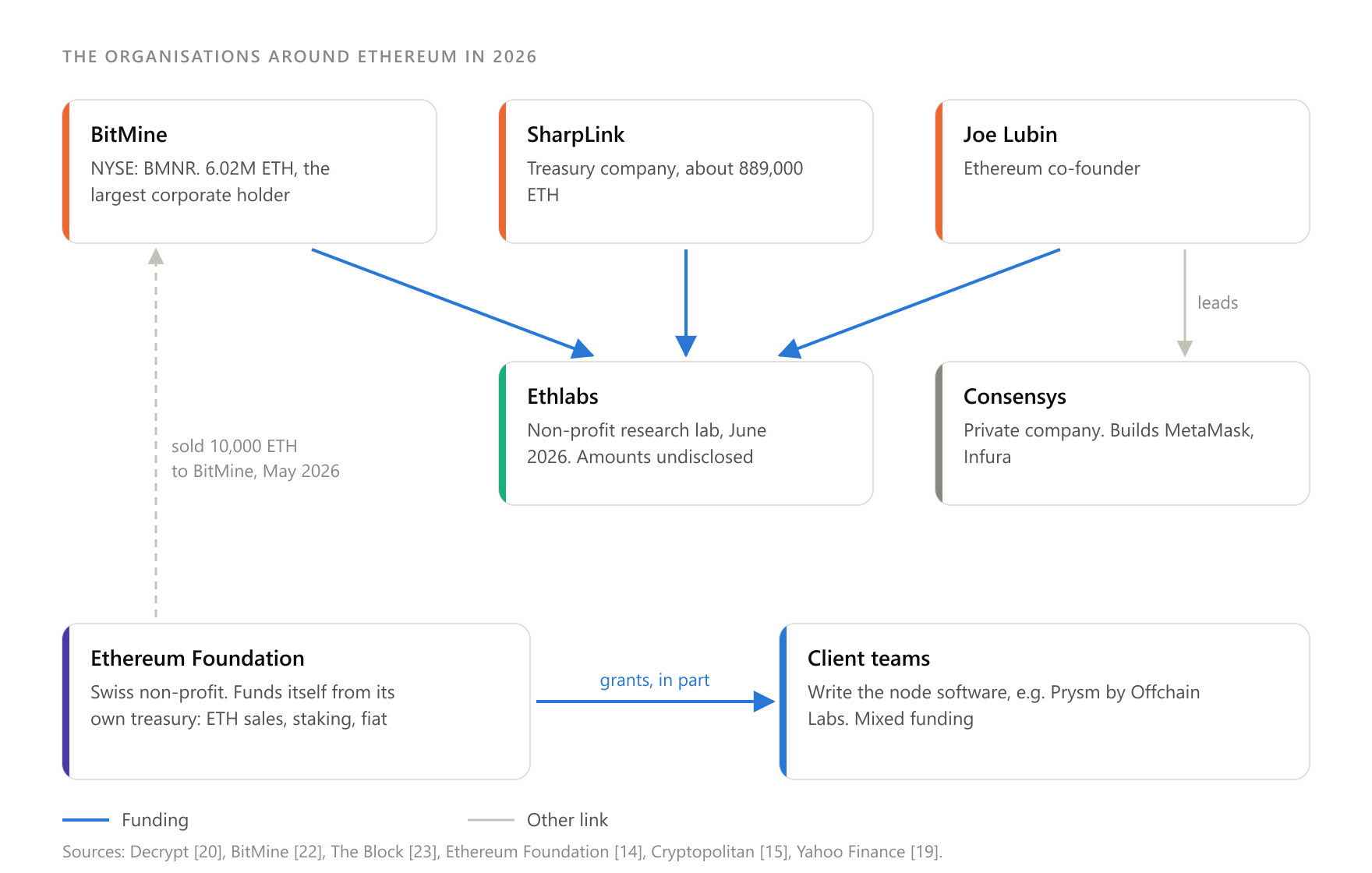
Over the same months, a single listed company was building an ETH position of a very different size. As of 4 October 2026, BitMine Immersion Technologies reported holding 6,016,414 ETH, which it put at 4.9% of the ETH supply [22]. That is more than 30 times the 172,650 ETH, plus 10,000 wrapped ether, that blockchain analytics firm Arkham showed the Foundation could deploy in February [17]. BitMine, together with SharpLink and Ethereum co-founder Joe Lubin, is also funding Ethlabs, a new non-profit research lab founded by former Foundation researchers [20].
The protocol itself kept moving. Ethereum shipped two hard forks in 2025 [4], and a third, Glamsterdam, activated on its first public testnet, Sepolia, on 6 October 2026 [38]. This article sets out who actually steers Ethereum now, what ETH's supply and security look like in on-chain data, and what the network has and has not delivered.
Key numbers at a glance
| Metric | Value | Source | Captured |
|---|---|---|---|
| ETH price | $2,714.14 | CoinMarketCap [2] | 6 Oct 2026 |
| Market capitalisation | about $331.4 billion | CoinMarketCap [2] | 6 Oct 2026 |
| Fully diluted valuation | equal to market cap (no maximum supply) | CoinMarketCap [2]; Tokenomist [37] | 6 Oct 2026 |
| All-time high | $4,953.73 | CoinMarketCap [2] | 6 Oct 2026 |
| Distance from all-time high | about 45% below | calculated from [2] | 6 Oct 2026 |
| Current supply | 122,103,819 ETH | ultrasound.money [1] | 6 Oct 2026 |
| ETH held in beacon chain validator balances | about 44.17 million ETH | ultrasound.money [1] | 6 Oct 2026 |
| Gas price | 0.1 gwei | ultrasound.money [1] | 6 Oct 2026 |
| Annualised supply growth | about 0.8% | Galaxy Research [24] | 12 May 2026 |
| US spot ether ETF net assets | about $15.21 billion | SoSoValue via Odaily [33] | 1 Sep 2026 |
| BitMine ETH holdings | 6,016,414 ETH | BitMine (company claim) [22] | 4 Oct 2026 |
Who actually runs Ethereum in 2026?
Ethereum has no company at the top. The project's own website says Ethereum has no CEO, board or single controlling party, and describes the Ethereum Foundation as a non-profit that supports the network without controlling it [3]. That is the project's own account. In practice, protocol changes are proposed as Ethereum Improvement Proposals, implemented by independent client teams and run by validators [3]. For most of Ethereum's history, the Foundation was the organisation that held this process together.
That organisation went through its most turbulent year in 2026. Stańczak had shared the leadership with Hsiao-Wei Wang since early 2025, after long-time executive director Aya Miyaguchi moved to a new role amid criticism that the Foundation was not pushing the ecosystem forward hard enough [10]. After Wang's resignation in June, board member Bastian Aue took on expanded responsibilities for the transition and day-to-day operations, and CoinDesk counted roughly nine senior figures who had left or transitioned out over six months [12]. The Foundation now groups its work into five clusters (protocol, access, user, community and institutional layers), plus an operations cluster and one supporting management [13].
The Foundation presents the change as a deliberate narrowing of scope. In a May 2026 post, Buterin argued that the Foundation is not the centre of Ethereum but one participant among several, with a defined purpose, and that it is choosing longevity over breadth by concentrating on censorship resistance, openness, privacy and security [34].
Others stepped into the space. Ethlabs was announced on 22 June 2026 as a non-profit research and development organisation founded by former Foundation researchers and funded by BitMine, SharpLink and Joe Lubin. The precise funding was not disclosed [20]. Its launch announcement states that final decisions on research priorities and technical direction will rest with Ethlabs leadership [21]. That independence is the organisation's own claim. Decrypt, which reported the launch, discloses that Lubin (through Consensys) and BitMine chairman Tom Lee are investors in its parent company [20].
The asymmetry in holdings is the core of the story. BitMine reports 5,067,309 of its ETH as staked [22]. According to SER data cited by The Block, the next-largest treasury companies are SharpLink with approximately 888,938 ETH and The Ether Machine with 496,712 ETH [23]. The Foundation does not publish a live balance. In February 2026, Arkham data showed it had 172,650 ETH available to deploy plus 10,000 wrapped ether [17]. By early April it had staked roughly 70,000 ETH, and Arkham showed about 102,400 ETH on the Foundation's tracked addresses [18]. It also sold 10,000 ETH to BitMine in a transaction completed on 1 May [19]. Arkham's address labels are estimates, not audited figures, so the Foundation's exact current holdings cannot be determined from public data.
| Organisation | Jurisdiction | Leadership | Role | Funding source |
|---|---|---|---|---|
| Ethereum Foundation | Switzerland (non-profit) [34] | Bastian Aue, interim co-executive director [9][12]; Aya Miyaguchi, president as of May 2026 [24] | Protocol research, coordination, grants [13] | Own treasury: ETH sales, staking, fiat reserves [14] |
| Ethlabs | Not disclosed | Former Foundation researchers [20] | Protocol research aimed at institutional use [20] | BitMine, SharpLink, Joe Lubin; amounts undisclosed [20] |
| Consensys | Not disclosed in our sources | Joseph Lubin [3] | Builds MetaMask and Infura [3] | Private company |
| BitMine Immersion Technologies | US-listed (NYSE: BMNR) [22][23] | Chaired by Tom Lee [23] | Largest corporate ETH holder; Ethlabs funder [22][20] | Public markets |
| Client teams (e.g. Prysm, by Offchain Labs) | Various | Various | Write and maintain node software [25] | Mixed; partly Foundation grants [15] |
The project is still most closely identified with one person. Buterin conceived Ethereum in late 2013 and remains actively involved, though the project's website says decisions are reached by group agreement rather than by any single individual [3].
Who decides changes, and who holds the money?
Ethereum has no on-chain governance and no protocol treasury. There is no vote turnout to report because there is no vote. The closest historical exception was the 2016 DAO fork, which was decided after an off-chain vote by ETH holders in which over 85% supported the fork [4].
The money that funds core work sits mainly with organisations. The Foundation's treasury policy, published in June 2025, set annual spending at 15% of the treasury with a 2.5-year operating buffer, and committed to cutting spending roughly linearly over five years to a 5% long-term baseline [14]. Under the same policy, the co-executive directors answer to the board for the treasury, and detailed quarterly reports go to the board and management [14]. Those quarterly reports are internal. The last public annual figures cover 2024: a treasury of $970.2 million, 81.3% of it in crypto assets and 99.45% of those in ETH. Across the ecosystem, organisations spent $497 million on project funding, of which the Foundation provided $240.3 million [16].
One funding line has ended. According to Cryptopolitan, the Foundation's four-year Client Incentives Program, which funded teams building Ethereum's core software, expired in April 2026 [15].
How was ETH originally distributed?
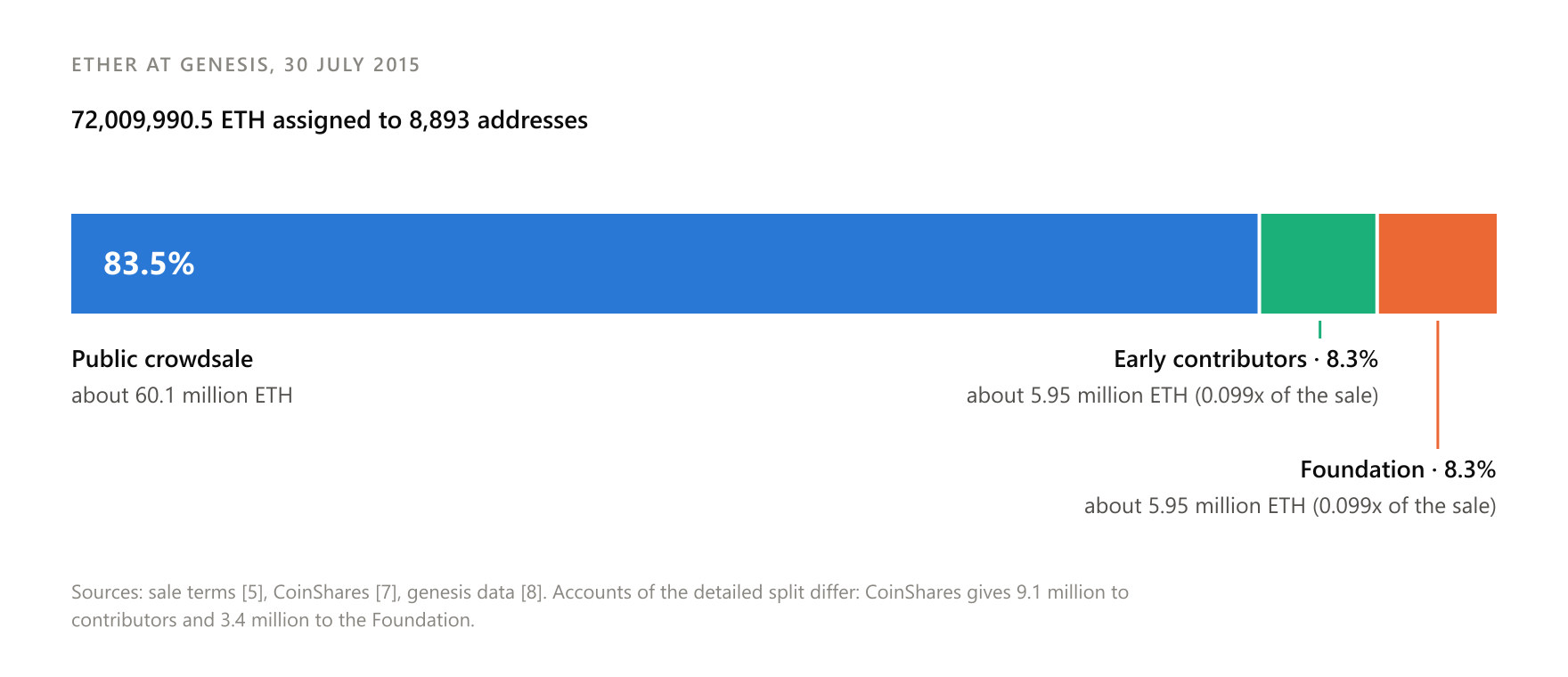
The whitepaper was released on 27 November 2013, and ether went on sale on 22 July 2014 for 42 days, payable in bitcoin [4]. The sale price started at 2,000 ETH per BTC for 14 days and then declined linearly to 1,337 ETH per BTC. Two endowment pools, each equal to 0.099 times the ether sold, were set aside: one for early contributors and one for the Foundation, reduced from an earlier proposal of 0.075x and 0.225x [5].
The sale raised 31,000 BTC, worth about $18 million at the time [3]. Buyers paid about $0.30 per ether on average, and the three largest purchasers received roughly 1 million ether each [6]. The genesis block assigned 72,009,990.49948 ETH to 8,893 addresses [8], and the network launched on 30 July 2015 [3].
Accounts of how the roughly 12 million premined ETH was split in detail differ. CoinShares puts the sale at 60.1 million ETH, with 9.1 million to early contributors and 3.4 million to the Foundation [7]. The Block describes 3 million as a Foundation endowment, 6 million shared among 85 contributors, and 3 million in a programme letting about 50 Foundation workers buy at crowdsale prices [6]. Their totals differ as well: CoinShares' figures add up to 72.6 million ETH [7], while the genesis block assigned 72,009,990.5 ETH [8]. Over time the genesis holders have largely moved on: at the last dataset refresh, only 3.12% of genesis ETH was still in its original addresses [8].
| Allocation at genesis | Amount | Share |
|---|---|---|
| Public crowdsale | about 60.1 million ETH [7] | about 83.5% |
| Early contributor pool (0.099x of sale) [5] | about 5.95 million ETH | about 8.3% |
| Foundation endowment (0.099x of sale) [5] | about 5.95 million ETH | about 8.3% |
| Total at genesis | 72,009,990.5 ETH [8] | 100% |
How does ETH supply work after the Merge?
ETH has no maximum supply [37]. Current supply stands at 122,103,819 ETH [1]. Two forces set the direction. New ETH is issued to validators. Since 5 August 2021, under EIP-1559, the base fee of every transaction has been burned. Priority fees paid on top are not burned [1].
The Merge to proof-of-stake on 15 September 2022 [4] cut issuance sharply [1]. For a period, burning outpaced issuance. That is no longer the case. Galaxy Research estimated in May 2026 that ETH was inflating at about 0.8% a year, with supply up roughly 1.1 million ETH since the Merge [24]. One reason is that EIP-4844 cut the cost for layer-2 networks to post data by roughly 99%, so less ETH is burned per transaction [24]. Cheaper scaling and ETH's supply dynamics pulled in opposite directions.
How does Ethereum work, and how fast is it in practice?
Since the switch to proof-of-stake in September 2022, the network has been secured by validators who lock up ETH and process transactions [3]. Applications run as smart contracts on the Ethereum Virtual Machine. Most retail activity now happens on layer-2 networks that settle back to Ethereum.
Real-world performance is modest. Ethereum produces a block every 12 seconds, finality takes about 13 minutes, and the base layer handles roughly 15 to 30 transactions per second under a 60 million gas limit [24]. Fees, however, have fallen. A simple ETH transfer cost around $0.095 in September 2026 [32]. The 2025 upgrades mostly changed how accounts and staking work. Pectra raised a single validator's maximum effective balance to 2,048 ETH and, through EIP-7702, let ordinary accounts execute code similar to a smart contract [4].
The trade-off is deliberate. Galaxy's analysis frames Ethereum's premium as credible neutrality, with slower speed as the cost of that premium [24].
How secure is Ethereum, and where is it concentrated?
Validator balances on the beacon chain total about 44.17 million ETH [1], about 36% of supply. To stop the chain finalising, an attacker would need more than a third of staked ETH: about 14.7 million ETH, roughly $40 billion at the price above. To finalise a chain of their choosing, they would need two thirds: about 29.4 million ETH, roughly $80 billion. These are theoretical floors. Buying that much ETH would move the price substantially.
The more realistic risk sits in software and infrastructure. On 4 December 2025, the day after the Fusaka upgrade, a Prysm bug caused 248 missed blocks out of 1,344 slots over 42 epochs, an 18.5% miss rate, with network participation dropping as low as 75% [25]. At epoch 411,448 voting participation was 74.7%, less than nine points above the two-thirds threshold needed for finality [27]. The same postmortem pointed at a larger concentration: Lighthouse may have represented more than 56% of the network as of 12 December 2025 [25]. Commentators noted that this left Lighthouse close to the two-thirds level at which a single client bug could finalise an invalid chain [26].
Block production is also concentrated. Over 90% of blocks are routed mainly through three relays, with no protocol-level fallback [24]. This has had real effects before. After the Tornado Cash sanctions in August 2022, over 70% of blocks began filtering sanctioned transactions [24].
The largest single owner of staked ETH is a listed company. BitMine says it has staked more ETH than any other entity [22]. That is the company's own claim.
Is staking ETH real yield or dilution?
Both, in different proportions. Most staking rewards are newly issued ETH. That transfers value from holders who do not stake to holders who do, rather than creating it. The smaller part comes from priority fees and MEV, which are genuine payments by users.
Galaxy puts the staking yield at about 3%, which it says underperforms US Treasuries on a risk-adjusted basis [24]. Set against roughly 0.8% annual supply growth [24], a staker's share of the network grows by a little over 2% a year. That is a gain relative to non-stakers, not income from outside the system.
Staking has become institutional. The deposit contract went live on 14 October 2020, and withdrawals were enabled on 12 April 2023 [4]. The Foundation itself completed staking roughly 70,000 ETH in April 2026 [18]. BlackRock's staked ETH fund, ETHB, had drawn about $705 million in cumulative net inflows by 1 September 2026 [33].
Has Ethereum delivered what it promised?
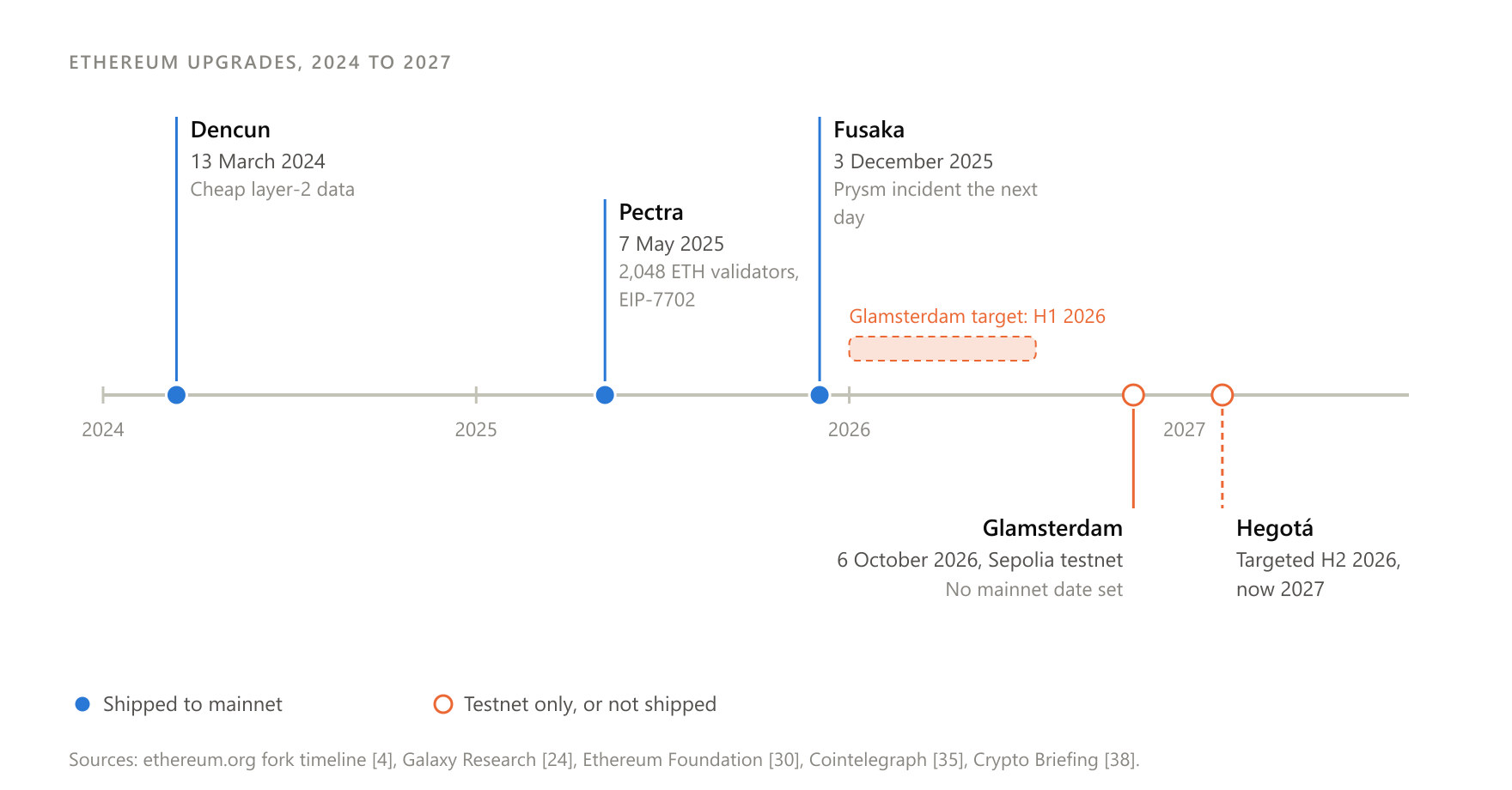
On upgrades, recent delivery has been steady. 2025 brought two hard forks in a single calendar year for the first time since 2021 [24]: Pectra on 7 May and Fusaka on 3 December [4]. The harder test is the next stage. In early 2026 the Foundation published the Strawmap, a single-page roadmap for the base layer through the end of the decade [24].
The first fork on that map has slipped. Glamsterdam was targeted for the first half of 2026, and by April the Foundation described it as trickier and slower than anticipated [24]. Developers first set its Sepolia testnet fork for 28 September 2026 [31]. The Foundation then scheduled activation on Sepolia for 6 October 2026 [30], and according to Crypto Briefing the upgrade went live on Sepolia that day at 13:53:36 UTC [38]. As of 6 October 2026, no mainnet date had been set [38].
Two longer-running items show the pattern. Native account abstraction has been deferred repeatedly since 2016, and Verkle trees were pushed back from several earlier forks because of migration complexity [24].
| Item | Promised or targeted | Shipped |
|---|---|---|
| Dencun (cheap layer-2 data) | Original target date not established in our sources | 13 March 2024 [4] |
| Pectra | Original target date not established in our sources | 7 May 2025 [4] |
| Fusaka | Original target date not established in our sources | 3 December 2025 [4] |
| Glamsterdam | First half of 2026 [24] | Not shipped to mainnet. Activated on Sepolia testnet on 6 October 2026; no mainnet date [30][38] |
| Hegotá (FOCIL, inclusion lists) | Second half of 2026, timing uncertain [24] | Not shipped. Developers now target 2027 [35] |
| Native account abstraction | Proposals since 2016 [24] | Not shipped |
What is Ethereum actually used for?
The data splits into two different pictures, and both come from one analyst firm that discloses an ETH position [24]. On capital that sits still, Ethereum leads. Its share of total value locked has held at about 55% to 60% since mid-2022. It hosts about half of all stablecoin market capitalisation and more than 60% of tokenised real-world assets [24].
On activity, it lags. Ethereum's share of total crypto network fees has fallen from over 90% in early 2020 to between 10% and 20%, and its share of decentralised exchange volume has dropped to about 20% [24]. Galaxy summarises Ethereum as a network that keeps the trust of capital but has lost the attention of users [24].
Regulated investment products add another layer of demand. On 1 September 2026, US spot ether ETFs held about $15.21 billion in net assets, 5.21% of ETH's market capitalisation, with cumulative net inflows of $13.07 billion [33].
What has gone wrong on Ethereum?
Failures of the chain itself and failures of applications built on it are different things, and they are kept apart here.
At the chain level, denial-of-service attacks in September and October 2016 forced two corrective hard forks [4]. In May 2023 the network lost finality for about 25 minutes, then for over an hour the following day, before recovering on its own [26]. The December 2025 Prysm incident described above did not break finality but came within nine percentage points of it [27].
At the application level, the defining event remains the 2016 DAO hack. The DAO contract was drained of over 3.6 million ETH. Some miners rejected the fork that returned the funds and went on to form Ethereum Classic [4]. The largest application exploit of 2026 followed the same logic of contagion through connected protocols. On 18 April 2026 an attacker drained about 116,500 rsETH, roughly $293 million, from KelpDAO's cross-chain bridge, left Aave with an estimated $196 million in bad debt, and Aave's deposits fell from $26.4 billion to about $18 billion within 48 hours [24]. Ethereum's own consensus was not affected in either case.
The case against Ethereum
The most serious criticism is economic. Galaxy Research argues that prioritising layer-2 scaling over the base layer broke ETH's value-accrual mechanics without delivering the unified user experience the rollup-centric vision promised [24]. In its bear case, ETH has been net inflationary since April 2024, fee revenue has collapsed, and ecosystem growth has not translated into value for the token [24]. The firm that makes this case holds ETH, which makes the criticism harder to dismiss, not easier.
Ethereum's best-known figure has conceded part of the argument. Buterin has said that the original vision of layer-2 networks as branded shards of Ethereum no longer makes sense [24]. That reverses the strategy that defined 2022 to 2025.
The second line of criticism targets the Foundation. Longtime contributor Zak Cole called the Foundation "completely out of touch" [34]. Not all critics go that far. Chris Boulos, president of Dromos Labs, said the critique that direction has been unclear and wasteful, and that the application layer has been treated as secondary, is fair [34].
The third line is structural. One consensus client was close to a supermajority in December 2025 [25]. Three relays handle most block building [24]. Features users have wanted for a decade remain deferred [24]. None of these has caused a catastrophic failure. Each is a single point that the protocol's design is meant to avoid.
Is ETH a security?
In the United States the question now has a formal answer. The SEC and the CFTC issued a joint interpretive release that names Ether, alongside Bitcoin, Solana, XRP and others, as a "digital commodity" that is not a security [28]. The release was issued on 17 March 2026 and sets out a five-category classification of crypto assets [29]. An interpretation can be revised by a future Commission. It is not a statute.
In the European Union, the MiCA regulation sets the rules for crypto-asset service providers, and the European Securities and Markets Authority (ESMA) publishes a central register of those that are authorised [36].
How does Ethereum compare with its rivals?
| Network | Where it leads | Where it trails Ethereum |
|---|---|---|
| Ethereum | TVL, stablecoins, tokenised assets [24] | Base-layer speed and fees share [24] |
| Solana | Roughly 25% to 30% of DEX volume; built for parallel execution from inception [24] | Smaller share of tokenised real-world assets [24] |
| Tron | Main gainer of stablecoin share, driven by payments in emerging markets [24] | DeFi depth [24] |
| Ethereum layer-2s (Base, Arbitrum) | Cheap execution; meaningful DEX share [24] | Fragmentation; less value flows back to ETH [24] |
| Bitcoin | Network built around holding [24] | Not designed as a general-purpose application platform [3] |
Solana and Tron each now generate network fees comparable to or greater than the Ethereum base layer [24]. Parallel execution has become standard for high-performance chains, and Ethereum has been the outlier [24]. Block-level access lists in Glamsterdam are meant to close that gap. Until they reach mainnet, that remains a plan.
Who Ethereum is for, and who it is not for
Ethereum suits people and institutions who value settlement that no single company controls, the deepest pool of on-chain lending and stablecoin liquidity, and a long operating history through several crises. It suits developers who want the largest existing base of applications and tools. It suits holders who understand that staking mainly redistributes new supply and are comfortable with that.
It is a poorer fit for anyone who needs fast, cheap transactions directly on the base layer today, since that is what layer-2 networks or rival chains currently offer. It is a poor fit for anyone expecting ETH supply to shrink: it has been growing since April 2024 [24]. And it suits nobody looking for a single accountable organisation, because that organisation does not exist, and the one that came closest is getting smaller.
What we could not verify
We could not confirm the date of ETH's all-time high. The Ethereum Foundation's exact current ETH holdings are not knowable from public data: Arkham's address labels are estimates, the Foundation's quarterly treasury reports are internal, and we did not find a public annual report later than the one covering 2024. We could not confirm current validator counts, staking queue lengths or the share of staked ETH held by individual providers. We did not obtain a current independent count of active developers. Ethlabs has not disclosed its funding amounts or legal domicile. At the time of writing, Glamsterdam's activation on Sepolia had been reported by one secondary source and not yet confirmed in a Foundation post, and its mainnet date has not been set.
Frequently asked questions
Who controls Ethereum?
No single entity. Changes are proposed as Ethereum Improvement Proposals, built by independent client teams and adopted by validators [3]. The Ethereum Foundation coordinates research and funding but says it does not control the network [3]. Its leadership changed twice in 2026 [9][11].
Is ETH a security?
In the United States, a joint SEC and CFTC interpretive release of 17 March 2026 names ETH as a digital commodity that is not a security [28][29]. In the EU, MiCA sets the rules for the crypto-asset service providers through which people buy ETH [36].
Is Ethereum safe to use?
The base chain has never been taken over. It has lost finality twice, briefly, in May 2023 [26], and it came close again in December 2025 [27]. Most losses on Ethereum come from applications built on it, such as the KelpDAO bridge exploit of April 2026 [24], not from the chain itself.
Where can I buy ETH in the EU?
From crypto-asset service providers authorised under MiCA. ESMA publishes a central register of authorised providers [36]. Check that a platform is on it before you open an account.
What is the difference between Ethereum and Bitcoin?
Buterin designed Ethereum as a general-purpose platform on which anyone can build applications, rather than a system built around one application [3]. ETH has no maximum supply [37], and the network has been secured by proof-of-stake since 2022 [4]. Galaxy Research puts the difference simply: Bitcoin depends on holders, while Ethereum depends on builders and continuous protocol development [24].
This article is for information only and is not investment advice. Market data was captured on 6 October 2026 (UTC) and may since have changed. Crypto assets are highly volatile and carry a high risk of loss.
Sources
All sources accessed between 2 and 6 October 2026.
- S: ultrasound.money, ETH supply dashboard, ultrasound.money, live (on-chain data dashboard)
- S: CoinMarketCap, Ethereum price today, coinmarketcap.com/currencies/ethereum, live
- S: ethereum.org, History of Ethereum: founder, launch and ownership, ethereum.org/ethereum-history-founder-and-ownership, updated 21 Jul 2026 (self-reported, Foundation-run site)
- S: ethereum.org, Timeline of all Ethereum forks, ethereum.org/ethereum-forks, updated 26 Jun 2026 (self-reported; cites block and epoch numbers)
- P: Ethereum Foundation Blog, Launching the ether sale, blog.ethereum.org/2014/07/22/launching-the-ether-sale, 22 Jul 2014 (self-reported)
- S: The Block, The Ethereum ICO: where did all the tokens go?, theblock.co/article/5383/the-ethereum-ico-where-did-all-the-tokens-go, 18 Dec 2018 (updated 26 Jul 2019)
- S: CoinShares, Ethereum bootstrapping, coinshares.com/us/resources/knowledge-bytes/ethereum-bootstrapping, undated (ETP issuer)
- S: DAIC Capital, Ethereum genesis wallets analysis, daic.capital/blog/ethereum-genesis-analysis, undated
- P: Ethereum Foundation Blog, Executive Leadership Update, blog.ethereum.org/2026/02/13/leadership-update, 13 Feb 2026 (self-reported)
- S: CoinDesk, Ethereum Foundation leadership shake-up: Tomasz Stańczak out as co-executive director, coindesk.com/tech/2026/02/13/ethereum-foundation-leadership-shake-up-tomasz-stanczak-out-as-co-executive-director, 13 Feb 2026
- S: Yahoo Finance, Ethereum Foundation's leadership exodus claims its second co-director, finance.yahoo.com/markets/crypto/articles/ethereum-foundation-leadership-exodus-claims-112030013.html, Jun 2026
- S: CoinDesk, Ethereum Foundation cuts 20% of staff amid leadership exodus, coindesk.com/tech/2026/06/23/ethereum-foundation-cuts-20-of-staff-amid-leadership-exodus, 23 Jun 2026
- P: Ethereum Foundation Blog, The EF's new structure, blog.ethereum.org/2026/06/23/ef-structure, 23 Jun 2026 (self-reported)
- P: Ethereum Foundation Blog, Ethereum Foundation Treasury Policy, blog.ethereum.org/2025/06/04/ef-treasury-policy, 4 Jun 2025 (self-reported)
- S: Cryptopolitan, Ethereum Foundation eliminates 54 positions in sweeping reorganization, cryptopolitan.com/ethereum-foundation-eliminates-54-positions, Jun 2026
- S: FXStreet, Ethereum lays out 2024 report after accusations of lack of transparency, fxstreet.com/cryptocurrencies/news/ethereum-lays-out-2024-report-after-accusations-of-lack-of-transparency-in-treasury-management-202411081513, 8 Nov 2024
- S: CoinDesk, Putting the treasury to work: the Ethereum Foundation just staked 70,000 ETH, coindesk.com/business/2026/02/24/putting-the-treasury-to-work-the-ethereum-foundation-just-staked-70-000-eth-to-fund-its-future, 24 Feb 2026 (Arkham data)
- S: CoinDesk, Ethereum Foundation stakes another $93 million ether, reaching its 70,000 ETH target, coindesk.com/markets/2026/04/03/ethereum-foundation-stakes-another-usd93-million-ether-reaching-its-70-000-eth-target, 3 Apr 2026 (Arkham data)
- S: Yahoo Finance, Ethereum Foundation unstakes 21,270 ETH, finance.yahoo.com/markets/crypto/articles/ethereum-foundation-unstakes-21-270-123700561.html, 12 May 2026
- S: Decrypt, BitMine, Sharplink, Joe Lubin back new Ethereum research and development lab, decrypt.co/371811/bitmine-sharplink-joe-lubin-ethereum-research-lab-ethlabs, 22 Jun 2026 (publisher discloses investor links to funders)
- S: GlobeNewswire (Sharplink), Ethlabs launches, globenewswire.com/news-release/2026/06/22/3315546/0/en/Ethlabs-Founded-by-Former-Ethereum-Foundation-Contributors-and-Funded-by-Bitmine-Sharplink-and-Joe-Lubin-Launches-to-Accelerate-Ethereum-s-Institutional-Supercycle.html, 22 Jun 2026 (self-reported, press release)
- S: PR Newswire (BitMine), Bitmine announces ETH holdings reach 6.02 million tokens, prnewswire.com/news-releases/bitmine-immersion-technologies-bmnr-announces-eth-holdings-reach-6-02-million-tokens-and-total-crypto-and-total-cash--marketable-securities-holdings-of-17-4-billion-302897949.html, 5 Oct 2026 (self-reported, company announcement)
- S: The Block, Tom Lee's Bitmine tops 6 million ETH, theblock.co/news/business/2026-09-28-tom-lees-bitmine-tops-6-million-eth-after-buying-another-17362-ether-416989, 28 Sep 2026
- S: Galaxy Research (Lucas Tcheyan), Mapping the Strawmap: Ethereum's big course correction, galaxy.com/insights/research/ethereum-strawmap-roadmap-l1-scaling-analysis, 12 May 2026 (publisher holds ETH, disclosed)
- P: Prysm (Offchain Labs), Mainnet postmortems: Fusaka mainnet Prysm incident, prysm.offchainlabs.com/docs/misc/mainnet-postmortems, Dec 2025
- S: Cointelegraph, Month-old Ethereum client bug blamed for Prysm outage, cointelegraph.com/news/month-old-ethereum-client-bug-blamed-prysm-outage, 15 Dec 2025
- S: Cointelegraph, Ethereum sees 25% validation drop post-Fusaka as Prysm bug nears finality loss, cointelegraph.com/news/ethereum-prysm-bug-fusaka-client-diversity-risk, 5 Dec 2025
- S: Lowenstein Sandler, SEC issues interpretive framework for crypto asset classification, lowenstein.com/news-insights/publications/client-alerts/sec-issues-interpretive-framework-for-crypto-asset-classification-fctm, Mar 2026 (law firm analysis)
- S: Cahill Gordon & Reindel, Howey and the SEC's crypto asset classification guidance, static.cahill.com/docs/CahillNXT%20Alert%20-%20Breaking%20Up%20Is%20Hard%20to%20Do%20-%20Howey%20and%20the%20SEC%E2%80%99s%20Crypto%20Asset%20Classification%20Guidance.pdf, 24 Mar 2026 (law firm analysis)
- P: Ethereum Foundation Blog, Glamsterdam Testnet Announcement, blog.ethereum.org/2026/09/17/glamsterdam-testnet-announcement, 28 Sep 2026 (self-reported)
- S: CryptoTicker, Glamsterdam has a date: Ethereum forks Sepolia on 28 September 2026, cryptoticker.io/en/ethereum-glamsterdam-date-sepolia-fork, 23 Aug 2026
- S: The Currency Analytics, Ethereum eyes 200 million gas limit as Glamsterdam testing kicks off, thecurrencyanalytics.com/altcoins/ethereum-eyes-200-million-gas-limit-as-glamsterdam-testing-kicks-off-october-6-299306, 1 Oct 2026
- S: Odaily (SoSoValue data), Ethereum spot ETFs net inflow, 1 September, odaily.news/en/newsflash/514690, 2 Sep 2026
- S: CoinDesk, Why the Ethereum Foundation is suddenly again at the center of crypto's culture war, coindesk.com/tech/2026/05/28/why-the-ethereum-foundation-is-suddenly-again-at-the-center-of-crypto-s-culture-war, 28 May 2026
- S: Cointelegraph, Ethereum schedules Glamsterdam upgrade on Sepolia for Oct. 6, cointelegraph.com/news/ethereum-glamsterdam-upgrade-sepolia, 29 Sep 2026
- P: ESMA, Markets in Crypto-Assets Regulation (MiCA) and interim MiCA register, esma.europa.eu/esmas-activities/digital-finance-and-innovation/markets-crypto-assets-regulation-mica, undated (regulator)
- S: Tokenomist, Ethereum (ETH) tokenomics, tokenomist.ai/ethereum, updated 17 Sep 2026
- S: Crypto Briefing, Ethereum's Sepolia testnet activates Glamsterdam with optional 200 million gas limit, cryptobriefing.com/ethereum-sepolia-forks-gloas-200m-gas, 6 Oct 2026
CRYPTONEA 24 (cryptonea24.com) | Research completed 2 October 2026 | Updated 6 October 2026