
Avalanche is a blockchain (a public ledger of transactions kept jointly by many computers) whose main network went live in September 2020 [3]. It is built mainly by Ava Labs, a New York company founded by Emin Gün Sirer, then a computer science professor at Cornell University, together with two of his doctoral students [2]. The network's native token (a digital unit of value) is called AVAX, and its supply can never exceed 720 million [4].
The problem it set out to solve is an old one. In Bitcoin, a payment is never final in an absolute sense: it simply becomes harder to reverse with every new block, which takes time. Older voting systems, by contrast, give quick final answers, but every computer has to talk to every other one, so only a small number can take part. Avalanche's designers proposed a third way: each computer asks a few others, chosen at random, what they think, and repeats the question until the whole network converges on the same answer [1].
On top of that idea, Avalanche built a second one: any application can run its own blockchain, with its own rules and its own participants, while staying connected to the main network [6].
This article explains where Avalanche comes from, how AVAX was distributed, how the chains, transactions and fees work, who produces blocks, who makes decisions, and what has already gone wrong. It is informational and is not investment advice.
Where it started: a pseudonymous paper and a Cornell lab
Avalanche's technical roots lie in a paper posted to IPFS, a file-sharing network, on 16 May 2018 by a group calling itself "Team Rocket" [1]. The paper described a new family of consensus protocols, each building on the previous one: Slush, Snowflake, Snowball and Avalanche [1]. Their common idea was metastability: a system that tips towards one answer once enough of its members lean the same way, the way a mass of snow on a slope, once disturbed, slides in one direction.
A revised version followed, with named authors: Team Rocket, Maofan Yin, Kevin Sekniqi, Robbert van Renesse and Emin Gün Sirer, all linked to Cornell University [1]. It was posted on arXiv, a server for papers that have not been through journal review, and its second version dates from 24 August 2020 [1]. The identity of Team Rocket has never been confirmed in the sources we examined.
Sirer, Yin and Sekniqi founded Ava Labs to turn the research into a working network. According to Cornell's own news service, Sirer was then an associate professor of computer science, and Yin and Sekniqi were his doctoral students [2]. The company's investors and funding rounds before the token sale are not set out in any published accounts that we found.
The launch: a sale that took less than five hours
Unlike networks that handed out their tokens for free, AVAX was sold. The public sale took place on 15 July 2020 and raised $42 million in less than five hours, according to Cornell's news service [2]. The main network followed in September 2020 [3].
The token paper set the rules from the start: a hard cap of 720 million AVAX, with 360 million created in the first block (the genesis block) and the other 360 million reserved for staking rewards, to be minted gradually over many years [5]. The genesis half was divided between the team, the Avalanche Foundation, investors who bought before the public, the public sale, a community fund, strategic partners and an airdrop (a free distribution to users); the shares are set out in the supply section below [29][30]. Each group's tokens were released on its own schedule: four years for the team and ten years, in quarterly instalments, for the foundation [29][30].
Those schedules are nearly over. According to the research firm Messari, 91% of the genesis supply had been released by the end of September 2025, with the last instalments due by December 2030 [3].
The original sale was not the last. In December 2024 the foundation raised $250 million in a sale of locked tokens to investors led by Galaxy, Dragonfly and ParaFi, to support the network upgrade described in the next section [8]. In October 2025 it sold more than 7.3 million AVAX at a discount to a newly formed US company that holds AVAX on its balance sheet [21]. That deal, and what happened next, is described in the supply section.
A change few people remember: the vote that never came
The 2020 platform paper described a network run, in part, by the people holding its token. Any participant would be able to propose a network-wide poll, and AVAX holders would decide "democratically" on the minimum amount needed to stake, the minting rate and other economic parameters [4]. Transaction fees, the paper said, would also be "subject to governance" [4]. The token paper added that the reward rate "will be subject to governance", within limits that would stop sudden changes [5].
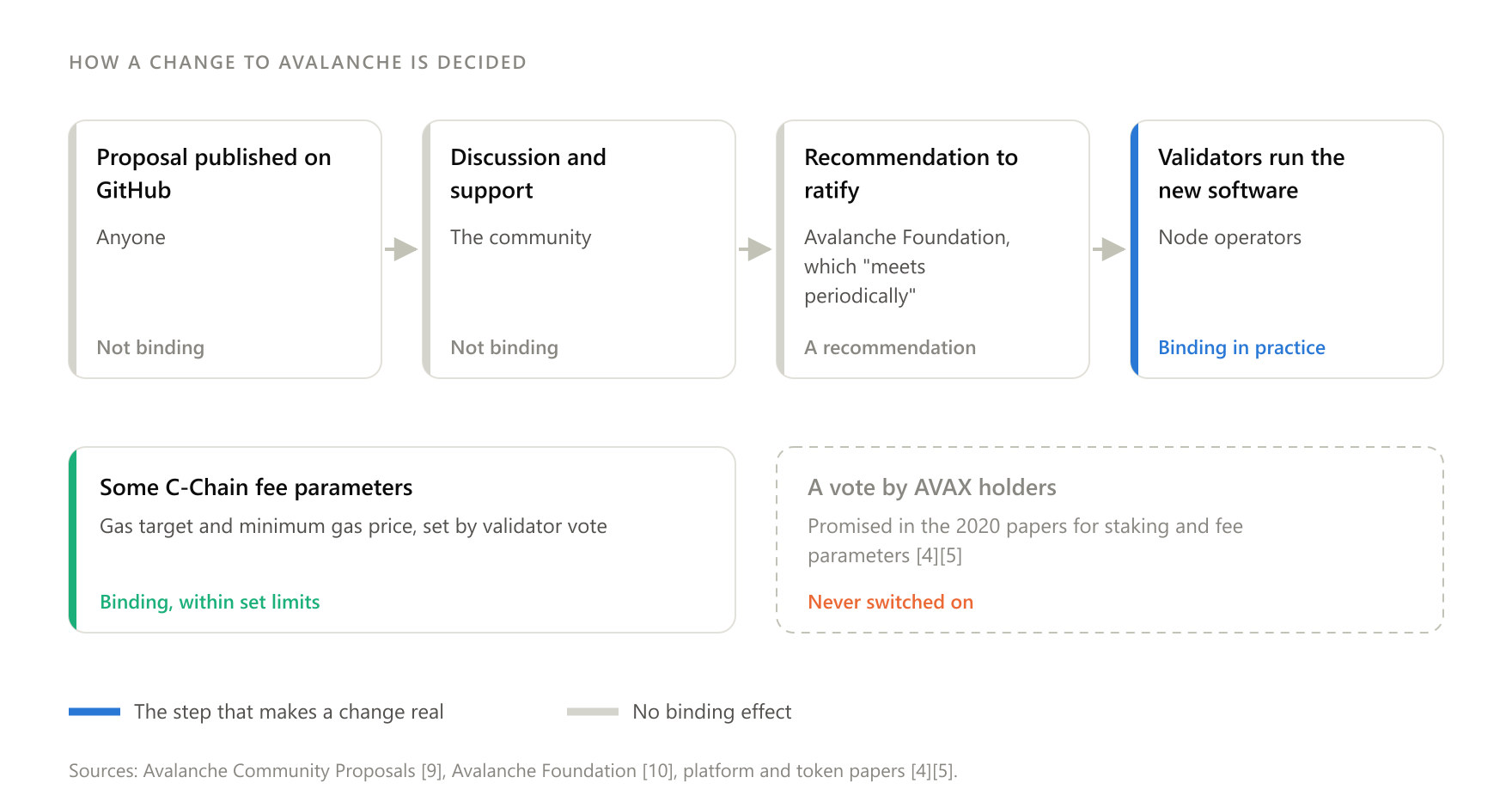
That system was never switched on. Changes to Avalanche now go through Avalanche Community Proposals (ACPs), documents written and discussed on GitHub. Support for a proposal is non-binding; the Avalanche Foundation "meets periodically to recommend the ratification" of proposals, and a change takes effect when node operators run software that contains it [9]. How this works in practice is described in the section on decisions.
A second change came later and was delivered. Originally, any independent blockchain built on Avalanche, then called a subnet, needed validators who also staked at least 2,000 AVAX on the main network [6]. For a game or a company wanting its own chain, that was an expensive entry ticket. The upgrade known as Avalanche9000 (code name Etna, proposal ACP-77) went live on 16 December 2024 [7]. It removed that requirement and replaced it with a small continuous fee in AVAX that each validator of an independent chain pays to the main network [6]. Subnets were renamed Avalanche L1s [6].
That is what the documents show. What follows is our reading.
The two changes moved in opposite directions. Avalanche9000 opened the door wider: launching a chain became cheaper, and the network delivered what it had promised. The governance change narrowed the circle that decides. In 2020 the promise was that holders would vote on the token's economics. In 2026 those decisions sit with developers, node operators and a foundation that holders cannot vote on. The parameters that set staking rewards and fees, the very ones the 2020 papers put to a vote, are now changed through proposals the foundation recommends.
The architecture: three chains and many L1s
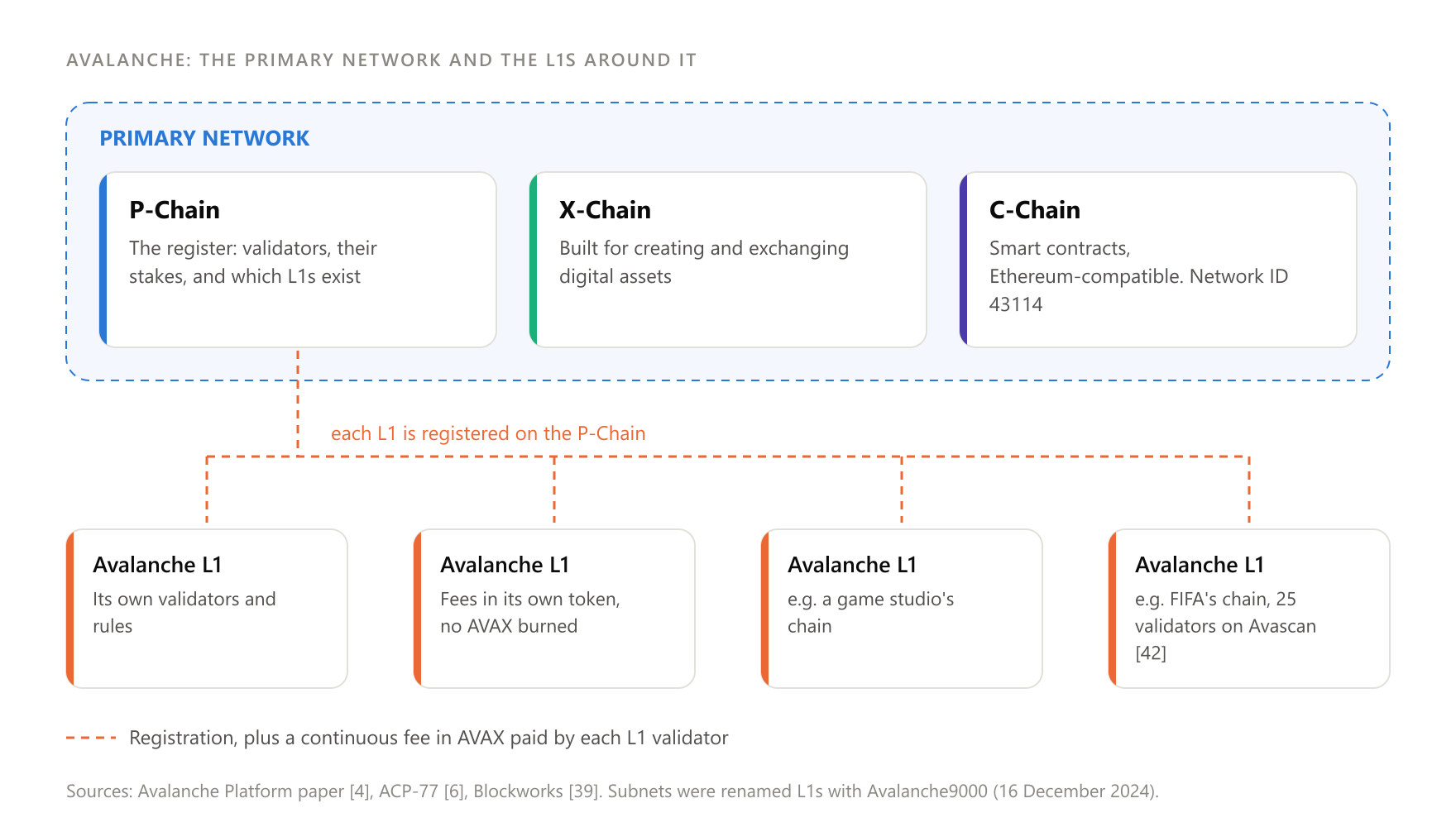
An ordinary blockchain is one chain. Avalanche's main network, the Primary Network, is three chains with three different jobs [4].
The P-Chain (Platform Chain) is the network's register: it records who the validators are, how much each has staked, and which independent L1s exist and who validates them [4][6]. The X-Chain (Exchange Chain) was built for creating and exchanging digital assets [4]. The C-Chain (Contract Chain) runs smart contracts (programs that run automatically on a blockchain) and is compatible with Ethereum, so tools and code written for Ethereum work on it [4]. Its network identifier on the main network is 43114 [18]. Most applications, and most of the activity users see, live on the C-Chain.
Around the Primary Network sit the Avalanche L1s. Each is an independent blockchain that chooses its own validators, its own rules and even the token used to pay its fees, while remaining registered on the P-Chain and able to exchange messages with the rest of the network [6][39]. A game studio, for example, can run its own chain where players pay fees in the game's own token, without touching AVAX at all.
An everyday analogy: picture a town. The P-Chain is the town hall, keeping the register of who holds which licence. The X-Chain is the marketplace. The C-Chain is the main workshop where most things get built. The L1s are private estates on the edge of town, with their own house rules, but listed in the same town register.
The token: what AVAX does
AVAX has three jobs on the Primary Network [5][6]. It is staked (locked up) by validators and those who back them, and the amount staked decides how much weight each validator carries. It pays transaction fees on the Primary Network's chains. And validators of independent L1s pay their continuous fee to the P-Chain in AVAX.
What happens to the fees is unusual. They do not go to the validators who process the transactions. They are burned: removed from circulation for good [5]. Validators are paid instead with newly created AVAX, minted from the half of the supply reserved for rewards [5]. The token paper presented this as a balance: burning makes tokens scarcer, and minting offsets it so that the system cannot run dry [5].
A common misconception follows from this. Because fees are burned, AVAX is often described as "deflationary", meaning its supply shrinks. In practice the opposite is happening: far more AVAX is minted for stakers than is burned in fees, so the total in circulation keeps rising. The numbers are in the supply section.
A second misconception concerns the L1s. AVAX is not required to use every chain in the Avalanche ecosystem. An L1 that charges fees in its own token burns no AVAX, however busy it is [39]. The only AVAX it needs is the validators' continuous fee to the P-Chain.
A transaction: how the network agrees
When a user sends a transaction, it spreads from computer to computer until it reaches the validators. Each validator then has to decide whether to accept it, and, if two transactions try to spend the same coins, which of the two to accept.
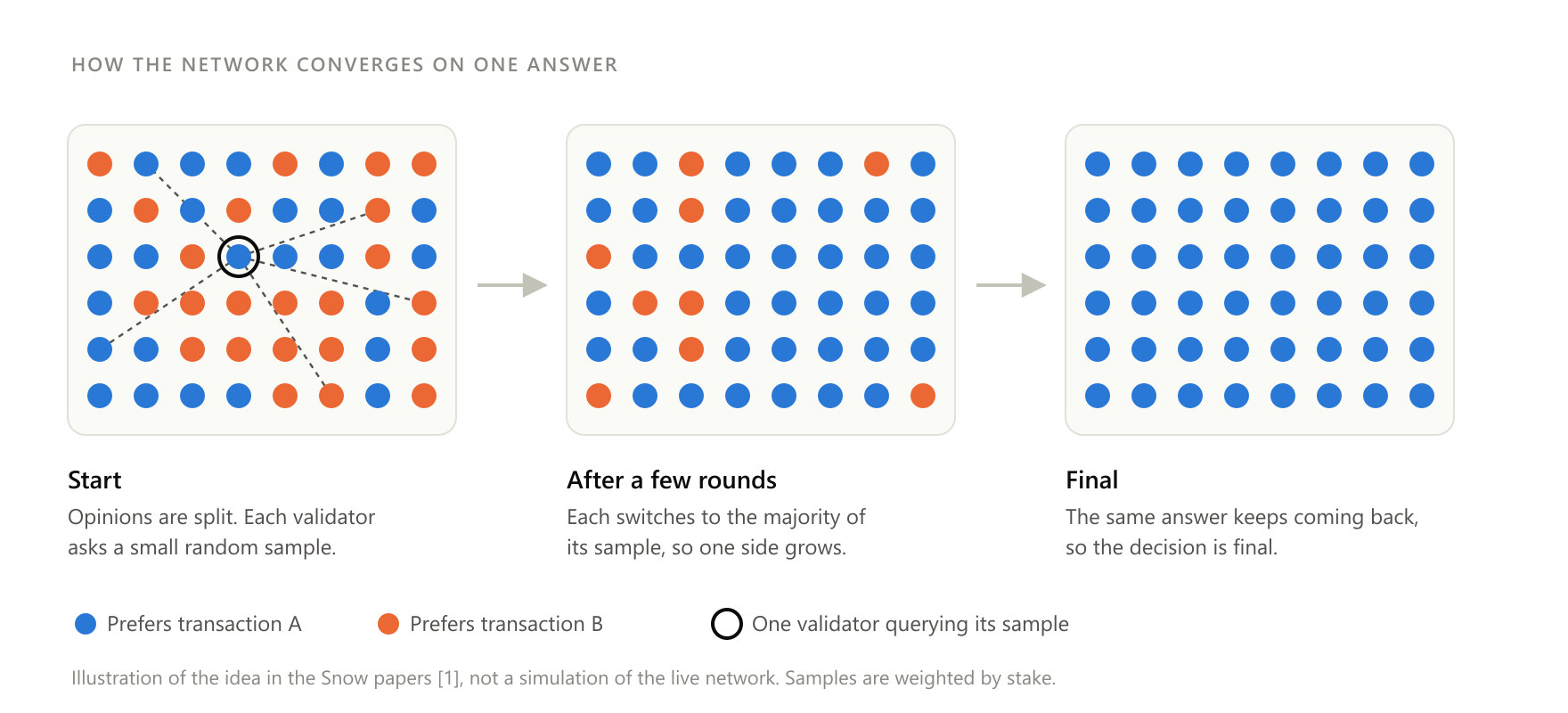
This is where Avalanche differs from Bitcoin. A validator does not wait for a miner to win a computing race, and it does not collect votes from every other validator. Instead, it picks a small random sample of validators, weighted by how much each has staked, and asks them which transaction they prefer [1]. If a large enough majority of the sample gives the same answer, the validator adopts that answer. It then asks another random sample, and another. Once the same answer has come back enough times in a row, the validator treats the decision as final and it cannot be reversed [1].
An everyday analogy: imagine a large hall where everyone must agree on one of two songs. Nobody counts the whole room. Each person asks a handful of others, switches to the song most of them prefer, and asks again. Within a few rounds the whole hall is singing the same song.
In the authors' own test, on computers spread across several continents, the network processed about 3,400 transactions per second with a median time to finality of 1.35 seconds [1]. The platform whitepaper speaks of more than 5,000 transactions per second [4]. Real use is far lower. On 17 October 2026 the network data site DefiLlama recorded 283,053 transactions in 24 hours [31], an average of about three per second (our calculation). Messari reported a much higher figure for the C-Chain in late 2025, an average of 2.1 million transactions a day in the fourth quarter [3]; the two sources may count differently, and we could not reconcile them.
Fees on the C-Chain are paid in AVAX and burned. Some of the parameters that set them, such as the gas target and the minimum gas price, are now chosen by validator vote rather than fixed in the code [10].
What independent researchers found
The main independent analysis comes from Christian Cachin's group at the University of Bern. In a peer-reviewed paper at the OPODIS 2022 conference, Ignacio Amores-Sesar, Christian Cachin and Enrico Tedeschi found that the Avalanche protocol, as described in the whitepaper, has a flaw in its liveness (its guarantee that the network keeps making progress): an attacker could delay decisions indefinitely [13]. Avalanche's developers replied that the version actually running avoids the problem; at the time, no security analysis of that version existed [14]. A 2024 paper by Amores-Sesar, Cachin and Philipp Schneider concluded that the trade-off between speed and security in the Snow protocols is "unfavorable" and proposed a change [15]. We found no independent study confirming the security of the version running today.
Keys and wallets: what you actually own
As with any blockchain, you do not really "own" AVAX in an account. You control private keys that allow it to be moved. If the keys are lost or stolen, the tokens may be lost for good, and a transfer to the wrong address cannot be reversed.
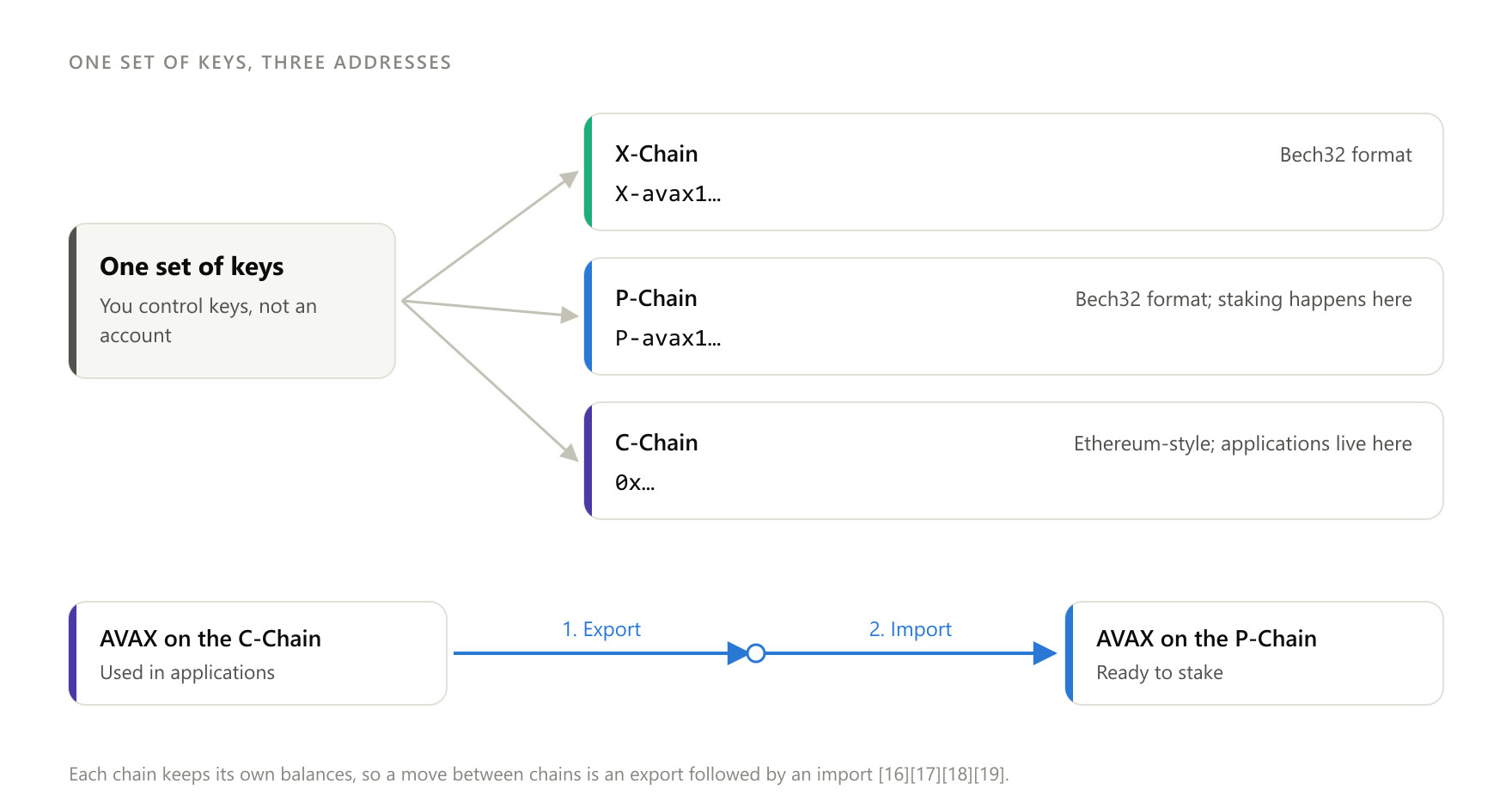
Avalanche adds a twist: the same keys produce different-looking addresses on different chains. On the X-Chain and the P-Chain, addresses use a format called Bech32 and begin with "X-avax1" or "P-avax1" on the main network. On the C-Chain, addresses look like Ethereum's: a string beginning with "0x" [16][17].
Because the three chains keep separate balances, moving AVAX between them is a two-step operation. The tokens are first exported from the source chain and then imported on the destination chain [17][18]. This matters in practice: AVAX used in applications sits on the C-Chain, while staking happens on the P-Chain, so a holder whose tokens are on the C-Chain must first move them across before staking [19].
The main wallet for doing this is Core, built by Ava Labs engineers. It runs as a browser extension and as a mobile app, supports staking, and can be used together with a Ledger hardware wallet (a separate device that keeps the keys offline) [19]. Because the C-Chain is compatible with Ethereum, Ethereum wallets can also connect to it [4].
The alternative is custody by a third party, such as an exchange that holds the keys on the customer's behalf. Self-custody gives full control and full responsibility; custody hands that control to the provider.
How blocks are made: validators and staking
Anyone can become a validator (a computer that checks transactions and helps decide on them) on the Primary Network by staking at least 2,000 AVAX for a period they choose, from two weeks to one year [11]. Holders who do not want to run a computer can delegate: lend the weight of at least 25 AVAX to a validator of their choice for a share of its rewards [11]. In both cases the tokens stay locked until the chosen period ends; there is no early exit [11][21].
Two limits keep any single validator from growing too large. A validator's total weight, its own stake plus what has been delegated to it, cannot exceed 3 million AVAX, and the delegated part cannot exceed four times its own stake [11].
Avalanche does not use slashing, the practice of confiscating part of a validator's stake for misbehaving. A validator that is online less than 90% of the time simply receives no rewards, and neither do those who delegated to it; the staked tokens themselves are returned in full [12][21].
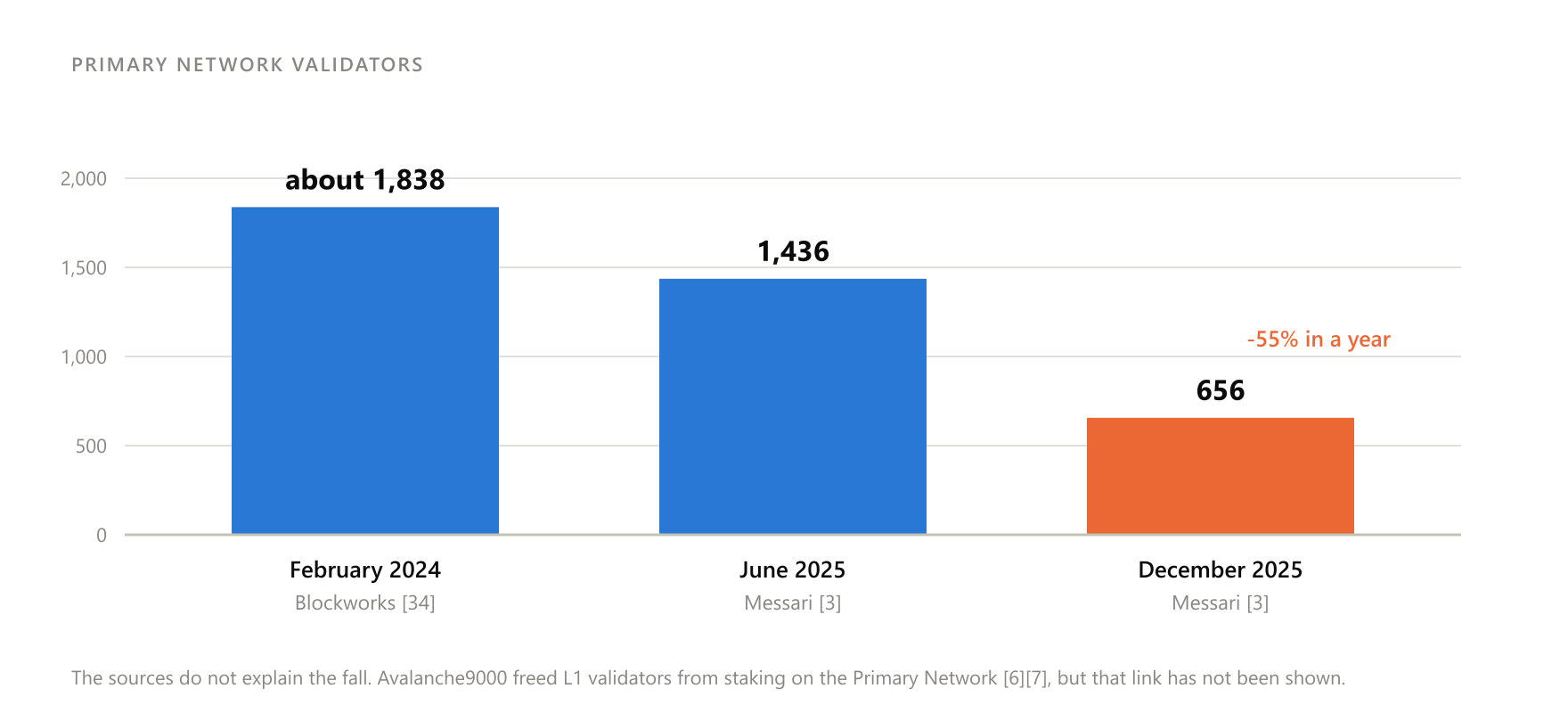
The number of validators has fallen sharply. About 1,838 were active in February 2024 [34]. Messari counted 1,436 at the end of June 2025 and 656 at the end of 2025, a fall of 55% in a year [3]. The sources we examined do not explain why. One possible factor is Avalanche9000, which freed validators of independent L1s from staking on the Primary Network [6][7], but that link has not been shown.
A community proposal published in October 2025 gives a closer picture of the validators that remained. Of the 854 active at the time, 451, or 52.8%, had no delegations at all, delegation was concentrated among about 100 operators, and a validator staking the minimum 2,000 AVAX was, in the authors' words, "barely profitable" [11]. No single validator held more than 2.5% of the total stake [11]. At the end of 2025, 185 million AVAX, 39.7% of the supply in circulation, was staked [3].
Staking: what it actually pays
Avalanche's own validator page shows a reward of about 6.7% a year [20]; the authors of a 2026 proposal put it at 6.08 to 6.12% when they wrote it [12]. That reward does not come from network revenue. Because every fee is burned, staking rewards are paid entirely in newly minted AVAX [5].
To be clear about what this means: with the supply growing by about 3% a year [3], a staker's real gain, measured in AVAX, is closer to 3.6% before the validator's fee (our calculation), while holders who do not stake see their share of the total shrink by about 3% a year. Our view at CRYPTONEA 24 is that this "yield" is best understood as a transfer from holders who do not lock up their AVAX to those who do, not as income from using the network.
Who runs it
| Organisation | What it does | Legal form and seat | Who leads it | Funding |
|---|---|---|---|---|
| Ava Labs, Inc. | Main developer of the node software and of the Core wallet [19] | Company, New York, USA [2] | Founder and chief executive Emin Gün Sirer [2] | Token sale proceeds [2]; other funding not disclosed in the sources we examined |
| Avalanche Foundation | Holds and sells the foundation's AVAX, funds grants and incentive programmes, recommends which proposals to adopt [9][21] | Two companies: Avalanche (BVI), Inc., British Virgin Islands, and Avalanche Cayman, Cayman Islands [21] | Aytunç Yıldızlı was chief executive and executive director in November 2024 [27] | Its share of the original AVAX allocation and later token sales [8][21] |
| Avalanche Treasury Corporation (Nasdaq: AVAT) | Holds and stakes AVAX as its main business [21] | Delaware company, listed on Nasdaq on 11 June 2026 [21] | Chief executive Bart Smith [23]; operations managed by Dragonfly Digital Management [21] | $216 million private placement plus AVAX contributed by Dragonfly funds [21] |
| AVAX One Technology Ltd. (Nasdaq: AVX) | Holds AVAX alongside Bitcoin mining and data centre plans [22] | Nasdaq-listed company with an office in West Palm Beach, Florida [22] | Chief executive Jolie Kahn [22] | Share issues; reported buying 9.38 million AVAX for $110 million in November 2025 [22] |
The foundation is usually described in the press as a non-profit based in Singapore. The filings of the company that bought its tokens give a more precise picture: it is two offshore companies, in the British Virgin Islands and the Cayman Islands [21]. We did not find financial statements, a list of directors or the addresses of the wallets that hold the foundation's tokens in any public source.
The relationship between the foundation and AVAT goes beyond a sale. Under the agreement of October 2025, AVAT received 18 months of exclusivity on the foundation's sales to competing US companies of the same kind, the foundation received a five-year right of first refusal on large sales of AVAX by AVAT, and the foundation gained the right to nominate a member of AVAT's board for five years [21].
Around these organisations are the validators who actually run the Primary Network, and the developers of independent L1s. The sources we examined record no public disagreement between Ava Labs and the foundation.
How decisions are made
Changes to the Primary Network pass through the Avalanche Community Proposals process [9]:
| Stage | Who | Binding? |
|---|---|---|
| A proposal is written and published on GitHub | Anyone [9] | No |
| Discussion and expressions of support | The community [9] | No, support is non-binding [9] |
| Recommendation to ratify | The Avalanche Foundation, which "meets periodically" for this [9] | No, it is a recommendation |
| Adoption | Node operators, by running software that contains the change [9] | Yes, in practice: a change exists once the validators run it |
| Some C-Chain fee parameters | Validators, by vote [10] | Yes, within set limits |
In plain terms, governance (the way a network decides on its own changes) on Avalanche rests on three groups: the developers who write the software, mainly Ava Labs; the foundation that recommends proposals; and the validators who choose whether to upgrade. Ordinary AVAX holders have no formal vote. Because no holder vote has ever taken place, there are no participation figures.
Several proposals that would change the network's economics were still open on 17 October 2026, with no decision reported. ACP-247 would lower the maximum weight of a single validator from 3 million to 1 million AVAX and raise the delegation multiplier from four to 24 [11]. ACP-273 would cut the minimum staking period from two weeks to 48 hours [12]. ACP-285 would lower the minimum reward rate for staking [10].
Supply: minted for stakers, burned in fees
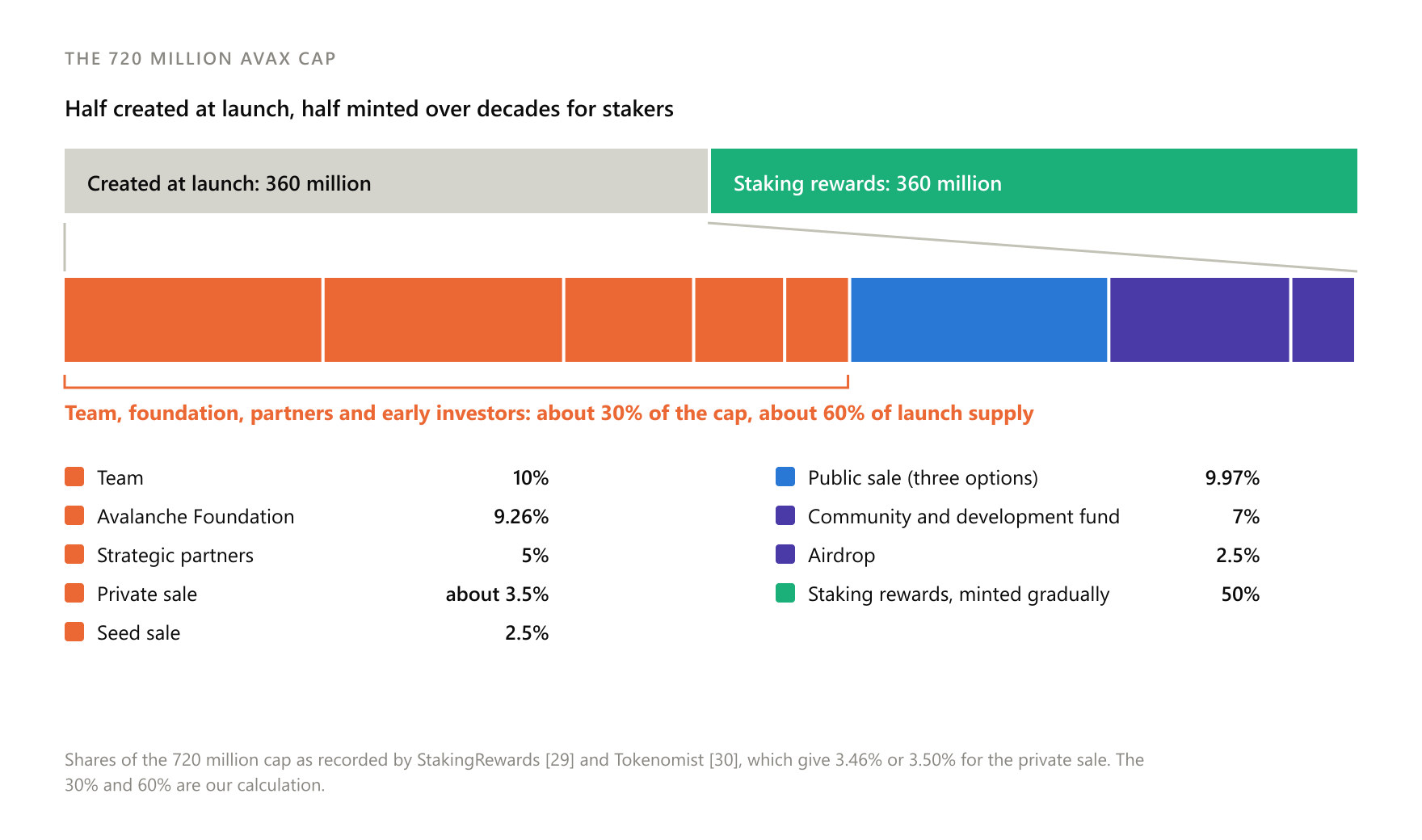
AVAX's supply can never exceed 720 million [5]. Half was created at launch; the other half is minted gradually as staking rewards, at a pace that slows as the total approaches the cap [5]. The original allocation, as recorded by token trackers that agree on the main shares [29][30]:
| Category | Share of 720 million | AVAX (approx.) | Release schedule |
|---|---|---|---|
| Staking rewards | 50% | 360,000,000 | Minted over decades [5] |
| Team | 10% | 72,000,000 | Four years |
| Avalanche Foundation | 9.26% | 66,670,000 | Ten years, quarterly |
| Public sale (three options) | 9.97% | 71,800,000 | Varied by option |
| Community and development fund | 7% | 50,400,000 | Varied |
| Strategic partners | 5% | 36,000,000 | Four years |
| Private sale | about 3.5% | about 25,000,000 | Varied |
| Seed sale | 2.5% | 18,000,000 | Varied |
| Airdrop | 2.5% | 18,000,000 | Four years |
The trackers disagree slightly on the private sale (3.46% or 3.50%). Taken together, the team, the foundation, strategic partners and private and seed investors received about 30% of the cap, which is about 60% of everything created at launch (our calculation).
Issuance versus burn
On 16 October 2026, 443.57 million AVAX were in circulation [32]. Messari put the annual inflation rate at 3.0% in the fourth quarter of 2025, and recorded 132,016 AVAX burned in fees in that quarter [3]. At 3% of roughly 460 million tokens in existence, about 13.8 million new AVAX are minted a year, while the burn runs at about 0.53 million a year. The burn therefore offsets only about 4% of new issuance (our calculation). The supply is growing, not shrinking.
Where the foundation's tokens went
The most detailed public account of the foundation's recent sales comes from AVAT's quarterly filing with the US Securities and Exchange Commission [21]. In October 2025 the foundation agreed to sell AVAX with a stated value of at least $200 million, at a 60% discount, in exchange for $50 million in cash or USDC and 3,000,000 AVAT shares valued at $30 million [21]. AVAT received 7,317,966 AVAX, locked for five years and released in 48 monthly instalments, partly enforced on the blockchain itself [21].
AVAT then ran into difficulty. Its operating company reported a net loss of $26.8 million in the first quarter of 2026 [21]. On 23 September 2026 it sold 2,082,371.6 AVAX back to Avalanche (BVI), Inc. for $15 million, choosing its longest-locked tokens and using the money mainly to reduce debt [24]. In the same period it disclosed Nasdaq notices over its share price and market value [24]; on 7 October 2026 it reported that Nasdaq had confirmed it was again meeting the minimum share price rule [25]. The second company of this kind, AVAX One, reported holding more than 13.8 million AVAX in November 2025 [22] and regained Nasdaq compliance in mid-2026 [26].
The parameters that set the network's economics
| Parameter | Value or rule | Who changes it |
|---|---|---|
| Minimum validator stake | 2,000 AVAX [11] | ACP process and node software [9] |
| Minimum delegation | 25 AVAX [11] | ACP process [9] |
| Staking period | Two weeks to one year [11] | ACP process; ACP-273 proposes 48 hours [12] |
| Maximum validator weight | 3 million AVAX [11] | ACP process; ACP-247 proposes 1 million [11] |
| Delegation multiplier | Four times the validator's own stake [11] | ACP process; ACP-247 proposes 24 [11] |
| Uptime required for rewards | 90% [12] | ACP process [9] |
| Slashing | None [21] | Not applicable |
| C-Chain gas target and minimum gas price | Set by validator vote [10] | Validators [10] |
| Fee destination | Burned [5] | Protocol rule [5] |
Units and names
| Unit | Subunit |
|---|---|
| AVAX | 1 AVAX = 1,000,000,000 nAVAX (nanoAVAX), used on the P-Chain and X-Chain [16] |
| AVAX on the C-Chain | Counted with 18 decimal places, like ether, for compatibility with Ethereum tools [16] |
The consensus family takes its names from snow: Slush, Snowflake, Snowball and Avalanche [1]. Avalanche9000's code name was Etna [6]. The authors of the original paper signed it "Team Rocket"; why they chose that name is not explained in the documents we examined.
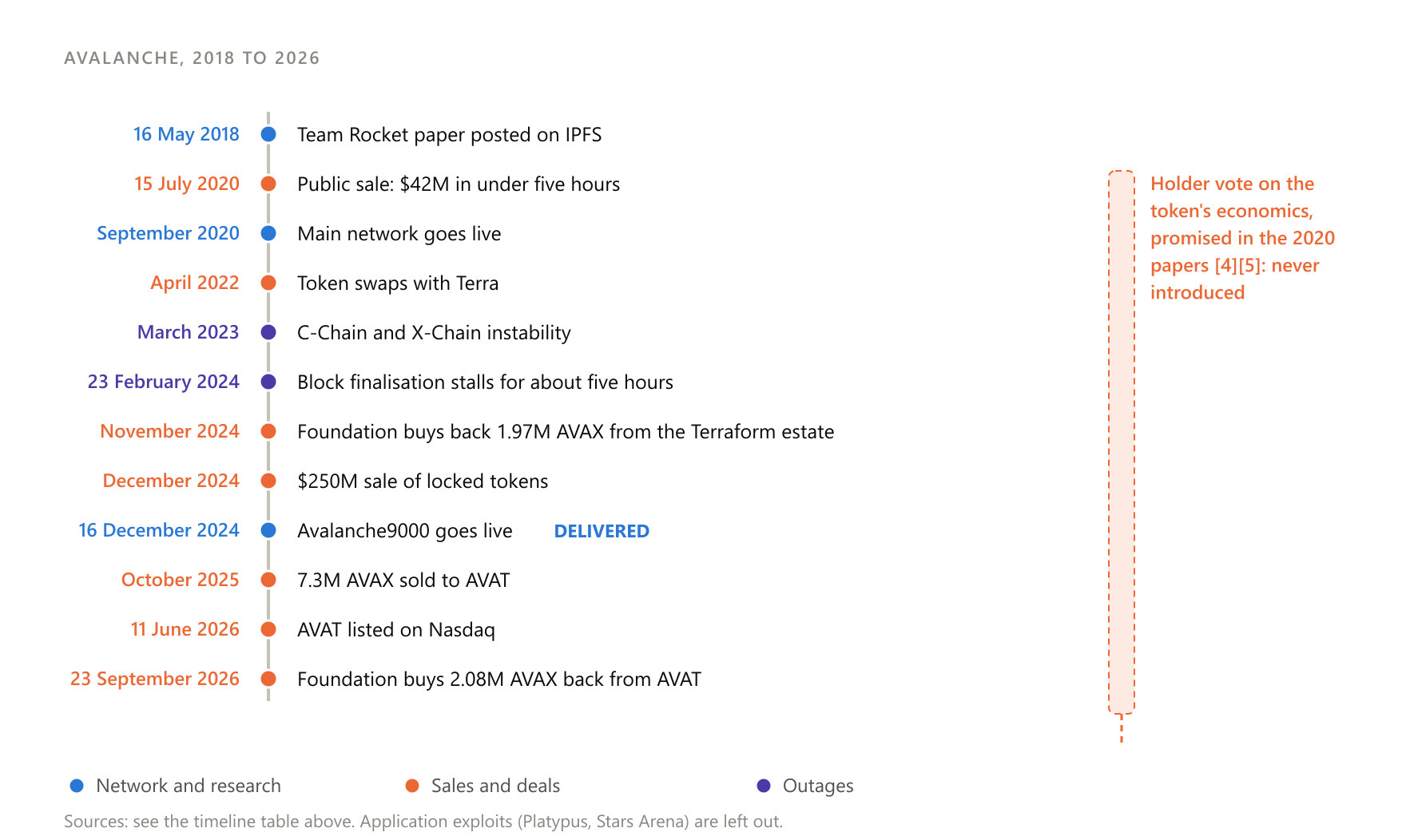
How it has changed: a timeline
| Date | Event |
|---|---|
| 16 May 2018 | Team Rocket paper posted on IPFS [1] |
| 15 July 2020 | Public sale raises $42 million in under five hours [2] |
| September 2020 | Main network goes live [3] |
| April 2022 | Token swaps between the foundation and the Terra ecosystem [27] |
| February 2023 | Platypus Finance exploited [36] |
| March 2023 | C-Chain and X-Chain instability from a software bug [35] |
| October 2023 | Stars Arena and Platypus Finance exploited [36][37] |
| 23 February 2024 | Block finalisation stalls for about five hours [33][34] |
| March 2024 | Vryx design announced, aiming at about 100,000 transactions per second [41] |
| November 2024 | Foundation buys back 1.97 million AVAX from the Terraform bankruptcy estate [27][28] |
| December 2024 | $250 million sale of locked tokens [8] |
| 16 December 2024 | Avalanche9000 goes live [7] |
| October 2025 | Foundation sells 7.3 million AVAX at a discount to AVAT [21] |
| 11 June 2026 | AVAT listed on Nasdaq [21] |
| 23 September 2026 | Foundation buys 2.08 million AVAX back from AVAT [24] |
| 7 October 2026 | AVAT reports it again meets Nasdaq's minimum share price rule [25] |
As plans without binding dates, the open proposals ACP-247, ACP-273 and ACP-285 would change staking rules [10][11][12]. HyperSDK, a toolkit for very fast custom chains released in early form in 2023 [40], and Vryx, whose test network was targeted for mid-2024 [41], have not been confirmed as running in production in the sources we examined.
Where it is used, and what it is not
Measured in dollars, most of the value on Avalanche today sits in stablecoins and in tokenisation (turning traditional financial assets into tokens on a blockchain), rather than in trading applications. On 17 October 2026, DefiLlama measured $1.13 billion in tokenised real-world assets on Avalanche, and $1.285 billion in stablecoins (tokens designed to track the dollar), of which 37.5% was BUIDL, a tokenised money market fund from BlackRock [31]. Messari reported that the value of real-world assets on Avalanche rose from $789.8 million to $1.33 billion in the fourth quarter of 2025 [3].
Decentralised finance (DeFi: lending, trading and similar services run by smart contracts) is smaller. DefiLlama measured $596.6 million locked in Avalanche DeFi applications on 17 October 2026, led by the lending service Aave ($364 million), Grove Finance ($263 million) and Benqi ($253 million), with 45,259 addresses active over 24 hours [31]. The same day it showed no token incentives being paid to attract users [31].
Among the independent L1s, FIFA runs its own chain, which appears on the Avascan explorer with 25 validators [42]; how heavily it is used was not something we could verify. Several high-profile claims come only from the companies involved: Sirer has said the game Off The Grid has more than 15 million users and that Bergen County in New Jersey plans to put land records on Avalanche, and Ava Labs' president has described a year of testing with the parent company of the New York Stock Exchange [43]. These are company claims, not independently confirmed figures.
It also helps to be clear about what Avalanche is not. It is not a single blockchain: the activity of an independent L1 does not necessarily touch AVAX [39]. AVAX is not deflationary: more is minted than burned [3]. And the network's core consensus design has not been formally verified: the founding paper is a preprint, and the independent analyses found weaknesses in the published version [1][13][15].
What has gone wrong
Two halts of the network
On 23 February 2024, starting at about 11:13 UTC, the network stopped finalising blocks on all three chains of the Primary Network for about five hours [33][34]. Kevin Sekniqi, a co-founder of Ava Labs, attributed it to a bug in how nodes managed the queue of pending transactions, triggered during a wave of "inscriptions", a fashion at the time for writing small pieces of data into transactions [33]. Because validators of the subnets of that era also had to validate the Primary Network, those chains stopped too [34]. In March 2023, the C-Chain and the X-Chain had already become unstable because of a bug in version 1.9.12 of the node software, which was fixed with an update [35]. In neither case were funds stolen from the network itself.
The Terra round trip
In April 2022 the Avalanche Foundation swapped AVAX for $200 million of the Terra ecosystem's UST and LUNA tokens, while Terra's Luna Foundation Guard separately acquired 1.97 million AVAX [27]. A few weeks later Terra collapsed. In November 2024, with the approval of a US bankruptcy court, the foundation bought those 1.97 million AVAX back from the Terraform bankruptcy estate for $45.5 million [27][28].
That is what the documents show. What follows is our reading.
The Terra deal and the AVAT deal, described in the supply section, follow the same pattern: the foundation sells AVAX to a counterparty that then runs into trouble, and later buys part of it back. In both cases the public learned the details mainly from the counterparty's side, a bankruptcy process in one case and SEC filings in the other, not from the foundation.
Applications that were exploited
Applications built on Avalanche have been attacked several times, through flaws in their own code rather than in the network. The Platypus Finance protocol lost about $9 million in February 2023 and about $2.2 million in October 2023, of which 90% was returned [36]. In October 2023 the social app Stars Arena lost 266,103 AVAX, and about 90% was later returned after negotiation with the attacker [37].
Where the ecosystem falls short
The clearest gap is one the foundation itself names. In a newsletter of August 2026 featuring foundation staff Matias Antonio and Eric Lu, The Block quoted the foundation's position that the link between the ecosystem's output and the value of AVAX is "the central problem we are working on" [38]. Blockworks had earlier reported that this link "has not yet occurred on a substantial level" [39]. The figures fit: on 17 October 2026 Avalanche's main chain collected $10,988 in fees over 24 hours [31], while the minting of new AVAX for stakers runs at millions of tokens a year [3].
The second gap is the validator base, which more than halved in under two years [3][34], with many of the remaining validators receiving no delegations [11].
The third gap is delivery on the most ambitious speed plans. HyperSDK was released in early form in 2023 [40] and Vryx was announced in March 2024 with a test network targeted for the middle of that year [41], but neither has been confirmed as running in production.
The fourth gap is transparency. The foundation publishes no accounts that we could find, and its largest recent token deals are known in detail only through the filings of the company on the other side [21]. The deployed version of the consensus protocol has no independent security analysis that we could find [14].
The open questions
The first question is who decides. The 2020 papers promised that AVAX holders would vote on the token's economics [4][5]. Today the parameters that set rewards and fees are changed through proposals that the foundation recommends and validators adopt [9]. The foundation is two offshore companies that publish no accounts we could find, and it has a contractual seat at the table of a listed company that holds its tokens [21]. Whether holders will ever get the vote they were promised is not addressed in the current proposals.
The second question is where the value goes. Activity on independent L1s does not have to touch AVAX, and the fees on the main chains are small next to the new tokens minted for stakers [3][31][39]. The foundation calls this its central problem [38]. How it intends to solve it, and whether the solution will change the staking rules, depends on proposals such as ACP-247, ACP-273 and ACP-285, none of which had been decided by 17 October 2026 [10][11][12].
The third question is how many validators the network needs. The Primary Network ended 2025 with 656 validators, less than half the number of early 2024 [3][34]. The proposals now under discussion would change how stake is spread among them [11]. Whether that brings validators back is something only the coming months will show.
Sources
- P: Team Rocket, Yin, Sekniqi, van Renesse, Sirer, Scalable and Probabilistic Leaderless BFT Consensus through Metastability, arxiv.org/pdf/1906.08936, August 2020 (project source)
- S: Cornell Chronicle, Blockchain startup raises a quick $42M in first sale, news.cornell.edu/stories/2020/08/blockchain-startup-raises-quick-42m-first-sale, August 2020
- S: Messari, State of Avalanche Q2 2022, Q2 2025 and Q3 2025, messari.io/report/state-of-avalanche-q2-2022, messari.io/report/state-of-avalanche-q2-2025, messari.io/report/state-of-avalanche-q3-2025; Q4 2025 figures as reported by MEXC News, mexc.com/news/606388 and mexc.com/it-IT/news/601719, January and February 2026
- P: Sekniqi, Laine, Buttolph, Sirer, Avalanche Platform, avalabs.org/whitepapers, June 2020 (project source)
- P: Buttolph, Moin, Sekniqi, Sirer, Avalanche Native Token (AVAX) Dynamics, avalabs.org/whitepapers, June 2020 (project source)
- P: Avalanche Academy, Motivation behind Avalanche9000, academy.avax.network/guide/etna-upgrade-motivation, and ACP-77: Reinventing Subnets, docs.avax.network/docs/acps/77-reinventing-subnets, 2024 (project source)
- S: The Block, Anticipated Avalanche9000 upgrade goes live, theblock.co/post/331101/anticipated-avalanche9000-upgrade-goes-live-reducing-costs-and-making-it-easier-to-launch-avalanche-subnets, December 2024
- P: Avalanche, Avalanche Momentum Accelerates as Galaxy, Dragonfly, and ParaFi Participate in $250M Token Sale, avax.network/blog/avalanche-momentum-accelerates-as-galaxy-dragonfly-and-parafi-lead-250m-investment-in-support-of-avalanche9000-upgrade, December 2024 (project source)
- P: Avalanche Docs, Avalanche Community Proposals, docs.avax.network/docs/acps, October 2026 (project source)
- P: Avalanche Foundation, From Static Constants to Dynamic Variables, avax.network/about/blog/from-static-constants-to-dynamic-variables-what-three-acps-say-about-where-avalanches-economics-are-headed, 2026 (project source)
- P: Avalanche Builder Hub, ACP-247: Delegation Multiplier Increase and Maximum Validator Weight Reduction, build.avax.network/docs/acps/247-delegation-multiplier-increase-maximum-validator-weight-reduction, October 2025
- P: Avalanche Docs, ACP-273: Reduce Minimum Staking Duration, docs.avax.network/docs/acps/273-reduce-minimum-staking-duration, 2026
- P: Amores-Sesar, Cachin, Tedeschi, When Is Spring Coming? A Security Analysis of Avalanche Consensus (OPODIS 2022), drops.dagstuhl.de/entities/document/10.4230/LIPIcs.OPODIS.2022.10, 2023
- S: University of Bern Cryptology and Data Security Group, Spring is coming: when does the snow melt?, crypto.unibe.ch/2022/10/31/avalanche_analysis.html, October 2022
- P: Amores-Sesar, Cachin, Schneider, An Analysis of Avalanche Consensus, boris.unibe.ch/194694, 2024
- P: Avalanche Builder Hub, Avalanche SDK: Utilities, build.avax.network/docs/tooling/avalanche-sdk/client/utils, October 2026 (project source)
- P: Avalanche Support, Transferring from the P-Chain to C-Chain with API calls, support.avax.network/en/articles/6719662-transferring-from-the-p-chain-to-c-chain-with-api-calls, undated (project source)
- P: Avalanche Docs, C-Chain API, docs.avax.network/api-reference/c-chain/api, October 2026 (project source)
- S: The Defiant, What Is Proof of Stake? Exploring Staking on Avalanche (AVAX), thedefiant.io/education/blockchains/what-is-proof-of-stake-exploring-staking-on-avalanche-avax, undated
- P: Avalanche, Validators, avax.network/build/validators, October 2026 (project source)
- P: Avalanche Treasury Corporation, Form 10-Q for the quarter ended 31 March 2026, sec.gov/Archives/edgar/data/2092446/000110465926078841/tmb-20260331x10q.htm, June 2026
- P: AVAX One Technology, press releases, barchart.com/story/news/510372/avax-one-reports-preliminary-full-year-2025-financial-results-introduces-2026-guidance and webull.co.th/en/news-detail/13912267882390528, November 2025 to March 2026 (company source)
- S: CoinDesk, Avalanche Treasury Co. going public in $675M SPAC deal, coindesk.com/business/2025/10/02/avalanche-treasury-co-going-public-in-usd675m-spac-deal-backed-by-avax-ecosystem, October 2025
- S: Investing.com, Avalanche Treasury completes $15 million AVAX token sale to Avalanche Foundation, investing.com/news/sec-filings/avalanche-treasury-completes-15-million-avax-token-sale-to-avalanche-foundation-93CH-4923796, September 2026
- S: TipRanks, Avalanche Treasury Regains Nasdaq Listing Compliance Status, tipranks.com/news/company-announcements/avalanche-treasury-regains-nasdaq-listing-compliance-status, October 2026
- S: Decrypt, Avalanche Treasury Firm AVAX One Reclaims Nasdaq Compliance After Reverse Stock Split, decrypt.co/373193/avalanche-treasury-firm-avax-one-reclaims-nasdaq-compliance, July 2026
- S: The Block, Avalanche Foundation buys back $52 million worth of AVAX tokens from Do Kwon's defunct Luna Foundation Guard, theblock.co/post/324885/avalanche-foundation-buys-back-52-million-worth-of-avax-tokens-from-do-kwons-defunct-luna-foundation-guard, November 2024
- S: Cointelegraph, Avalanche to repurchase 2 million AVAX tokens sold to Terra, cointelegraph.com/news/avalanche-repurchase-2-million-avax-terra-luna-foundation, October 2024
- S: StakingRewards, Avalanche, stakingrewards.com/asset/avalanche, October 2026
- S: Tokenomist, Avalanche, tokenomist.ai/avalanche-2, October 2026
- S: DefiLlama, Avalanche, defillama.com/chain/avalanche, October 2026
- S: OKX, Avalanche price, okx.com/en-us/price/avalanche-avax, October 2026
- S: The Block, Avalanche confirms block finalization stall, theblock.co/news/ecosystems/2024-02-23-avalanche-block-finalization-stall-278816, February 2024
- S: Blockworks, Avalanche operational again after 5 hour outage, blockworks.com/news/avalanche-blockchain-downtime, February 2024
- S: Cointelegraph, Avalanche halts block production amid inscription wave launch, cointelegraph.com/news/avalanche-block-production-stops-inscription-issues, February 2024
- S: BlockSec, Platypus Finance: Surviving Three Attacks with a Stroke of Luck, blocksec.com/blog/5-platypus-finance-surviving-three-attacks-with-a-stroke-of-luck, February 2024
- S: ForkLog, Stars Arena coverage, forklog.com/en/?p=85632 and forklog.com/en/?p=85878, October 2023
- S: The Block, Layer One: How the Avalanche Foundation is rethinking L1 economics, theblock.co/newsletters/layer-one/2026-08-17-layer-one-avalanche-foundation-economics-411803, August 2026
- S: Blockworks, Why are big games building on Avalanche instead of Ethereum?, blockworks.com/news/gaming-avalanche-subnets-over-ethereum, undated
- P: Avalanche, Introducing HyperSDK, kr.avax.network/blog/introducing-hypersdk-a-foundation-for-the-fastest-blockchains-of-the-future, 2023 (project source)
- S: The Block, Ava Labs outlines scaling solution Vryx in plan for Avalanche to reach 100,000 TPS, theblock.co/post/274683/ava-labs-outlines-scaling-solution-vryx-in-plan-for-avalanche-to-reach-100000-tps, March 2024
- S: Avascan, Validators, avascan.info/staking/validators, October 2026
- S: Crypto Briefing, Ava Labs president details NYSE's year-long testing of Avalanche technology, cryptobriefing.com/nyse-ice-avalanche-ats-testing, September 2026; and When Shift Happens podcast, interview with Emin Gün Sirer, 2025 (company claims)
This article is educational and for general information. The facts in crypto move quickly, so verify them before you act on anything here. This is not financial advice.